Sealife guideThe moontail bullseyePriacanthus hamrur
Last updated on 10/13/2026 at 12:52 AM
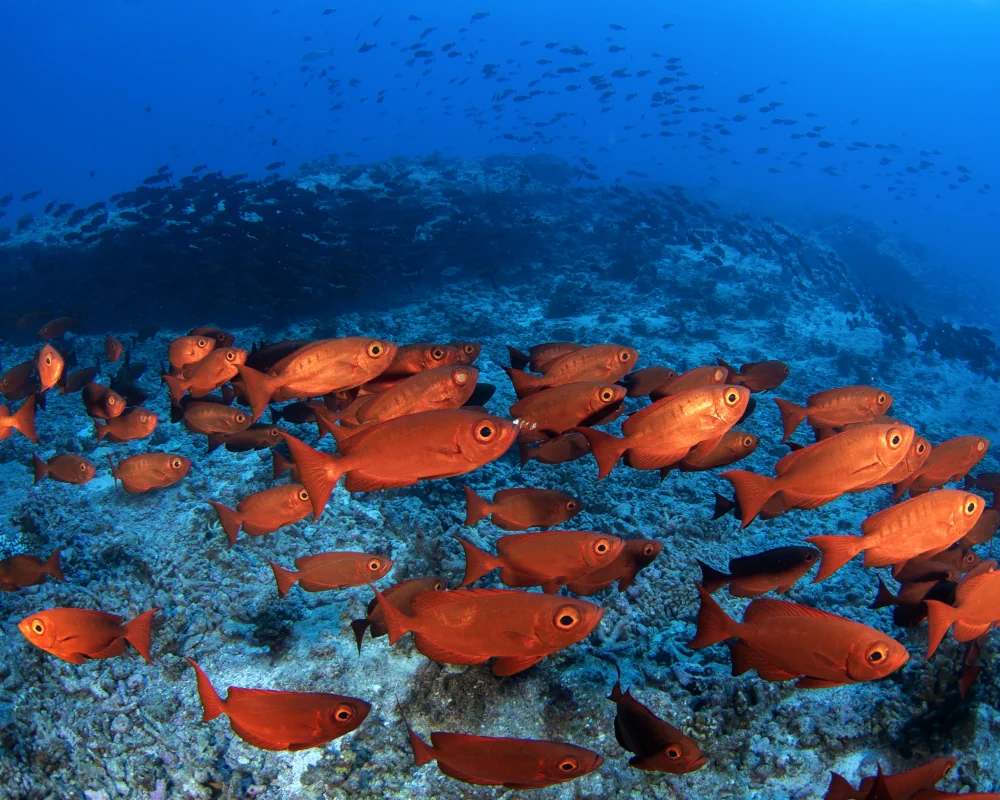
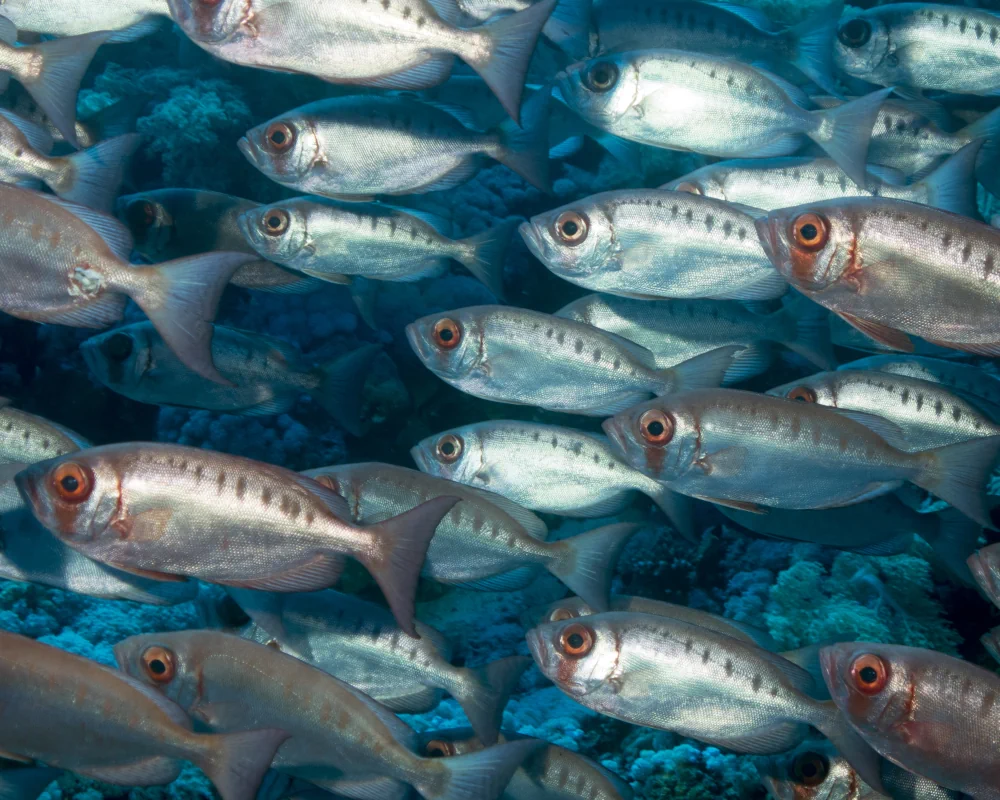
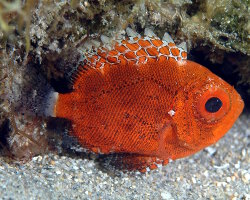
With its enormous eyes and bright red body, the moontail bullseye (Priacanthus hamrur) is a tropical fish that stands out. It has a remarkable feature: its coloration can change rapidly, shifting from red to silvery with red bands or spots.
It inhabits the warm waters of the Indo-Pacific, where it is found around coral reefs and underwater rocky formations. This carnivorous predator feeds on crustaceans, small fish, and other marine animals.
Taxonomy
English names
Moontail bullseyeCrescent tail bigeye
French namesGros-yeux commun
Spanish namesCatalufa espejuelo
Scientific namePriacanthus hamrur (Forsskål, 1775)
Description
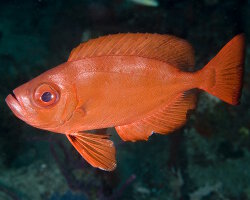
The moontail bullseye has a relatively short, deep body that is compressed from side to side. Its head is characterized by very large eyes and an oblique mouth. Its coloration is often entirely red or orange, but it can quickly turn silvery, with several red bands or large red spots on the upper part of its body. A black spot is usually visible at the base of the pelvic fins, while the tips of some fins are dark.
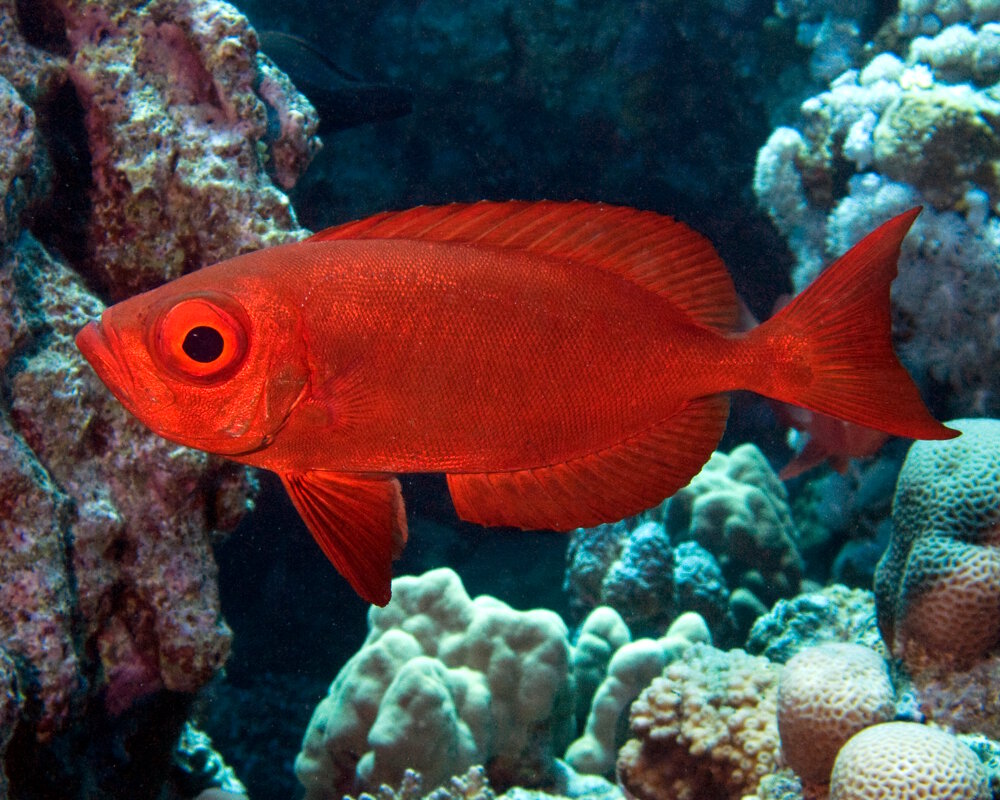
With its enormous eyes and bright red body, the moontail bullseye (Priacanthus hamrur) is hard to miss
© Sdubrov | Dreamstime.comThe moontail bullseye commonly measures between 12 and 16 inches in total length, but the largest individuals can reach about 18 inches.
Geographic range
The moontail bullseye inhabits tropical waters of the Indo-Pacific, from the Red Sea and the coasts of southern Africa to French Polynesia. Its range extends north to southern Japan and South Korea, and south to the coasts of
Australia.
It is found around
Réunion, Mayotte, the Scattered Islands, New Caledonia, Wallis and Futuna, and Easter Island.
Habitat
The moontail bullseye is found mainly around coral reefs, outer reef slopes, and rocky formations in deep lagoons. It often shelters beneath overhangs, near caves, or close to coral formations, where it finds refuge during the day.
It is usually observed at depths of 26 to 262 feet, but can also be found as deep as 820 feet. It lives alone or in small groups and sometimes forms schools offshore.
Diet
The moontail bullseye is a carnivorous fish that feeds mainly on
crustaceans, particularly shrimp and small crabs. It also eats fish and
mollusks, including squid, cuttlefish, and octopuses.
Reproduction
The reproductive biology of the moontail bullseye remains poorly understood, despite several studies conducted off the Indian coast, including one in 1997 off southwestern India and another in 2001 off Cochin.
Did you know ?
The moontail bullseye can change color rapidly. Usually red or orange, it can also turn silvery and develop red bands or large red spots on its sides.
Its very large eyes are adapted for seeing in low-light environments. They help it detect its surroundings in the shaded areas of reefs, beneath rocky overhangs, or near caves.
The moontail bullseye is listed as many other marine species within The
IUCN Red List of threatened species. The moontail bullseye appears in the
IUCN Red List since 2016 within the category Least Concern !
Within the same genus
Within the same family
Discover also
The marine species in the Indo-Pacific