

Sealife guideThe red starfishEchinaster sepositus
Last updated on 02/17/2025 at 07:03 PM
Taxonomy
English names
Red starfish
French namesEtoile de mer rouge
Spanish namesEstrella espinosa
Scientific nameEchinaster sepositus (Retzius, 1783)
FamilyEchinasteridae
OrderSpinulosida
ClassAsteroidea
Description
The red starfish is a medium-sized sea star. It typically measures around 8 inches across, with a maximum size reaching up to 12 inches. The red starfish usually has five elongated, highly tapered arms, with the diameter decreasing towards the tips. However, the central disc of the red starfish is relatively small compared to its span.

The red starfish typically has five elongated, tapered arms, with the diameter decreasing toward the tips
The color of the red starfish is, as you might expect, bright red, but it also varies towards a reddish-orange hue. The countless bumps, corresponding to papulae, that cover the entire surface of the body and arms of the red starfish are a darker red and give it its speckled appearance.
Geographic range
The red starfish is primarily found in the Mediterranean sea and also along the coasts of the English Channel.
Habitat
The red starfish can be found from the surface to depths of over 328 feet. It frequents rocky bottoms and rocky crevices where it shelters during the day.
Diet
The red starfish primarily feeds on mollusks and crustaceans, but also consumes the remains of dead animals.
Reproduction
The red starfish exhibits sexual reproduction. The female releases her eggs into the seawater, which are then fertilized by sperm released by the male.
Like other sea stars, the red starfish also exhibits asexual reproduction, meaning it is capable of regenerating all or part of its body.
Tips for observing
Look carefully in the nooks and crannies of rocky bottoms and coralline areas to find red starfishs quietly resting in shelter and darkness!

The color of the red starfish is, as you might expect, bright red, but it also varies towards a reddish-orange hue
Within the same family
Discover also
Giant basket starAstrophyton muricatum
Long-spined sea urchinDiadema antillarum
Noduled sea starFromia nodosa
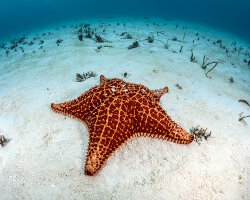
Red cushion sea starOreaster reticulatus
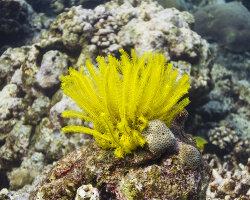
Schelgel's feather starComaster schlegelii
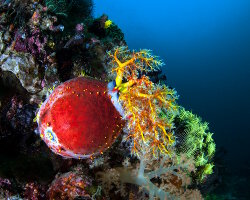
Sea ApplePseudocolochirus violaceus
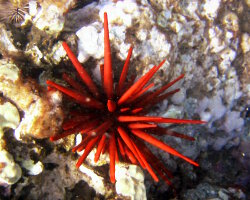
Slate pencil urchinHeterocentrotus mamillatus
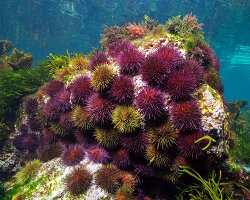
Stony sea urchinParacentrotus lividus
The marine species in the Mediterranean Sea
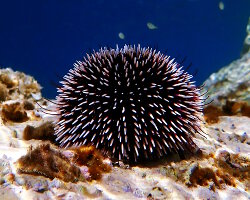
Our latestUpdates
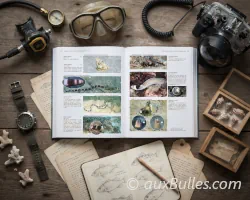
The Guide des poissons de Nouvelle-CalédonieDiscover Guide to the Fishes of New Caledonia by Pierre Laboute and René Grandperrin, an illustrated reference featuring nearly 1,200 species, from rivers and coral reefs to the depths of the ocean.Read more
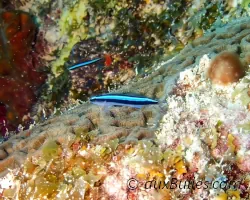
The neon gobyDiscover the neon goby (Elacatinus oceanops), a small western Atlantic reef fish known for its brilliant blue stripe and its role as a cleaner fish that removes parasites from other fish.Read more

The poison gobyDiscover the poison goby (Gobiodon citrinus), a tiny reef fish with a bright yellow body and distinctive blue markings. It lives among branching Acropora corals in the tropical waters of the Indo-Pacific.Read more
Photo of the Day
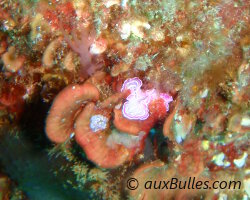
Ver plat rose
(Prostheceraeus roseus)
(Prostheceraeus roseus)
 Copyright © 2007-2026 auxBulles.com - All rights reserved. Legal notices.
Photo credits - Our partners