Sealife guideThe Klunzinger's wrasseThalassoma rueppellii
Last updated on 09/12/2026 at 01:31 PM
Taxonomy
English names
Klunzinger's wrasse
French namesGirelle-paon de Klunzinger
Scientific nameThalassoma rueppellii (Klunzinger, 1871)
Description
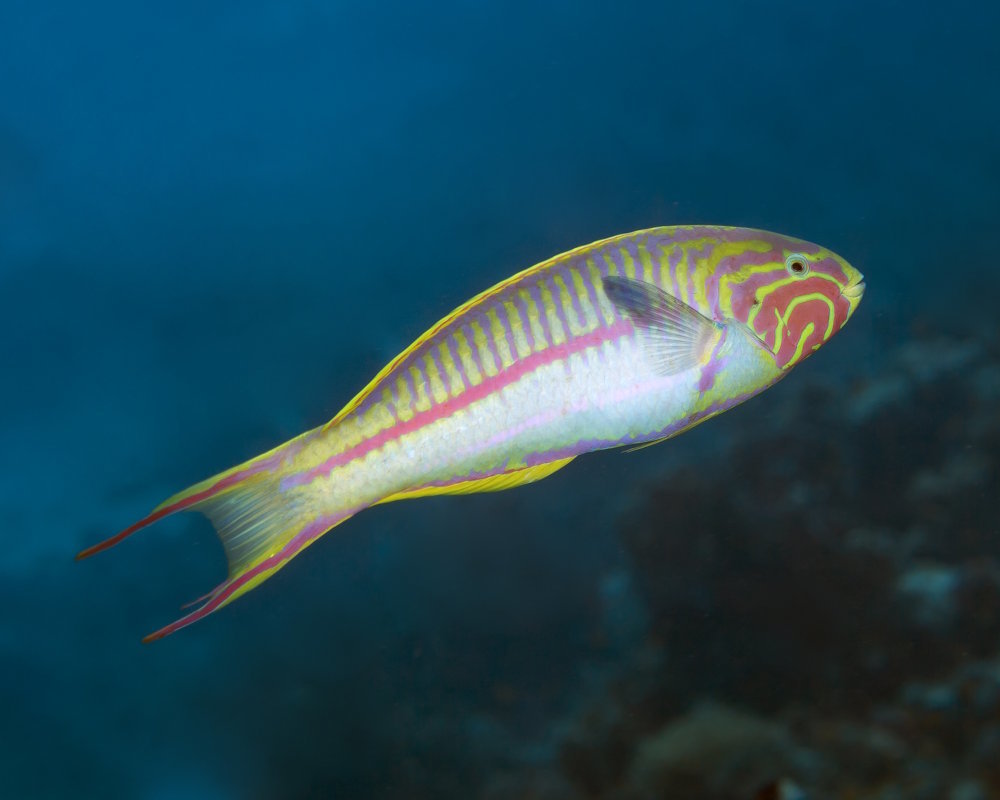
The Klunzinger's wrasse has an elongated body that is slightly compressed from side to side, with the typical shape of a wrasse, and can reach a maximum length of 8 inches. Its coloration is particularly vivid, especially in males, which have an easily recognizable pattern with several contrasting colors on the body and head. As in many wrasses, coloration can vary with age and sex, with adult males generally being the most spectacular.
Its small mouth, lined with fine teeth, allows it to seize the small animals it captures on the reef. Its streamlined body and well-developed fins allow it to move quickly among the contours of the reef while searching for food.
Geographic range
The Klunzinger's wrasse is endemic to the Red Sea, occurring notably along the coasts of Egypt and Sudan as well as in the Gulf of Aqaba, including Israel and Jordan. This distinguishes it from the five-stripe wrasse (Thalassoma quinquevittatum), which has a similar coloration but, in contrast, does not occur in the Red Sea.
Habitat
The Klunzinger's wrasse is found on coral reefs, particularly along their edges and on slopes facing the open sea, from the surface to depths of 100 feet, making it relatively easy to observe while scuba diving or snorkeling on a reef.
It moves above the substrate and among coral formations, where it can move quickly in search of prey. Like many reef fish, it therefore remains closely associated with the reef, which provides both feeding areas and opportunities for shelter.
Diet
The Klunzinger's wrasse is a predator that feeds primarily on small animals living on or around the reef. It actively searches for prey by exploring the surfaces and crevices of coral reefs where they may hide.
Reproduction
The Klunzinger's wrasse is an
oviparous species: the female lays eggs that are then fertilized in the water. During the breeding season, individuals form pairs and release their
gametes into the marine environment.
After hatching, the young drift in the open water for some time before reaching the reefs. They are carried by currents, allowing them to disperse before settling on the seafloor and beginning their life on the reef.
Within the same genus
Within the same family
Discover also
The marine species in the Red Sea