

Sealife guideThe great Atlantic scallopPecten maximus
Last updated on 09/14/2026 at 11:03 PM
The great Atlantic scallop (Pecten maximus) is a large marine bivalve easily recognized by its fan-shaped shell adorned with radiating ribs. Highly prized as seafood, it lives on the seafloor of the northeastern Atlantic, where it filters water to feed on tiny organisms.
Contrary to the image of an immobile shellfish resting on the seafloor, the great Atlantic scallop is capable of swimming short distances. It can also detect the approach of certain predators thanks to the many small eyes arranged along the edge of its mantle.
Taxonomy
English names
Great Atlantic scallopKing scallopGreat scallopSt James shell
French namesCoquille Saint-Jacques
Spanish namesConcha de santiagoConcha de peregrino
Scientific namePecten maximus (Linnaeus, 1758)
FamilyPectinidae
OrderPectinida
ClassBivalvia
Description
The great Atlantic scallop has an almost round shell consisting of two very different valves. The right valve is strongly convex and generally rests on the seafloor, while the left valve is flatter. Both valves have about 15 to 17 rounded ribs radiating from the hinge. The shell can reach up to 6.0 to 6.3 inches in width.
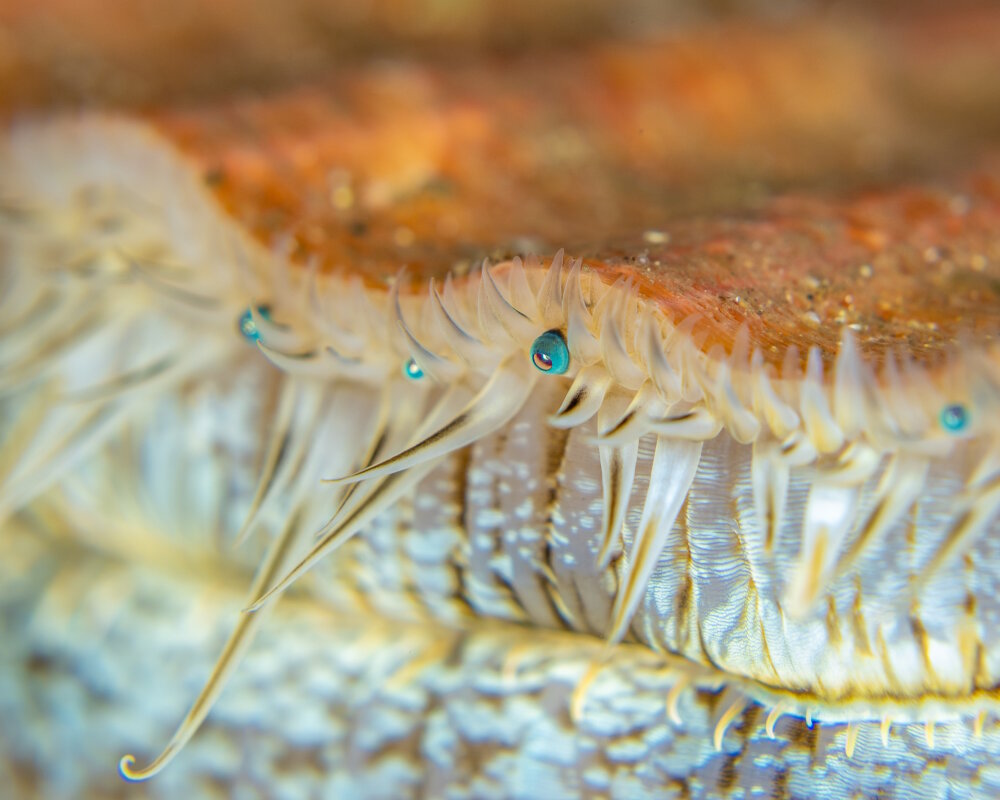
The great Atlantic scallop (Pecten maximus) has dozens of small eyes arranged along the edge of its shell © Jeremy Brown | Dreamstime.com
The edge of the mantle is particularly remarkable: it bears numerous small light-sensitive eyes as well as tentacles capable of detecting various stimuli in the water. When the great Atlantic scallop rapidly closes its valves, it can expel water and propel itself forward, allowing it to quickly move away from a predator.
Geographic range
The great Atlantic scallop primarily inhabits the temperate waters of the northeastern Atlantic, from the coasts of Norway to the Iberian Peninsula, including the British Isles, the English Channel, and the Atlantic coast of France.
In France, the great Atlantic scallop is found along the coasts of the English Channel and Atlantic, notably in the Bay of Somme, Bay of Seine, Bay of Mont-Saint-Michel, Bay of Saint-Brieuc, Brest harbor, and Quiberon Bay.
Habitat
The great Atlantic scallop lives on seafloors consisting mainly of sand, fine gravel, or soft sediments containing little mud. It is generally found in relatively sheltered areas, often near currents that bring the food it needs.
It most often lives between about 33 and 330 feet deep, with populations particularly common between 66 and 164 feet. The great Atlantic scallop rests on its convex right valve and can partially bury itself in the sediment. Young individuals may initially attach themselves to various surfaces before becoming more mobile and settling on the seafloor.
Diet
The great Atlantic scallop is a filter feeder. It draws water into its mantle cavity through the movements of its gills and extracts tiny food particles, particularly phytoplankton. The retained particles are then directed toward its mouth through coordinated movements of its tissues and cilia.
The amount of food available in the water directly influences its growth and reproduction. Areas where currents regularly bring water rich in food particles can therefore support the development of large populations.
Reproduction
The great Atlantic scallop is hermaphroditic: a single individual possesses both male and female reproductive organs. Reproduction occurs through the release of reproductive cells into the water, where fertilization takes place. The breeding season varies depending on the region and environmental conditions, but spawning can occur from spring to early fall.
After fertilization, the eggs develop into larvae that live in the open water for about a month and drift with ocean currents. They gradually develop before undergoing metamorphosis and settling on the seafloor. Young great Atlantic scallops may then temporarily attach themselves to various surfaces before becoming free-living individuals on the seafloor.
Did you know ?
The great Atlantic scallop has dozens of small eyes arranged along the edge of its shell. They do not allow it to see as we do, but they can detect changes in light and help it detect the approach of certain predators.
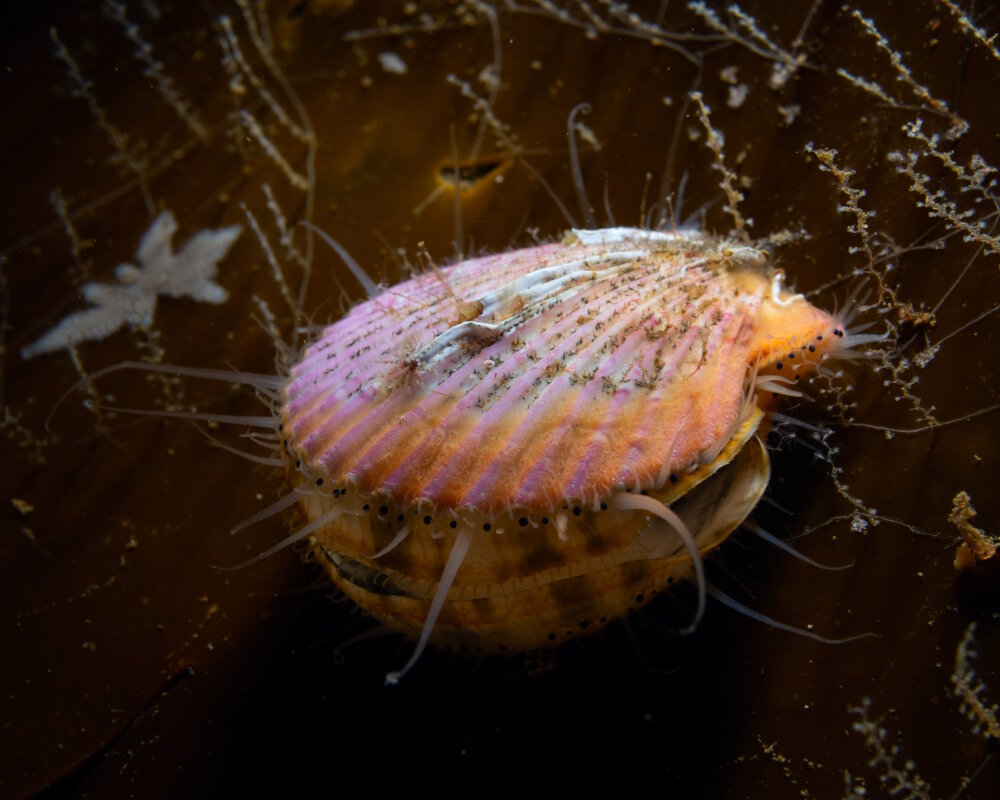
The great Atlantic scallop (Pecten maximus) © Jeremy Brown | Dreamstime.com
When threatened, the great Atlantic scallop can quickly move away by opening and closing its valves. These movements force water out of its shell and propel it forward in short bursts. This remarkable ability allows it to escape predators even though it normally rests on the seafloor.
Within the same family
Discover also
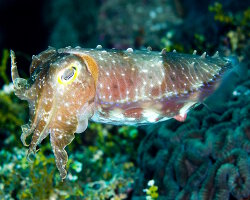
Broadclub cuttlefishAscarosepion latimanus
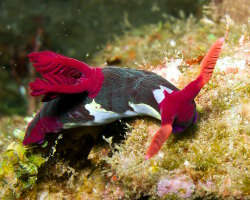
Chamberlain's sea slugNembrotha chamberlaini
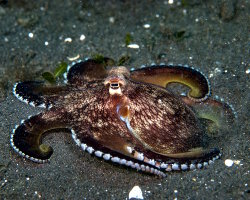
Coconut octopusAmphioctopus marginatus
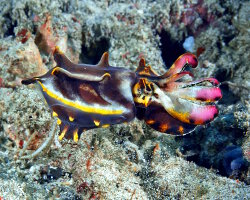
Flamboyant cuttlefishMetasepia pfefferi
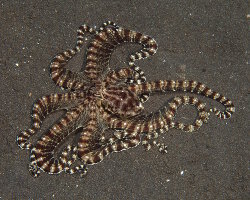
Mimic octopusThaumoctopus mimicus
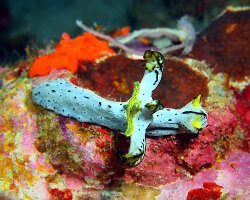
Serena's notodorisNotodoris serenae
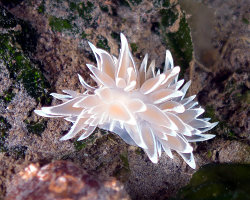
White lined dironaDirona albolineata
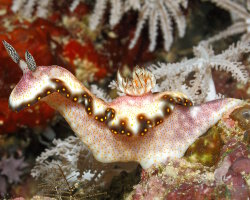
Yellow speckled dorisHypselodoris godeffroyana
The marine species in the Northeastern Atlantic
Our latestUpdates
The Guide des poissons de Nouvelle-CalédonieDiscover Guide to the Fishes of New Caledonia by Pierre Laboute and René Grandperrin, an illustrated reference featuring nearly 1,200 species, from rivers and coral reefs to the depths of the ocean.Read more
The neon gobyDiscover the neon goby (Elacatinus oceanops), a small western Atlantic reef fish known for its brilliant blue stripe and its role as a cleaner fish that removes parasites from other fish.Read more

The poison gobyDiscover the poison goby (Gobiodon citrinus), a tiny reef fish with a bright yellow body and distinctive blue markings. It lives among branching Acropora corals in the tropical waters of the Indo-Pacific.Read more
Photo of the Day

Serran arlequin
(Serranus tigrinus)
(Serranus tigrinus)
 Copyright © 2007-2026 auxBulles.com - All rights reserved. Legal notices.
Photo credits - Our partners