

Sealife guideThe dugongDugong dugon
Last updated on 01/30/2026 at 11:44 PM
The dugong is a little-known yet fascinating marine mammal. A close relative of the manatee, it lives in the warm waters of the Indian and Pacific Oceans. Nicknamed « sea cow » because of its herbivorous diet, this gentle giant plays a vital role in the health of coastal ecosystems.
There are currently five species of sirenians in the world: four species of manatees — the West Indian manatee (Trichechus manatus manatus), the Florida manatee (Trichechus manatus latirostris), the African manatee (Trichechus senegalensis) and the Amazonian manatee (Trichechus inunguis) — and a single species of dugong (Dugong dugon).
Taxonomy
English names
Dugong
French namesDugong
Spanish namesDugón
Scientific nameDugong dugon (Müller, 1776)
FamilyDugongidae
OrderSirenia
ClassMammalia
Description
The dugong has a streamlined, robust body, thick grayish skin, and a large crescent-shaped tail that allows it to propel itself efficiently. Its downward-facing snout, equipped with thick, flexible lips, is specially adapted to graze on seagrass beds on sandy bottoms.

The dugong grazes on seagrass beds every day © Izanbar | Dreamstime.com
The dugong is a large marine mammal that, as an adult, typically measures between 7.2 and 11.2 feet in length and weighs between 507 and 1,100 lb, although some individuals can reach up to 13 feet long and weigh 1,980 lb or more.
Geographic range
The dugong is found in the warm coastal waters of the Indo-Pacific, over a vast area stretching from the east coast of Africa to the islands of the western Pacific. Dugongs are found notably in the Red sea, the Indian ocean, around Southeast Asia, northern Australia — which hosts the largest global population — as well as in certain Pacific regions such as Papua New Guinea.
Habitat
The dugong mainly inhabits shallow areas rich in seagrass beds, such as bays, lagoons, and estuaries. However, its distribution is now fragmented due to habitat degradation and human activities, which isolates some populations and increases their vulnerability.
The dugong is a solitary animal or lives in small groups. It spends most of its time feeding or resting near the seabed.
Diet
A true « sea cow », the dugong is one of the few strictly herbivorous marine mammals. It grazes daily on seagrass meadows — flowering plants living underwater — and can consume up to 66 lb of vegetation each day to satisfy its appetite.
By grazing on these seagrass beds, the dugong prevents overgrowth and promotes their renewal. This behavior helps maintain the ecological balance of coastal areas, which also serve as a refuge for numerous fish species.
Reproduction
The dugong's reproductive cycle is very slow, which contributes to the species' vulnerability. The female gives birth to a single calf after a long gestation of 12 to 15 months. At birth, the young measures between 3.3 and 4.3 feet in length, weighs around 44 lb, and remains dependent on its mother, who nurses it for more than a year.
Did you know ?
The dugong may have inspired mermaid legends: seen from afar by sailors, its silhouette and the way it carries its young against its chest fueled the imagination of mythological stories.

The dugong has a streamlined, robust body, thick grayish skin and a large crescent-shaped tail © Tim Heusinger Von Waldegge | Dreamstime.com
The dugong breathes air, nurses its young, and must regularly surface, which reminds us that it is indeed a mammal despite living almost entirely underwater.
The dugong lives exclusively in the sea and feeds only on seagrass beds, while the manatee can inhabit both marine and freshwater environments and has a more varied diet.
The dugong is listed as many other marine species within The IUCN Red List of threatened species. The dugong appears in the IUCN Red List since 2019 within the category Vulnerable !
Discover also
Amazon river dolphinInia geoffrensis
Atlantic white-sided dolphinLeucopleurus acutus
Commerson's dolphinCephalorhynchus commersonii
Florida manateeTrichechus manatus latirostris
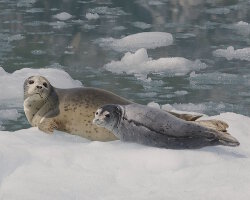
Harbor sealPhoca vitulina

Short-finned pilot whaleGlobicephala macrorhynchus

Spinner dolphinStenella longirostris
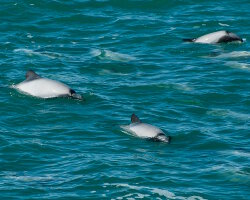
White headed dolphinCephalorhynchus hectori
Our latestUpdates
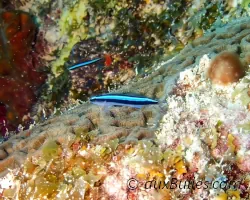
The neon gobyDiscover the neon goby (Elacatinus oceanops), a small western Atlantic reef fish known for its brilliant blue stripe and its role as a cleaner fish that removes parasites from other fish.Read more

The poison gobyDiscover the poison goby (Gobiodon citrinus), a tiny reef fish with a bright yellow body and distinctive blue markings. It lives among branching Acropora corals in the tropical waters of the Indo-Pacific.Read more
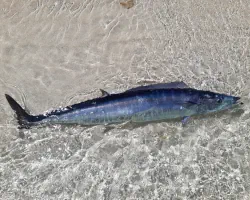
The wahooDiscover the wahoo (Acanthocybium solandri), a powerful pelagic predator found in tropical and subtropical oceans. Recognizable by its streamlined body and distinctive blue vertical stripes, it is a fast swimmer that feeds mainly on fish and squid.Read more
Photo of the Day
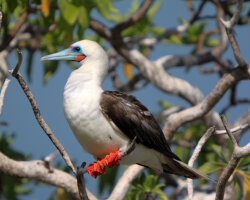
Fou à pieds rouges
(Sula sula)
(Sula sula)
 Copyright © 2007-2026 auxBulles.com - All rights reserved. Legal notices.
Photo credits - Our partners