

Sealife guideThe short bigeyePristigenys alta
Last updated on 10/14/2026 at 12:35 AM
With its enormous eyes and red coloration, the short bigeye (Pristigenys alta) is a discreet fish that lives near the bottom in the western Atlantic, where its large eyes help it navigate in low-light environments.
Taxonomy
English names
Short bigeye
French namesBeauclaire du large
Spanish namesCatalufa de lo alto
Scientific namePristigenys alta (Gill, 1862)
FamilyPriacanthidae
OrderPerciformes
ClassActinopterygii
Description
The short bigeye has a deep, thick, broadly oval body that is compressed from side to side. Its head is relatively large, and its eyes are particularly prominent. Its body, head, and fins are dark red. The dorsal, anal, and caudal fins have black edges, as does the rear tip of the pelvic fins.
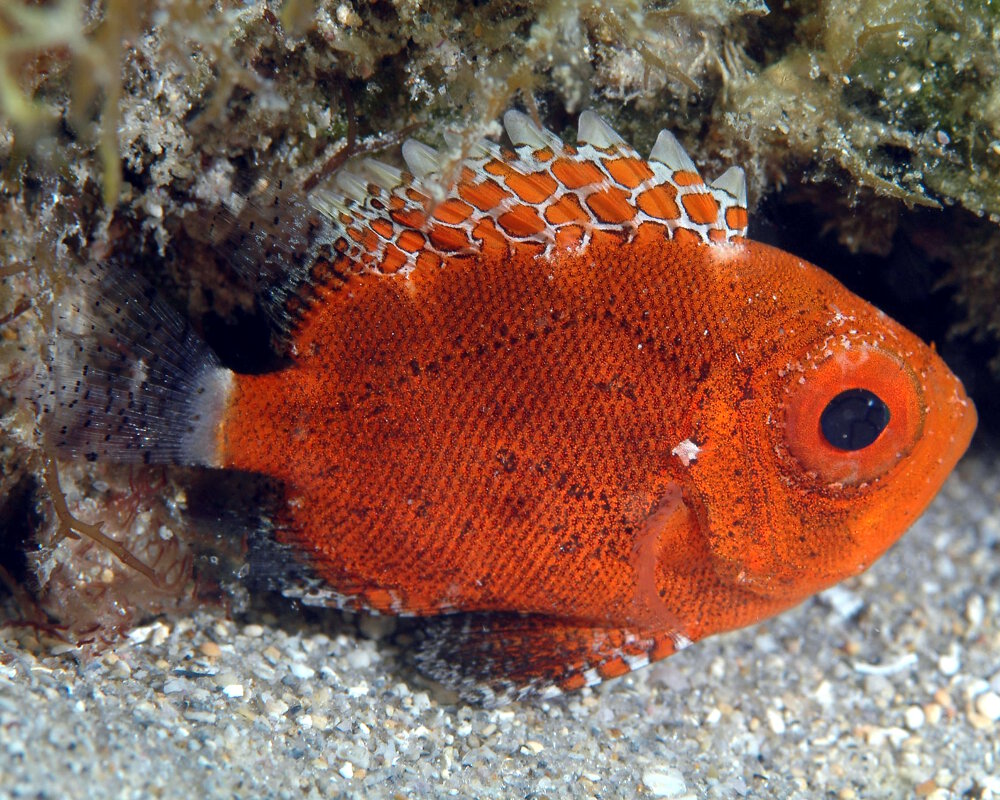
The juvenile coloration of the short bigeye (Pristigenys alta) © Peter Leahy | Dreamstime.com
It commonly measures around 8 inches in total length, but the largest individuals can reach about 12 inches.
In juveniles, the first dorsal fin is black and covered with numerous red spots. The second dorsal fin, anal fin, and caudal fin are translucent and scattered with small black spots.
Geographic range
The short bigeye inhabits tropical and subtropical waters of the western Atlantic. Its range extends along the eastern coast of North America, including Florida, and from Bermuda to the Gulf of Mexico and the Caribbean Sea, where it occurs in the Bahamas and throughout the West Indies, and south to the coasts of Central America.
Habitat
The short bigeye often lives alone near the seabed, among rocky areas where it finds shelter. It is generally found at depths of 16 to 656 feet, but may occasionally occur as deep as about 985 feet.
Diet
The short bigeye feeds mainly on small fish and crustaceans, such as shrimp and crabs. It hunts near rocks and shelters where its prey hide.
Reproduction
The short bigeye is oviparous: the female lays eggs that develop in the water after fertilization. As they grow, the young fish gradually move toward the seabed.
Studies off southern Florida indicate that spawning occurs from mid-July to mid-September, although this timing cannot necessarily be generalized to the species' entire range.
The short bigeye lays eggs that float in the water rather than remaining attached to the seabed. After hatching, the larvae also live in open water. As they grow, the young fish gradually move toward the seabed.
Off southern Florida, spawning has been observed from mid-July to mid-September, although this period cannot necessarily be generalized to the species' entire range.
Did you know ?
Young short bigeyes initially live in open water. They have a silvery-gray coloration that helps camouflage them beneath the surface, along with a dark dorsal fin. As they mature, they move toward the seabed and develop the reddish-orange coloration of adults.
The short bigeye is listed as many other marine species within The IUCN Red List of threatened species. The short bigeye appears in the IUCN Red List since 2015 within the category Least Concern !
Within the same family
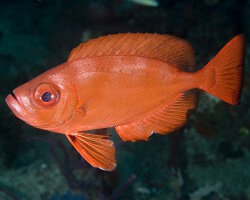
Atlantic bigeyePriacanthus arenatus
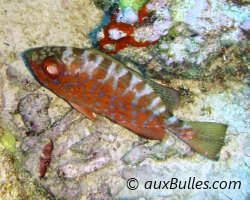
Glasseye snapperHeteropriacanthus cruentatus

Moontail bullseyePriacanthus hamrur
Discover also

Barramundi codCromileptes altivelis

Coral rabbitfishSiganus corallinus
Giant trevallyCaranx ignobilis

Gold-spotted rabbitfishSiganus punctatus

Goldbelly damselfishPomacentrus auriventris

Grey morayGymnothorax griseus

Lined rabbitfishSiganus lineatus

Tail spot blennyEcsenius stigmatura
The marine species in the Northwestern Atlantic


Dive centers


Our latestUpdates

Major movesThe 2026 Route du Rhum enters a decisive phase as Tom Laperche extends his lead in the Ultim class, Armel Le Cléac'h capsizes, and Class40 skippers prepare to face a powerful weather front.Read more

A tough startThe 2026 Route du Rhum gets off to an intense start, with major technical failures, Francis Joyon's capsize, impressive speeds and strategic route choices near the Azores. A look back at the first 48 hours of racing.Read more

A smooth start, an uncertain AtlanticDiscover the 2026 Route du Rhum start off Saint-Malo, where favorable initial conditions contrast with an uncertain Atlantic crossing shaped by changing winds and weather.Read more
Photo of the Day

Méduse pélagique
(Pelagia noctiluca)
(Pelagia noctiluca)
 Copyright © 2007-2026 auxBulles.com - All rights reserved. Legal notices.
Photo credits - Our partners