

Sealife guideThe Mobulidae familyThe taxonomy of marine species
Explore the taxonomy of the sea vertebrates including the cetaceans like the whales or the dolphins, the sea birds, the fish, the sharks and the sea turtles !
The order Myliobatiformes includes a wide group of rays that are mainly benthic and pelagic, encompassing stingrays, eagle rays, and manta rays. Found in all of the world’s oceans, from shallow coastal waters to open seas, they are characterized by their flattened, disc-shaped bodies and enlarged pectoral fins that form broad “wings” in some species. Many have slender tails equipped with one or more venomous stingers used for defense, although some species such as manta rays lack them. They inhabit a wide range of environments, from sandy and muddy seabeds to open pelagic zones, and display diverse lifestyles ranging from discreet bottom-dwelling behavior to active swimming in open water. Their diet is equally varied, ranging from benthic invertebrates and small fish to, in some species, plankton filtered from the water column.
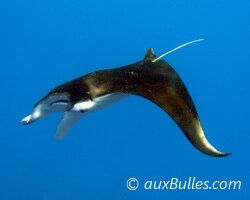
The Mobulidae family includes manta rays and devil rays, some of the largest rays in the world. They are characterized by their broad, wing-like pectoral fins, forward-facing cephalic lobes, and their filter-feeding behavior, which allows them to consume plankton. Mostly pelagic, these species live in open water and are capable of traveling long distances

Our latestUpdates
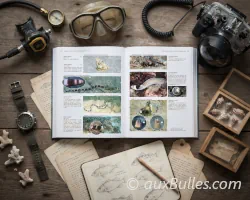
The Guide des poissons de Nouvelle-CalédonieDiscover Guide to the Fishes of New Caledonia by Pierre Laboute and René Grandperrin, an illustrated reference featuring nearly 1,200 species, from rivers and coral reefs to the depths of the ocean.Read more
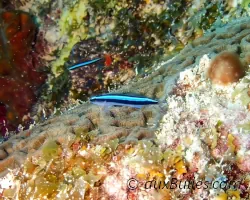
The neon gobyDiscover the neon goby (Elacatinus oceanops), a small western Atlantic reef fish known for its brilliant blue stripe and its role as a cleaner fish that removes parasites from other fish.Read more

The poison gobyDiscover the poison goby (Gobiodon citrinus), a tiny reef fish with a bright yellow body and distinctive blue markings. It lives among branching Acropora corals in the tropical waters of the Indo-Pacific.Read more
Photo of the Day
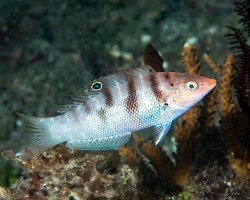
Girelle de Batu
(Coris batuensis)
(Coris batuensis)
 Copyright © 2007-2026 auxBulles.com - All rights reserved. Legal notices.
Photo credits - Our partners