

Sealife guideThe Myliobatiformes orderThe taxonomy of marine species
Explore the taxonomy of the sea vertebrates including the cetaceans like the whales or the dolphins, the sea birds, the fish, the sharks and the sea turtles !
The order Myliobatiformes includes a wide group of rays that are mainly benthic and pelagic, encompassing stingrays, eagle rays, and manta rays. Found in all of the world’s oceans, from shallow coastal waters to open seas, they are characterized by their flattened, disc-shaped bodies and enlarged pectoral fins that form broad “wings” in some species. Many have slender tails equipped with one or more venomous stingers used for defense, although some species such as manta rays lack them. They inhabit a wide range of environments, from sandy and muddy seabeds to open pelagic zones, and display diverse lifestyles ranging from discreet bottom-dwelling behavior to active swimming in open water. Their diet is equally varied, ranging from benthic invertebrates and small fish to, in some species, plankton filtered from the water column.
The Aetobatidae family includes the leopard rays, which were previously classified under Myliobatidae family. They are distinguished by their long, protruding snouts, slender bodies and characteristic spotted patterns. These powerful swimmers inhabit open water and primarily feed on mollusks and crustaceans, which they crush using strong dental plates.
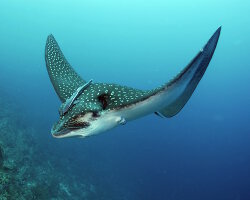
Atlantic white-spotted eagle ray
(Aetobatus narinari)
(Aetobatus narinari)
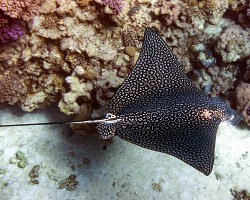
Ocellated eagle ray
(Aetobatus ocellatus)
(Aetobatus ocellatus)
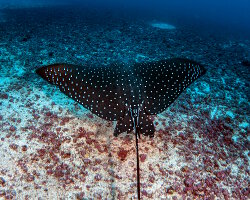
Pacific white-spotted eagle ray
(Aetobatus laticeps)
(Aetobatus laticeps)
The Dasyatidae family includes stingrays, a group of cartilaginous fish widely distributed in tropical and temperate waters around the world. These rays are characterized by their flattened, disc-shaped bodies, their long, slender tails often equipped with one or more venomous stingers, and their primarily benthic lifestyle. They most commonly inhabit sandy, muddy, or coastal seabeds, where they partially bury themselves to camouflage and ambush prey.
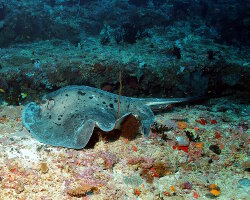
Black blotched stingray
(Taeniura meyeni)
(Taeniura meyeni)
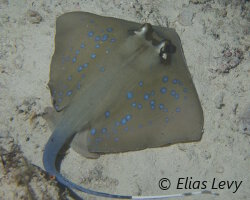
Blue spotted stingray
(Neotrygon kuhlii)
(Neotrygon kuhlii)
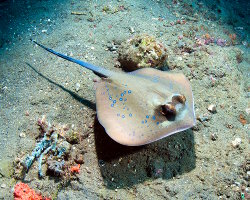
Bluespotted ribbontail ray
(Taeniura lymma)
(Taeniura lymma)

Darkspotted stingray
(Himantura uarnak)
(Himantura uarnak)
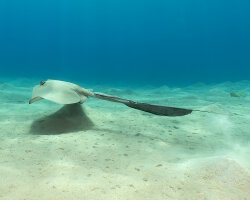
Fantail stingray
(Pastinachus sephen)
(Pastinachus sephen)
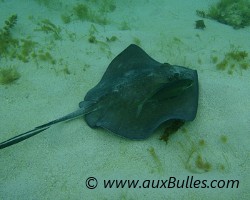
Southern stingray
(Dasyatis americana)
(Dasyatis americana)
The Mobulidae family includes manta rays and devil rays, some of the largest rays in the world. They are characterized by their broad, wing-like pectoral fins, forward-facing cephalic lobes, and their filter-feeding behavior, which allows them to consume plankton. Mostly pelagic, these species live in open water and are capable of traveling long distances
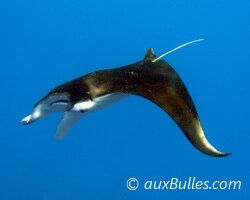
Giant manta
(Mobula birostris)
(Mobula birostris)

Reef manta ray
(Mobula alfredi)
(Mobula alfredi)
The Urolophidae family includes small to medium-sized stingrays primarily found in the temperate and tropical waters of the Indian and Pacific Oceans. These rays are characterized by a generally rounded disc-shaped body, a relatively short and sturdy tail often equipped with a venomous stinger, and a strictly benthic lifestyle. They inhabit sandy or muddy seabeds in coastal areas and along the continental shelf, where they partially bury themselves to camouflage and ambush their prey.
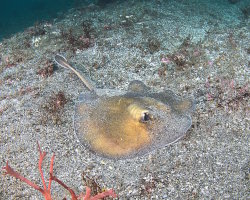
Sepia stingray
(Urolophus aurantiacus)
(Urolophus aurantiacus)
The Urotrygonidae family includes small stingrays primarily found in the tropical coastal waters of the eastern Pacific Ocean, particularly along the coasts of the Americas. These rays are characterized by their generally small size, rounded to slightly oval disc-shaped bodies, and slender tails equipped with a venomous stinger. They inhabit sandy or muddy bottoms in shallow waters, where they partially bury themselves to camouflage and capture prey. Opportunistic carnivores, they mainly feed on small benthic invertebrates such as crustaceans, marine worms, and mollusks. Their discreet behavior and coastal habitat sometimes make them difficult to observe in the wild.
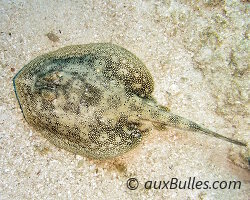
Yellow stingray
(Urobatis jamaicensis)
(Urobatis jamaicensis)
Our latestUpdates
The white trevallyDiscover the white trevally (Pseudocaranx dentex), a silvery fish with a blue-green back that schools near reefs and rocky bottoms.Read more

Morrocoy National ParkDiscover Morrocoy National Park in Venezuela, with white-sand beaches, turquoise waters, coral reefs, mangroves, scenic cayos, and remarkable marine biodiversity.Read more

Milos IslandDiscover Milos Island in the Cyclades, known for its volcanic landscapes, crystal-clear beaches, traditional villages, and the famous Venus de Milo.Read more
Photo of the Day
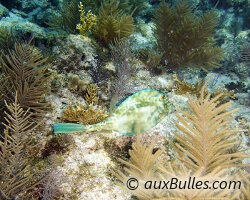
Poisson coffre graffitis
(Acanthostracion quadricornis)
(Acanthostracion quadricornis)
 Copyright © 2007-2026 auxBulles.com - All rights reserved. Legal notices.
Photo credits - Our partners