

Sealife guideThe twinspot gobySignigobius biocellatus
Last updated on 09/25/2026 at 07:10 PM
The twinspot goby (Signigobius biocellatus) is a small fish found on coral reefs in the western Pacific. It is easily recognized by its two large eyespots, which look like eyes, on its dorsal fins.
This small goby usually lives on sandy or muddy bottoms and spends much of its time near its burrow, which it often shares with a partner. It moves along the bottom in search of food and sifts sand with its mouth to extract small animals.
Taxonomy
English names
Twinspot gobyCrab-eye gobyFour-eyed gobyTwinspot signal goby
French namesGobie à deux ocellesGobie aux yeux de crabe
Spanish namesGobio de dos ocelos
Scientific nameSignigobius biocellatus (Hoese & Allen, 1977)
FamilyGobiidae
OrderGobiiformes
ClassActinopterygii
Description
The twinspot goby has an elongated body ranging from bluish gray to yellowish brown, with several brown spots and markings. A thin brown bar crosses the head below the eye, and several irregular bands are visible along the sides. Its pelvic and anal fins are dark and covered with small blue spots.

Its two large eyespots look like real eyes when the twinspot goby spreads its dorsal fins © Jeremy Brown | Dreamstime.com
Each of its two dorsal fins bears a large dark eyespot surrounded by several colors. These false eyes are especially visible when the fish spreads its fins. Its caudal fin is rounded and slightly translucent.
Geographic range
The twinspot goby inhabits tropical waters of the western Pacific Ocean, from the Philippines and Palau to the Solomon Islands and Vanuatu, and southward to the southern part of the Great Barrier Reef.
Habitat
The twinspot goby mainly lives on sandy or muddy bottoms in lagoons and coastal bays. It is generally found between 6.5 and 98 feet deep, often near rocks, coral rubble, or plant debris that can provide shelter.
Adults generally live alone or in pairs and often share a burrow dug into the sand. The fish stays close to this hiding place and can quickly retreat into it when threatened.
Diet
The twinspot goby feeds on small invertebrates living in the sand. It takes mouthfuls of sand and sifts through them to extract the animals it is looking for. After collecting its food from between the grains, it spits out the sand and starts again a little farther away.
Reproduction
Reproduction in the twinspot goby is still poorly known. The species usually lives in pairs and appears to form monogamous bonds.
Did you know ?
Its two large eyespots look like real eyes when the twinspot goby spreads its dorsal fins. This highly visible feature gives the species its English common name, Twinspot goby.

The twinspot goby (Signigobius biocellatus) lives in pairs and often shares a burrow dug into the sand © Lakshmi Sawitri sous licence Creative Commons
Within the same family

Blotched sandgobyFusigobius inframaculatus

Gorgeous prawn-gobyAmblyeleotris wheeleri

Maiden gobyValenciennea puellaris

Mural gobyValenciennea muralis

Orange spotted prawn gobyAmblyeleotris guttata

Pallid gobyCoryphopterus eidolon
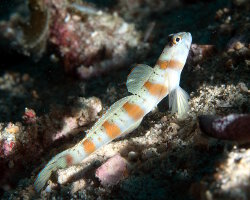
Redmargin shrimpgobyAmblyeleotris rubrimarginata

Striped gobyAsterropteryx striata
Discover also

Leopard snake eelMyrichthys pardalis

Pontoh's pygmy seahorseHippocampus pontohi
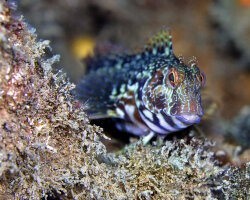
Ringneck blennyParablennius pilicornis

Scrawled cowfishAcanthostracion quadricornis
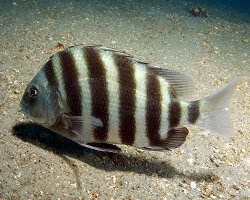
SheepsheadArchosargus probatocephalus

Speckledfin grouperEpinephelus ongus

Spotgill cardinalfishOstorhinchus chrysopomus
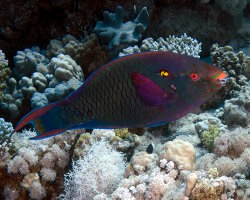
Swarthy ParrotfishScarus niger
Our latestUpdates

Major movesThe 2026 Route du Rhum enters a decisive phase as Tom Laperche extends his lead in the Ultim class, Armel Le Cléac'h capsizes, and Class40 skippers prepare to face a powerful weather front.Read more

A tough startThe 2026 Route du Rhum gets off to an intense start, with major technical failures, Francis Joyon's capsize, impressive speeds and strategic route choices near the Azores. A look back at the first 48 hours of racing.Read more

A smooth start, an uncertain AtlanticDiscover the 2026 Route du Rhum start off Saint-Malo, where favorable initial conditions contrast with an uncertain Atlantic crossing shaped by changing winds and weather.Read more
Photo of the Day

Méduse pélagique
(Pelagia noctiluca)
(Pelagia noctiluca)
 Copyright © 2007-2026 auxBulles.com - All rights reserved. Legal notices.
Photo credits - Our partners