

Sealife guideThe reticulated sandperchParapercis tetracantha
Last updated on 09/10/2026 at 10:35 PM
The reticulated sandperch is a small fish that lives in the tropical waters of the Indo-Pacific. Its elongated body and striking brown-and-white pattern give it an easily recognizable appearance. It generally lives close to the bottom, on sandy or rubble-covered areas bordering reefs.
Taxonomy
English names
Reticulated sandperchBlack-banded sandperch
French namesPerche de sable à bandes noires
Scientific nameParapercis tetracantha (Lacepède, 1801)
FamilyPinguipedidae
OrderPerciformes
ClassActinopterygii
Description
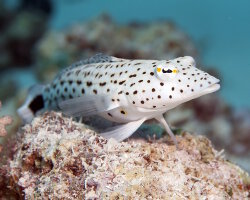
The reticulated sandperch has an elongated, cylindrical body and can reach a maximum length of about 10.2 inches. Its coloration is dominated by grayish-brown and whitish tones, with three longitudinal rows of large pale spots separated by darker areas that form a distinctive reticulated pattern. A broad dark band also crosses its head at eye level, while a second dark band is located toward the back of the head.

Reticulated sandperch waiting near the seafloor in the Bali Sea, Indonesia © Orlandin | Dreamstime.com
Geographic range
The reticulated sandperch inhabits tropical and subtropical waters of the western Indo-Pacific, from the Bay of Bengal to Japan and Indonesia. It occurs around the Andaman Islands, Cocos Islands, Ryukyu Islands and the Philippines, as well as in the waters of Taiwan, Thailand, Palau, Papua New Guinea, the Solomon Islands and Christmas Island.
Habitat
The reticulated sandperch lives close to the bottom and can be found at depths of up to about 66 feet. It inhabits rocky areas, sandy or rubble-covered bottoms along coastlines where hard and soft substrates alternate, as well as occasionally deeper coastal slopes.
It generally lives alone or in small groups and remains alert close to the bottom, where its shape and coloration help it blend into its surroundings.
Diet
The reticulated sandperch is a predator that hunts close to the bottom and feeds mainly on small fish and benthic invertebrates.
It can remain motionless near the bottom before darting toward prey that comes within range. However, detailed information about the exact composition of its diet remains limited for this species, so it is preferable not to attribute a more specific list of prey without additional observations or dedicated studies.
Reproduction
Reproduction in the reticulated sandperch remains poorly understood. Like several other species in its genus, it may be a protogynous hermaphrodite, meaning that individuals begin their reproductive life as females before potentially becoming males.

Reticulated sandperch with its striking brown-and-white pattern in the Bohol Sea, Philippines © Orlandin | Dreamstime.com
Within the same genus

Discover also
Black sea bassCentropristis striata
Diagonal-banded SweetlipPlectorhinchus lineatus
Double barred rabbitfishSiganus virgatus
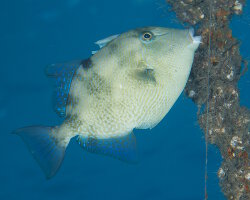
Gray triggerfishBalistes capriscus

Half and half wrasseHemigymnus melapterus

Signalfin sandgobyFusigobius signipinnis
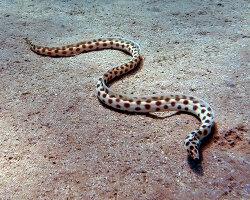
Tiger snake eelMyrichthys maculosus

Yellowstriped cardinalfishOstorhinchus cyanosoma
Our latestUpdates
The Guide des poissons de Nouvelle-CalédonieDiscover Guide to the Fishes of New Caledonia by Pierre Laboute and René Grandperrin, an illustrated reference featuring nearly 1,200 species, from rivers and coral reefs to the depths of the ocean.Read more
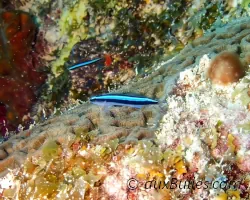
The neon gobyDiscover the neon goby (Elacatinus oceanops), a small western Atlantic reef fish known for its brilliant blue stripe and its role as a cleaner fish that removes parasites from other fish.Read more

The poison gobyDiscover the poison goby (Gobiodon citrinus), a tiny reef fish with a bright yellow body and distinctive blue markings. It lives among branching Acropora corals in the tropical waters of the Indo-Pacific.Read more
Photo of the Day

Gorette bleue
(Haemulon sciurus)
(Haemulon sciurus)
 Copyright © 2007-2026 auxBulles.com - All rights reserved. Legal notices.
Photo credits - Our partners