Sealife guideThe potato grouperEpinephelus tukula
Last updated on 09/24/2026 at 11:00 PM
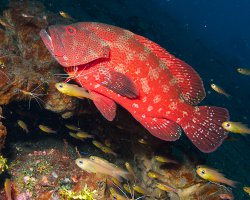
The potato grouper (Epinephelus tukula) is a very large grouper found throughout the Indo-Pacific. It gets its name from its massive body covered with large dark spots that, in their shape and arrangement, resemble the shape and appearance of potatoes. Solitary and territorial, it mainly inhabits rocky and coral reefs, where it can reach an impressive length of 6.6 feet and weigh more than 220 lb.
Taxonomy
English names
Potato grouperPotato cod
French namesMérou patate
Spanish namesMero patata
Scientific nameEpinephelus tukula (Morgans, 1959)
Description
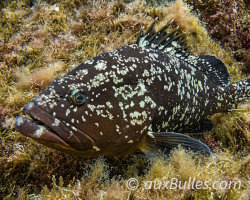
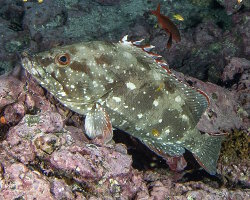
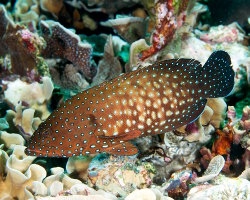
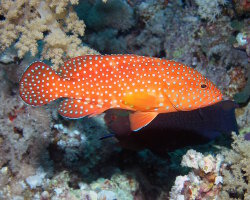
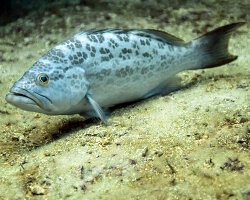
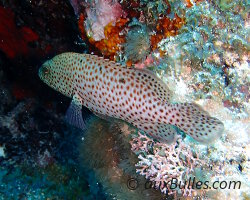
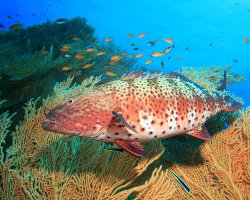
The potato grouper has a massive body that is slightly compressed from side to side, with a large head and a wide mouth equipped with small teeth and canine teeth. Its coloration is generally grayish brown to dark brown, with large dark spots that are often round, oval, or elongated and distributed across the body. The head has numerous small spots and finer markings around the eyes, while the fins also have dark spots.
Juveniles have a more contrasting pattern than large adults. With age, the coloration can become much darker, to the point that some very large specimens appear almost black. The largest individuals can reach up to 6.6 feet in length and weigh around 240 lb.
Geographic range
The potato grouper inhabits tropical waters throughout the Indo-Pacific. In the western Indian Ocean, it is found from the coasts of South Africa (KwaZulu-Natal), Mozambique, Tanzania, and the Red Sea to Madagascar,
Réunion,
Mauritius, and the
Seychelles. In the Pacific Ocean, it occurs in South and Southeast Asia, particularly along the coasts of India and Sri Lanka, as well as Indonesia, the Philippines, Vietnam, and southern Japan.
In Oceania, it is particularly well known along
Australia's
Great Barrier Reef, especially at the world-famous Cod Hole, as well as in Papua New Guinea and as far east as the Solomon Islands.
Habitat
The potato grouper mainly inhabits coral and rocky reefs, particularly deep passes, around drop-offs, and on seamounts exposed to currents. It is generally found at depths between 33 and 492 feet, and sometimes as deep as 1,312 feet.
Juvenile potato groupers live in shallow water, particularly in tidal pools and rocky pools influenced by the tides. As they grow, they move into deeper reef areas. The potato grouper is a solitary and territorial species that inhabits rocks and reefs where it finds shelter and hunts its prey.
Diet
The potato grouper is an ambush predator. It captures its prey by suddenly opening its large mouth, creating strong suction that allows it to quickly swallow animals nearby.
Its diet includes various reef fish, as well as
crustaceans such as crabs and lobsters. It can also eat rays and cephalopods.
Reproduction
Like many groupers, the potato grouper is a protogynous hermaphrodite: individuals begin their sexual life as females, and some later become males. This sex change allows some of the older and larger individuals to participate in reproduction as males.
Reproduction occurs through external fertilization: eggs and sperm are released into the water, where fertilization takes place. Potato groupers can form spawning aggregations, with several individuals gathering in the same area.
Did you know ?
The potato grouper is among the largest groupers in the world. It can reach 6.6 feet in length and weigh more than 220 lb, making it one of the top predators on the reefs it inhabits.
The potato grouper is listed as many other marine species within The
IUCN Red List of threatened species. The potato grouper appears in the
IUCN Red List since 2018 within the category Least Concern !
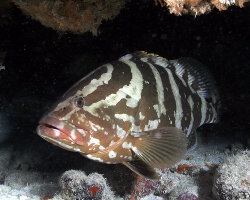
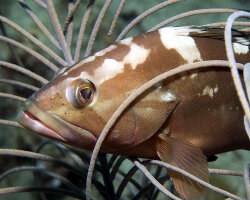
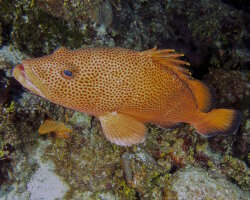
Within the same family
Discover also
The marine species in the Indo-Pacific