

Sealife guideThe five-lined cardinalfishCheilodipterus quinquelineatus
Last updated on 09/23/2026 at 12:45 AM
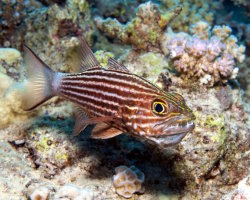
The five-lined cardinalfish (Cheilodipterus quinquelineatus) is a small tropical fish recognizable by its pale gray to whitish body marked with five thin black stripes. The base of its caudal fin has a black spot sometimes surrounded by yellow, and its jaws bear large, pointed teeth that resemble canine teeth.
This species lives on Indo-Pacific reefs, where it takes shelter in crevices, under overhangs, or among branching corals. Mainly active at night, it leaves its shelter to search for small prey before returning to the reef for protection.
Taxonomy
English names
Five-lined cardinalfish
French namesApogon à cinq lignes
Spanish namesPez cardenal de cinco líneas
Scientific nameCheilodipterus quinquelineatus (Cuvier, 1828)
FamilyApogonidae
OrderApogoniformes
ClassActinopterygii
Description
The five-lined cardinalfish has an elongated body that is slightly compressed on the sides. Its pale gray to whitish coloration is marked with five thin black stripes. At the base of its caudal fin is a circular black spot, sometimes surrounded by yellow. The largest individuals can grow to about 5.1 inches in length.

The five-lined cardinalfish (Cheilodipterus quinquelineatus) © Francesco Ricciardi | Dreamstime.com
Its jaws bear large, pointed teeth that are particularly noticeable in this small fish. They resemble canine teeth and are adapted for capturing prey.
Geographic range
The five-lined cardinalfish inhabits tropical waters of the Indo-Pacific, from the Red Sea and the coasts of East Africa to the Pitcairn Islands in the Pacific. To the north, its range extends to southern Japan, while to the south it reaches Lord Howe Island and Rapa.
Habitat
The five-lined cardinalfish lives on reef flats, in lagoons, and on exposed offshore reefs. It is generally found from the surface to depths of about 131 feet.
The five-lined cardinalfish is mainly active at night. During the day, it takes shelter in reef crevices, under overhangs, among branching corals, or between the long spines of the long-spined sea urchin (Diadema setosum). It sometimes lives alone but can also form groups of several individuals.
Diet
The five-lined cardinalfish mainly feeds on small animals it finds around the reef. Its diet includes small crustaceans and gastropods, as well as small fish.
It mainly hunts at night, when it leaves its shelter to explore the surrounding area. It generally stays close to the reef, where numerous crevices and coral structures provide plenty of hiding places in case of danger.
Reproduction
During reproduction, the male and female come together before spawning to form a pair. The male then holds the eggs in his mouth while they develop. This mouthbrooding protects the eggs until they hatch.
As in other cardinalfish that practice mouthbrooding, the eggs remain protected until they hatch. This strategy allows the developing young to grow while sheltered from the many dangers found on the reef.
Did you know ?
Despite its small size, this fish has large canine-like teeth that allow it to seize and hold its prey.

The five-lined cardinalfish (Cheilodipterus quinquelineatus) © Rickard Zerpe sous licence Creative Commons
The five-lined cardinalfish is listed as many other marine species within The IUCN Red List of threatened species. The five-lined cardinalfish appears in the IUCN Red List since 2022 within the category Least Concern !
Within the same genus
Within the same family

CardinalfishApogon imberbis

FlamefishApogon maculatus
Frostfin cardinalfishOstorhinchus hoevenii

Narrowstripe cardinalfishPristiapogon exostigma

Pajama cardinalfishSphaeramia nematoptera

Seale's cardinalfishOstorhinchus sealei

Spotgill cardinalfishOstorhinchus chrysopomus

Yellowstriped cardinalfishOstorhinchus cyanosoma
Discover also

Blacklip butterflyfishChaetodon kleinii

Blue-green chromisChromis viridis

CometfishCalloplesiops altivelis
Coral hindCephalopholis miniata
Gray angelfishPomacanthus arcuatus
Mental wrasseOxycheilinus mentalis
Scrawled filefishAluterus scriptus

Springer's damselfishChrysiptera springeri
The marine species in the Indo-Pacific



Our latestUpdates
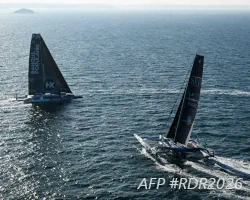
Major movesThe 2026 Route du Rhum enters a decisive phase as Tom Laperche extends his lead in the Ultim class, Armel Le Cléac'h capsizes, and Class40 skippers prepare to face a powerful weather front.Read more

A tough startThe 2026 Route du Rhum gets off to an intense start, with major technical failures, Francis Joyon's capsize, impressive speeds and strategic route choices near the Azores. A look back at the first 48 hours of racing.Read more

A smooth start, an uncertain AtlanticDiscover the 2026 Route du Rhum start off Saint-Malo, where favorable initial conditions contrast with an uncertain Atlantic crossing shaped by changing winds and weather.Read more
Photo of the Day

Méduse pélagique
(Pelagia noctiluca)
(Pelagia noctiluca)
 Copyright © 2007-2026 auxBulles.com - All rights reserved. Legal notices.
Photo credits - Our partners