

Sealife guideThe immaculate pufferfishArothron immaculatus
Last updated on 08/25/2026 at 10:07 PM
The immaculate pufferfish (Arothron immaculatus) is a fish recognizable by its pale gray coloration and large dark spot at the base of its pectoral fins. Like other pufferfish, it has a powerful mouth and fused, beak-like teeth that allow it to crush hard-shelled or armored prey. It mainly lives in the tropical waters of the Indo-Pacific and inhabits both reefs and shallow coastal areas.
Despite its placid appearance, the immaculate pufferfish is a solitary predator that explores the seafloor in search of small animals. Like other Tetraodontidae, it is also capable of inflating its body when threatened, making it much more difficult for a potential predator to swallow. Its flesh is also toxic and should not be eaten.
Taxonomy
English names
Immaculate pufferfish
French namesPoisson-ballon immaculé
Spanish namesPez globo inmaculado
Scientific nameArothron immaculatus (Bloch & Schneider, 1801)
FamilyTetraodontidae
OrderTetraodontiformes
ClassActinopterygii
Description
The immaculate pufferfish has a short, stocky body that is slightly compressed on the sides, with a large head and a short, rounded snout. Its skin is covered with small spines that become more visible when the fish inflates. Its coloration is generally pale gray to brownish on the back and becomes lighter, sometimes almost white, on the belly. A large yellowish to dark brown, sometimes almost black, spot surrounds the base of each pectoral fin, while the caudal fin is generally yellow with a dark edge. Dark bands are also visible around the eyes.

The immaculate pufferfish (Arothron immaculatus) is easily recognizable by its pale gray coloration and large dark spot at the base of its pectoral fins © Orlandin | Dreamstime.com
The immaculate pufferfish can reach a maximum length of about 15 inches. Like other pufferfish, it does not have well-developed dorsal and pelvic fins for propulsion. It mainly moves using the rapid movements of its pectoral, dorsal, and anal fins, allowing it to maneuver precisely around reefs and through seagrass beds.
Geographic range
The immaculate pufferfish is found in the tropical waters of the western Indo-Pacific, from the Red Sea and the East African coast to Indonesia, and northward to southern Japan.
The immaculate pufferfish occurs around numerous islands in the Indian Ocean and western Pacific, including the Seychelles, Comoros, Madagascar, Réunion, Mauritius, the Philippines, Indonesia, New Caledonia, and Vanuatu.
Habitat
The immaculate pufferfish generally lives in shallow waters between 10 and 98 feet deep. It inhabits a variety of coastal environments, including reefs, seagrass beds, vegetated areas, and mangroves. It can also venture into estuaries, where the water is less salty than in the open sea.
It is generally solitary and moves close to the seafloor in search of food. Juveniles can be observed in particularly shallow seagrass beds or mangrove areas, sometimes only 3 to 6 feet below the surface.
Diet
The immaculate pufferfish is a predator that searches for small bottom-dwelling animals by foraging through seagrass beds, sand, and rocky areas near reefs. Like other pufferfish, it has powerful teeth adapted to a diet that includes animals protected by shells or hard exoskeletons. It uses its beak-like teeth to crush them and access the edible parts of its prey.
Reproduction
The immaculate pufferfish is oviparous, meaning that the female lays eggs that develop outside her body. After the female and male release their gametes into the open water, the eggs are fertilized and hatch into larvae that spend their early developmental stages drifting with the currents before transforming into young pufferfish and settling on the seafloor.
Did you know ?
The immaculate pufferfish is listed as many other marine species within The IUCN Red List of threatened species. The immaculate pufferfish appears in the IUCN Red List since 2014 within the category Least Concern !
Within the same genus

Blackspotted pufferArothron nigropunctatus
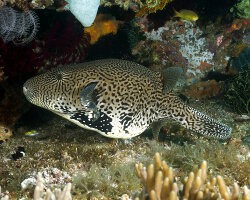
Guineafowl pufferArothron meleagris

Map pufferArothron mappa
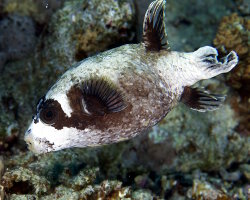
Masked pufferArothron diadematus

Narrow lined pufferfishArothron manilensis

Starry pufferfishArothron stellatus
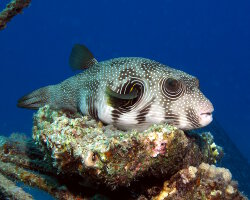
White-spotted pufferArothron hispidus
Within the same family
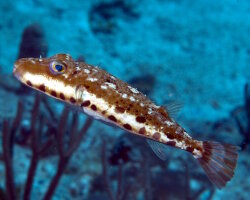
Bandtail pufferSphoeroides spengleri
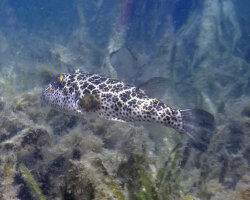
Checkered pufferSphoeroides testudineus
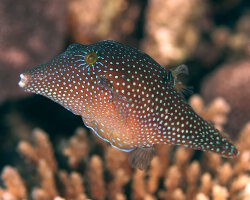
Pearl tobyCanthigaster margaritata

Valentin's sharpnose pufferCanthigaster valentini
Discover also

Banded morayGymnothorax rueppelliae

Banded snake eelMyrichthys colubrinus
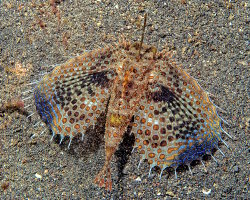
Flying gurnardDactylopterus volitans
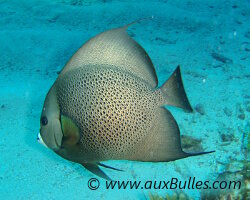
Gray angelfishPomacanthus arcuatus
Humphead wrasseCheilinus undulatus

Princess damselfishPomacentrus vaiuli

Sand diverSynodus intermedius

Yellowsaddle goatfishParupeneus cyclostomus
The marine species in the western Indo-Pacific



Our latestUpdates

Major movesThe 2026 Route du Rhum enters a decisive phase as Tom Laperche extends his lead in the Ultim class, Armel Le Cléac'h capsizes, and Class40 skippers prepare to face a powerful weather front.Read more

A tough startThe 2026 Route du Rhum gets off to an intense start, with major technical failures, Francis Joyon's capsize, impressive speeds and strategic route choices near the Azores. A look back at the first 48 hours of racing.Read more

A smooth start, an uncertain AtlanticDiscover the 2026 Route du Rhum start off Saint-Malo, where favorable initial conditions contrast with an uncertain Atlantic crossing shaped by changing winds and weather.Read more
Photo of the Day

Méduse pélagique
(Pelagia noctiluca)
(Pelagia noctiluca)
 Copyright © 2007-2026 auxBulles.com - All rights reserved. Legal notices.
Photo credits - Our partners