Sealife guideThe bluering angelfishPomacanthus annularis
Last updated on 11/17/2026 at 10:25 PM

The bluering angelfish (Pomacanthus annularis) © Sergey Skleznev | Dreamstime.com
The bluering angelfish (Pomacanthus annularis) is a tropical fish easily recognized by its beautiful blue lines contrasting with its golden-brown body. Found in the warm waters of the Indo-Pacific, it mainly inhabits coral reefs and rocky areas, where it finds shelter and food.
With its deep, laterally compressed body, well-developed fins and colorful patterns, this angelfish is one of the most remarkable species found in coral reef ecosystems. It is also known for the spectacular transformation of its coloration as it grows.
Taxonomy
English names
Bluering angelfish
French namesPoisson-ange annelé
Spanish namesPez ángel de anillo azul
Scientific namePomacanthus annularis (Bloch, 1787)
Description
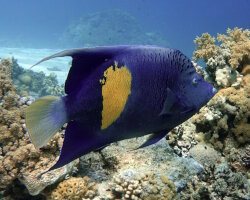
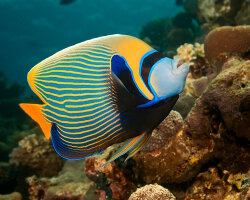
The bluering angelfish has an oval-shaped, deep and strongly laterally compressed body that can reach approximately 18 inches in length. Adults display a golden-brown to orange coloration, crossed by curved blue lines extending from the pectoral fins toward the back and flanks. Two additional blue stripes cross the head, one of which runs through the eye. A distinctive blue ring-shaped marking appears just above and behind the gill opening, giving the species its common name. The tail fin is white with a yellow edge, while the dorsal and anal fins also feature blue lines.
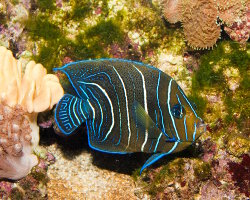
Juveniles have a very different appearance from adults. Their dark blue to almost black bodies are decorated with fine white and light blue stripes arranged in concentric arcs along the flanks.
Geographic range
The bluering angelfish inhabits tropical waters of the western Indo-Pacific, ranging from the eastern coast of Africa, particularly around Madagascar, to New Caledonia, through Sri Lanka, Indonesia, the Philippines and New Guinea. Its range extends north to southern Japan and east to the Solomon Islands.
Habitat
The bluering angelfish inhabits coastal coral reefs, lagoons and rocky bottoms, where numerous crevices provide shelter. It is most commonly found at depths of 30 to 100 feet, but can be observed as deep as 200 feet.
Adults are often seen alone or in pairs near underwater cavities and caves. Juveniles tend to occupy shallow coastal areas, particularly rocky bottoms and dead coral surfaces covered with filamentous algae.
Diet
The bluering angelfish feeds mainly on organisms attached to the bottom or living near reefs, particularly
sponges and tunicates, including sea squirts. It also consumes zooplankton and other small invertebrates found on rocky and coral substrates. Its regular consumption of
sponges makes it primarily a spongivore, like many other large reef angelfish.
Reproduction
The reproduction of the bluering angelfish remains relatively poorly documented in the wild. In large angelfish of the genus Pomacanthus, spawning generally takes place at dusk. During courtship, the male and female gradually rise through the water column before simultaneously releasing their reproductive cells. Fertilization takes place externally, and the fertilized eggs develop into larvae that drift in the plankton. After several weeks of pelagic life, young fish settle on the reefs and gradually adopt a benthic lifestyle.
Did you know ?
The bluering angelfish undergoes a spectacular transformation in coloration as it grows. Juveniles have a dark blue, almost black body adorned with fine white and light blue stripes arranged in arcs along their flanks. As they mature, they gradually develop the adult coloration, with a golden-brown body crossed by curved blue lines. This transformation is so striking that juveniles and adults could easily be mistaken for entirely different species.
The bluering angelfish is listed as many other marine species within The
IUCN Red List of threatened species. The bluering angelfish appears in the
IUCN Red List since 2010 within the category Least Concern !
Within the same family
Discover also
The marine species in the western Indo-Pacific