

Sealife guideThe Bengal snapperLutjanus bengalensis
Last updated on 09/24/2026 at 11:00 PM
The Bengal snapper (Lutjanus bengalensis) is a small tropical fish from the Indo-Pacific. It is easily recognized by its yellowish body crossed by four blue stripes. It mainly lives around coral reefs and can gather in small schools near underwater structures.
Taxonomy
English names
Bengal snapper
French namesVivaneau du Bengale
Spanish namesPargo de Bengala
Scientific nameLutjanus bengalensis (Bloch, 1790)
FamilyLutjanidae
OrderPerciformes
ClassActinopterygii
Description
The Bengal snapper has a fairly elongated body that is slightly compressed from side to side. Its back and sides are yellow, while the belly is whitish. Four bright blue stripes run lengthwise along the sides of the body. Its fins are generally yellow with translucent tips, and its caudal fin is slightly forked.
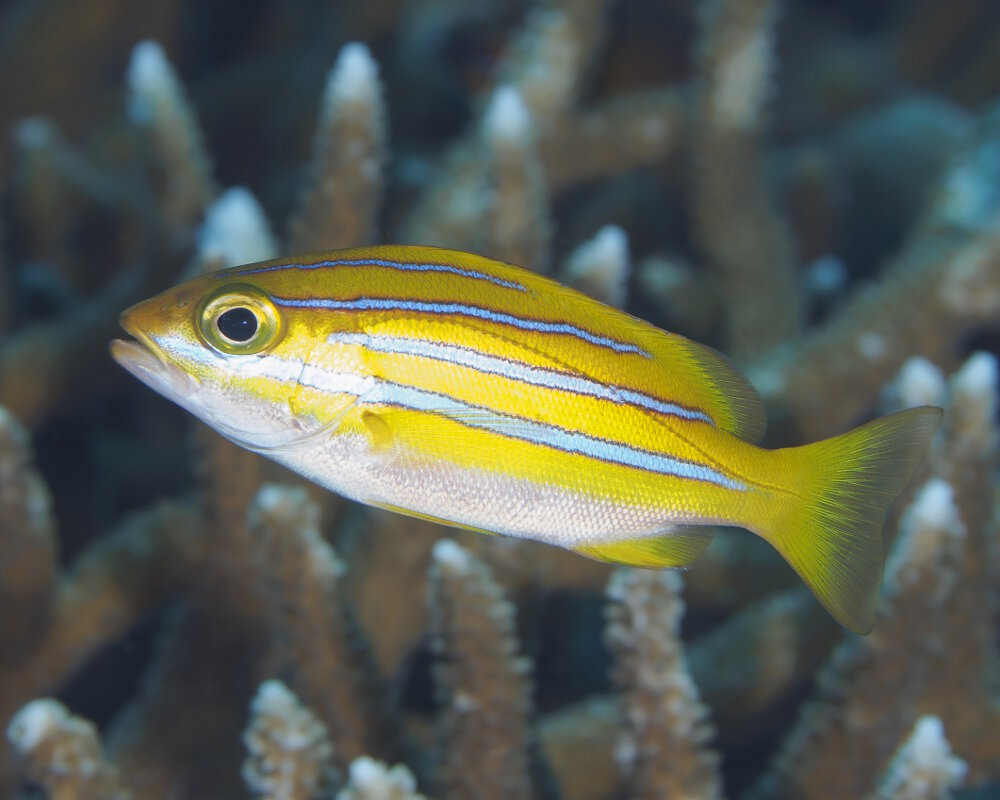
The Bengal snapper (Lutjanus bengalensis) © Orlandin | Dreamstime.com
This coloration makes it fairly easy to recognize underwater, but it can be confused with the common bluestripe snapper (Lutjanus kasmira), a closely related species that also has four blue stripes on a yellow body.
The Bengal snapper averages less than 8 inches in length, although the largest individuals can reach up to 12 inches.
Geographic range
The Bengal snapper inhabits tropical waters of the western Indo-Pacific, from the coasts of East Africa and the Red Sea to the Moluccas in Indonesia.
Habitat
The Bengal snapper mainly lives on coral reefs, particularly in sheltered lagoons. It is generally found at depths between 33 and 82 feet and often stays near rocks and coral formations.
During the day, Bengal snappers may form small groups around underwater structures. They often remain close to reefs and coral heads, where they are easy to observe.
Diet
The Bengal snapper is a predator that feeds mainly on fish and crustaceans. It hunts its prey around reefs and rocky bottoms.
Reproduction
The reproduction of the Bengal snapper is still poorly understood. Scientists have little information about its breeding season, the age at which it reaches sexual maturity, and how it lays its eggs.
Did you know ?
Its four blue stripes make it easy to recognize, but this coloration can lead to confusion with the common bluestripe snapper (Lutjanus kasmira), a closely related species that also has four blue stripes.
The bengal snapper is listed as many other marine species within The IUCN Red List of threatened species. The bengal snapper appears in the IUCN Red List since 2019 within the category Least Concern !
Tips for observing
The Bengal snapper can be confused with the common bluestripe snapper (Lutjanus kasmira), which also has four blue stripes on a yellow body. To tell them apart, look particularly at the belly: the Bengal snapper's belly is generally whitish, while the common bluestripe snapper's is more yellow. The Bengal snapper is also smaller, and its body is generally more slender.
Within the same genus
Blackspot snapperLutjanus ehrenbergii
Blubberlip snapperLutjanus rivulatus

Common bluestripe snapperLutjanus kasmira
Gray snapperLutjanus griseus
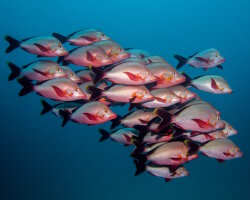
Humpback red snapperLutjanus gibbus

Longspot snapperLutjanus fulviflamma
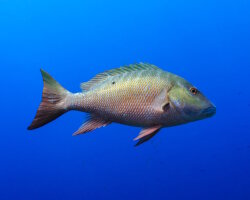
Mutton snapperLutjanus analis

Whipper snapperLutjanus jordani
Within the same family
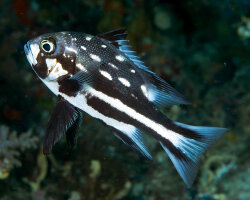
Midnight snapperMacolor macularis
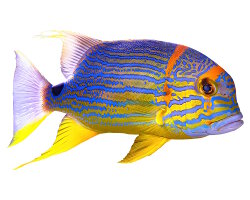
Sailfin snapperSymphorichthys spilurus
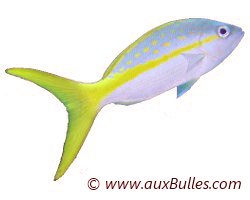
Yellowtail snapperOcyurus chrysurus
Discover also
Atlantic tarponMegalops atlanticus

Blackspotted pufferArothron nigropunctatus

Blackwedged butterflyfishChaetodon falcula
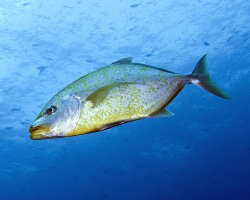
Blue runnerCaranx crysos

Fangtooth morayEnchelycore anatina

Shadowfin soldierfishMyripristis adusta

Six line wrassePseudocheilinus hexataenia
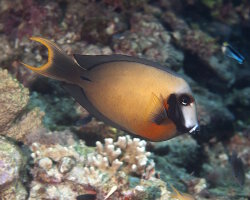
Yellowmask surgeonfishAcanthurus mata
The marine species in the western Indo-Pacific



Our latestUpdates

Major movesThe 2026 Route du Rhum enters a decisive phase as Tom Laperche extends his lead in the Ultim class, Armel Le Cléac'h capsizes, and Class40 skippers prepare to face a powerful weather front.Read more

A tough startThe 2026 Route du Rhum gets off to an intense start, with major technical failures, Francis Joyon's capsize, impressive speeds and strategic route choices near the Azores. A look back at the first 48 hours of racing.Read more

A smooth start, an uncertain AtlanticDiscover the 2026 Route du Rhum start off Saint-Malo, where favorable initial conditions contrast with an uncertain Atlantic crossing shaped by changing winds and weather.Read more
Photo of the Day

Méduse pélagique
(Pelagia noctiluca)
(Pelagia noctiluca)
 Copyright © 2007-2026 auxBulles.com - All rights reserved. Legal notices.
Photo credits - Our partners