

Sealife guideThe common bluestripe snapperLutjanus kasmira
Last updated on 09/24/2026 at 11:00 PM
The common bluestripe snapper (Lutjanus kasmira) is a reef fish that is easily recognized by its yellow body crossed by four bright blue stripes. It lives in tropical waters of the Indo-Pacific and often forms large gatherings around reefs.
The common bluestripe snapper mainly lives on coral reefs and can be found in shallow lagoons as well as on outer reef slopes. During the day, it often stays grouped near coral formations, caves, and shipwrecks.
Taxonomy
English names
Common bluestripe snapper
French namesVivaneau à raies bleues
Spanish namesPargo de rayas azules
Scientific nameLutjanus kasmira (Forsskål, 1775)
FamilyLutjanidae
OrderPerciformes
ClassActinopterygii
Description
The common bluestripe snapper has a fairly stocky body, with a bright yellow back and sides. The underside of the body and head is white. Four bright blue stripes run lengthwise along its sides. Its fins are yellow, and its caudal fin is slightly notched.
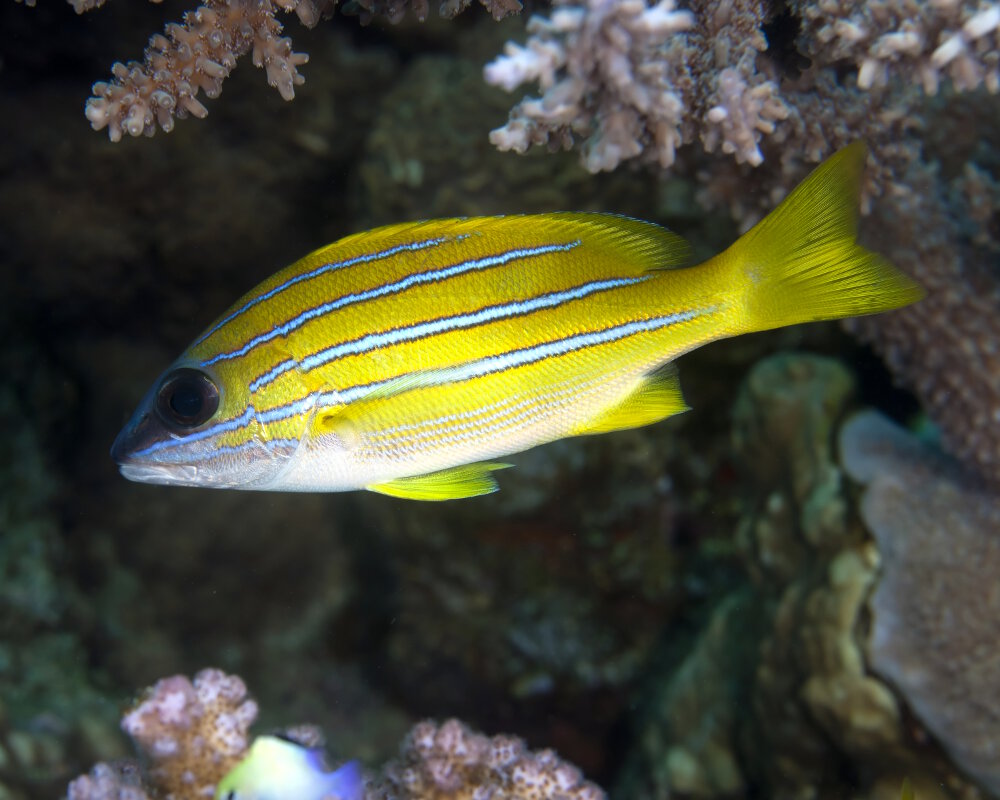
The common bluestripe snapper (Lutjanus kasmira) © Stephankerkhofs | Dreamstime.com
The common bluestripe snapper averages 10 inches in length, but the largest individuals can reach up to 16 inches.
Geographic range
The common bluestripe snapper inhabits tropical waters of the Indo-Pacific, from the Red Sea and the coasts of East Africa to the Marquesas Islands and the Line Islands, and from southern Japan to Australia.
Habitat
The common bluestripe snapper mainly lives on coral reefs. It inhabits shallow lagoons and outer reef slopes and can be found at depths of several dozen feet.
During the day, it often forms large groups around coral formations, caves, rocky structures, or shipwrecks. Juveniles may also inhabit seagrass beds around reefs.
Diet
The common bluestripe snapper is an opportunistic predator that feeds mainly on small fish and crustaceans. It eats shrimp, crabs, and stomatopods, as well as cephalopods and small planktonic crustaceans.
It mainly feeds at night, when the large groups observed during the day disperse across the reef in search of food. It may also consume some algae.
Reproduction
The common bluestripe snapper reproduces in groups, generally in the evening or at night. Males begin the courtship display by rubbing against or gently nudging the females. The fish then swim upward together toward the surface and release their gametes. The fertilized eggs drift with the ocean currents and hatch in less than a day.
Did you know ?
The common bluestripe snapper can form large gatherings of several hundred individuals around reefs, caves, or shipwrecks during the day. At nightfall, these groups disperse to search for food.
The common bluestripe snapper is also found in Hawaii, where it was introduced in the 1950s and 1960s. This population originated from fish introduced from the western Pacific.
The common bluestripe snapper is listed as many other marine species within The IUCN Red List of threatened species. The common bluestripe snapper appears in the IUCN Red List since 2016 within the category Least Concern !
Tips for observing
The common bluestripe snapper can be confused with the Bengal snapper (Lutjanus bengalensis), which also has four blue stripes on a yellow body. The common bluestripe snapper is generally larger, and its belly is distinctly white, while the belly of the Bengal snapper is also whitish but its body is more slender. To tell them apart, also look at the overall body shape and the size of the fish.
Within the same genus



Within the same family
Discover also





The marine species in the Indo-Pacific



Our latestUpdates
The neon gobyDiscover the neon goby (Elacatinus oceanops), a small western Atlantic reef fish known for its brilliant blue stripe and its role as a cleaner fish that removes parasites from other fish.Read more

The poison gobyDiscover the poison goby (Gobiodon citrinus), a tiny reef fish with a bright yellow body and distinctive blue markings. It lives among branching Acropora corals in the tropical waters of the Indo-Pacific.Read more
The wahooDiscover the wahoo (Acanthocybium solandri), a powerful pelagic predator found in tropical and subtropical oceans. Recognizable by its streamlined body and distinctive blue vertical stripes, it is a fast swimmer that feeds mainly on fish and squid.Read more
Photo of the Day
Fou à pieds rouges
(Sula sula)
(Sula sula)
 Copyright © 2007-2026 auxBulles.com - All rights reserved. Legal notices.
Photo credits - Our partners