

Sealife guideThe bluespotted ribbontail rayTaeniura lymma
Last updated on 09/18/2026 at 11:46 PM
The bluespotted ribbontail ray (Taeniura lymma) is a small ray that is easily recognized by its numerous bright blue spots. It lives in the tropical waters of the Indo-Pacific, mainly around coral reefs and in shallow coastal areas.
Despite its bright colors, it is elusive and spends part of the day hiding in caves or beneath reef rocks. It feeds on small animals living on the seafloor and uses its venomous spine for defense when it feels threatened.
Taxonomy
English names
Bluespotted ribbontail rayBlue spotted stingray
French namesRaie pastenague à pois bleus
Spanish namesRaya látigo rabo cinta
Scientific nameTaeniura lymma (Forsskål, 1775)
FamilyDasyatidae
OrderMyliobatiformes
ClassElasmobranchii
Description
The bluespotted ribbontail ray has a flattened, oval-shaped disc, with broad pectoral fins surrounding the head. Its back is generally yellowish brown, olive, or reddish brown and covered with numerous large, bright blue spots, while its underside is white. Its slender, tapering tail is longer than its body and has blue stripes along the sides. A venomous spine is usually present at the base of the tail. The largest individuals can reach a disc width of up to 14 inches.
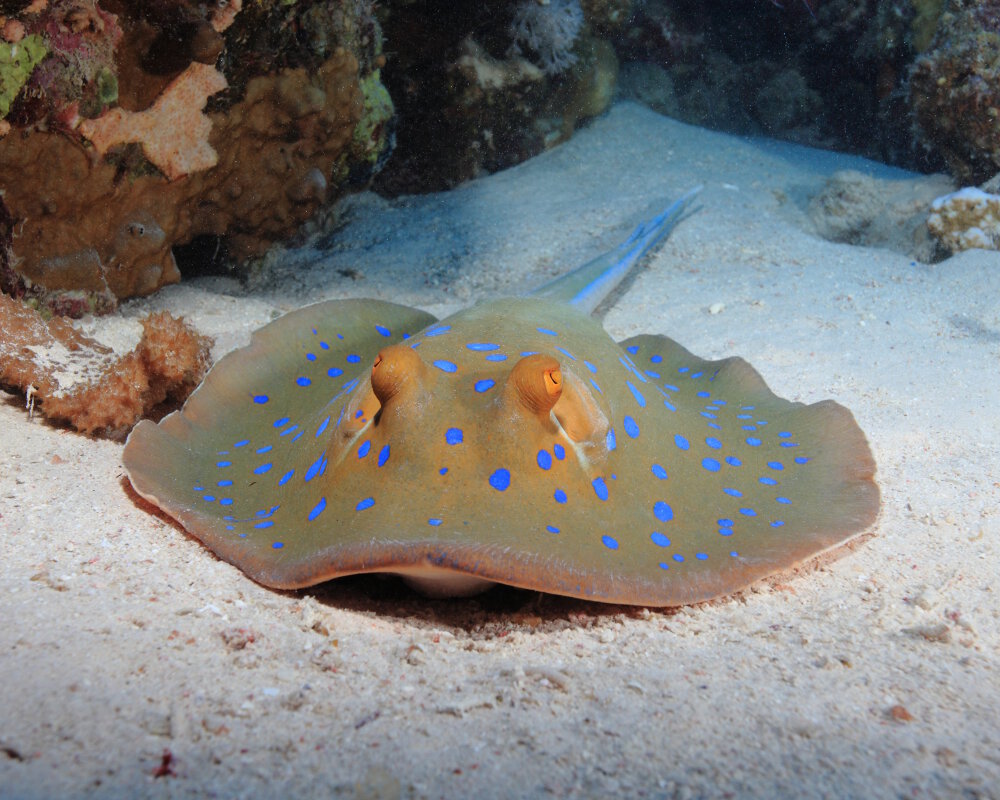
The numerous bright blue spots characteristic of the bluespotted ribbontail ray (Taeniura lymma) © Aquanaut4 | Dreamstime.com
Its eyes and spiracles, which allow it to breathe, are located on top of its head. This position allows it to rest on the seafloor while breathing without directly drawing in sand.
Geographic range
The bluespotted ribbontail ray inhabits the tropical waters of the western Indo-Pacific, from the Persian Gulf, Red Sea, and coast of East Africa to the Solomon Islands. It is found in particular in the Maldives, Seychelles, Bali, Raja Ampat, and the Philippines. Its range extends north to southern Japan and south to northern Australia.
Habitat
The bluespotted ribbontail ray is mainly found in shallow water, generally from the surface to around 66 feet deep, around coral reefs, on sandy seafloors, and in areas where corals provide shelter.
As the tide comes in, it sometimes moves in groups toward shallow sandy areas to feed. As the tide goes out, it returns to the reef and takes shelter in caves or beneath ledges.
Diet
The bluespotted ribbontail ray feeds on small animals living on the seafloor, including mollusks, marine worms, shrimp, and crabs, as well as small fish.
It searches for prey by slowly moving over the seafloor or probing through the sand. It may also lie in wait, partially buried, to capture small animals that pass nearby.
Reproduction
The bluespotted ribbontail ray is ovoviviparous, and the female can give birth to up to seven pups.
Did you know ?
The bluespotted ribbontail ray has a respiratory system particularly well adapted to life on the seafloor. It draws seawater in through its spiracles, located on top of its head, and then expels it through its gill slits beneath its body. This allows it to breathe while resting on the seafloor without drawing sand into its gills.
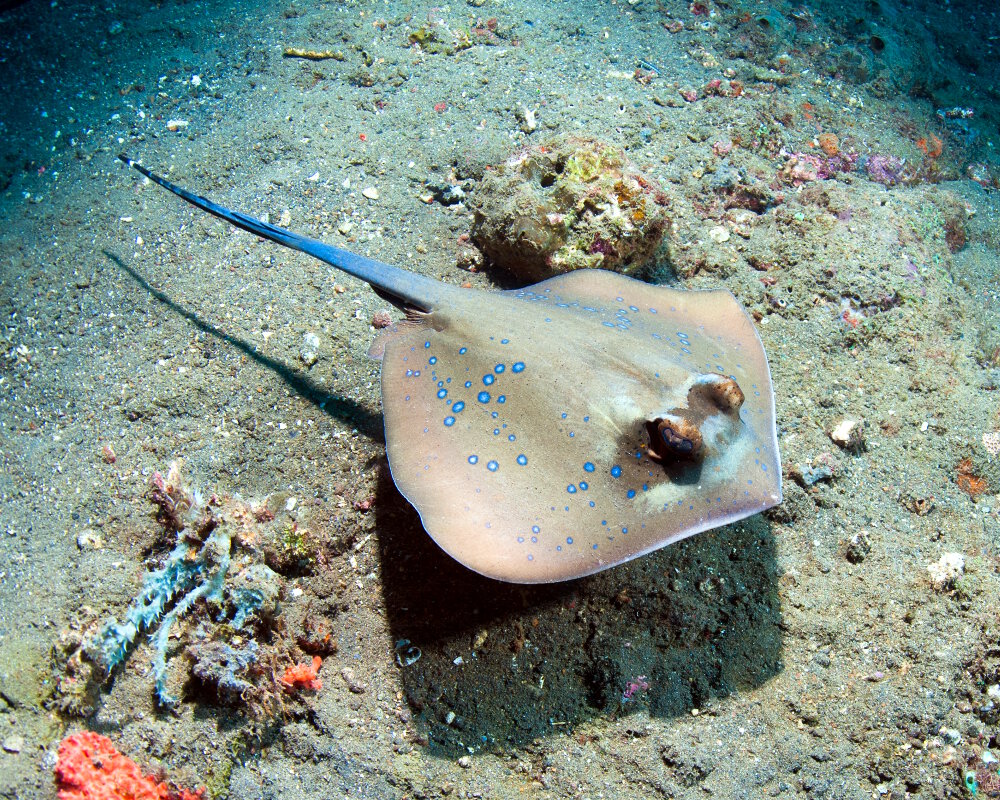
The bluespotted ribbontail ray (Taeniura lymma) © Ericsch | Dreamstime.com
The long tail of the bluespotted ribbontail ray bears a venomous spine capable of inflicting a very painful sting. However, it does not use this spine to hunt: it is primarily a means of defense when the ray feels threatened.
The bluespotted ribbontail ray is listed as many other marine species within The IUCN Red List of threatened species. The bluespotted ribbontail ray appears in the IUCN Red List since 2021 within the category Least Concern !
Within the same genus
Within the same family
Blue spotted stingrayNeotrygon kuhlii

Darkspotted stingrayHimantura uarnak
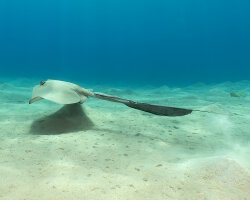
Fantail stingrayPastinachus sephen
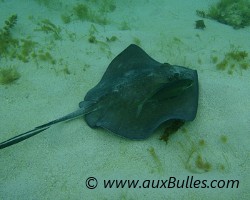
Southern stingrayDasyatis americana
Discover also
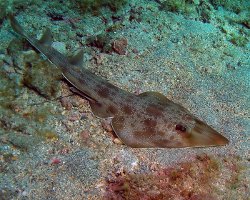
Atlantic guitarfishRhinobatos lentiginosus
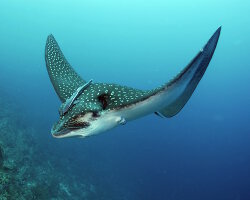
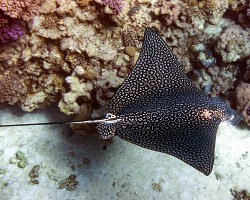
Atlantic white-spotted eagle rayAetobatus narinari

Big skateRaja binoculata
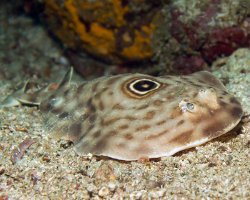
Bullseye electric rayDiplobatis ommata
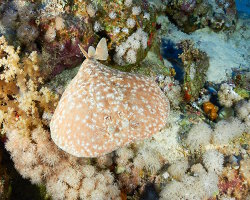
Panther electric rayTorpedo panthera
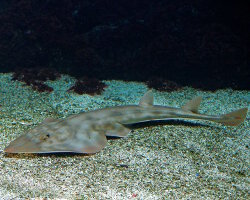
Shovelnose guitarfishPseudobatos productus
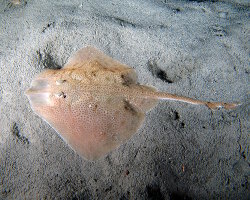
Thornback rayRaja clavata
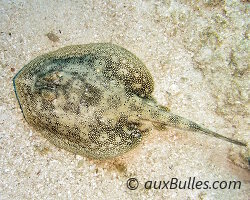
Yellow stingrayUrobatis jamaicensis
The marine species in the Indo-Pacific

Our latestUpdates
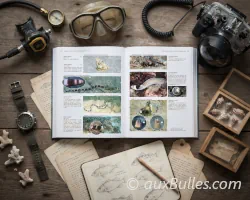
The Guide des poissons de Nouvelle-CalédonieDiscover Guide to the Fishes of New Caledonia by Pierre Laboute and René Grandperrin, an illustrated reference featuring nearly 1,200 species, from rivers and coral reefs to the depths of the ocean.Read more
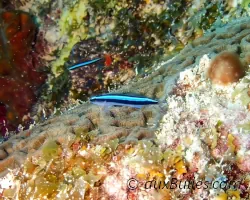
The neon gobyDiscover the neon goby (Elacatinus oceanops), a small western Atlantic reef fish known for its brilliant blue stripe and its role as a cleaner fish that removes parasites from other fish.Read more

The poison gobyDiscover the poison goby (Gobiodon citrinus), a tiny reef fish with a bright yellow body and distinctive blue markings. It lives among branching Acropora corals in the tropical waters of the Indo-Pacific.Read more
Photo of the Day
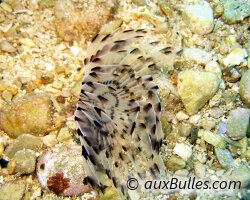
Sabelle paon
(Sabella pavonina)
(Sabella pavonina)
 Copyright © 2007-2026 auxBulles.com - All rights reserved. Legal notices.
Photo credits - Our partners