Offshore SailingEight Ultim, one winnerThe Route du Rhum 2026
Last updated on 10/30/2026 at 11:14 PM
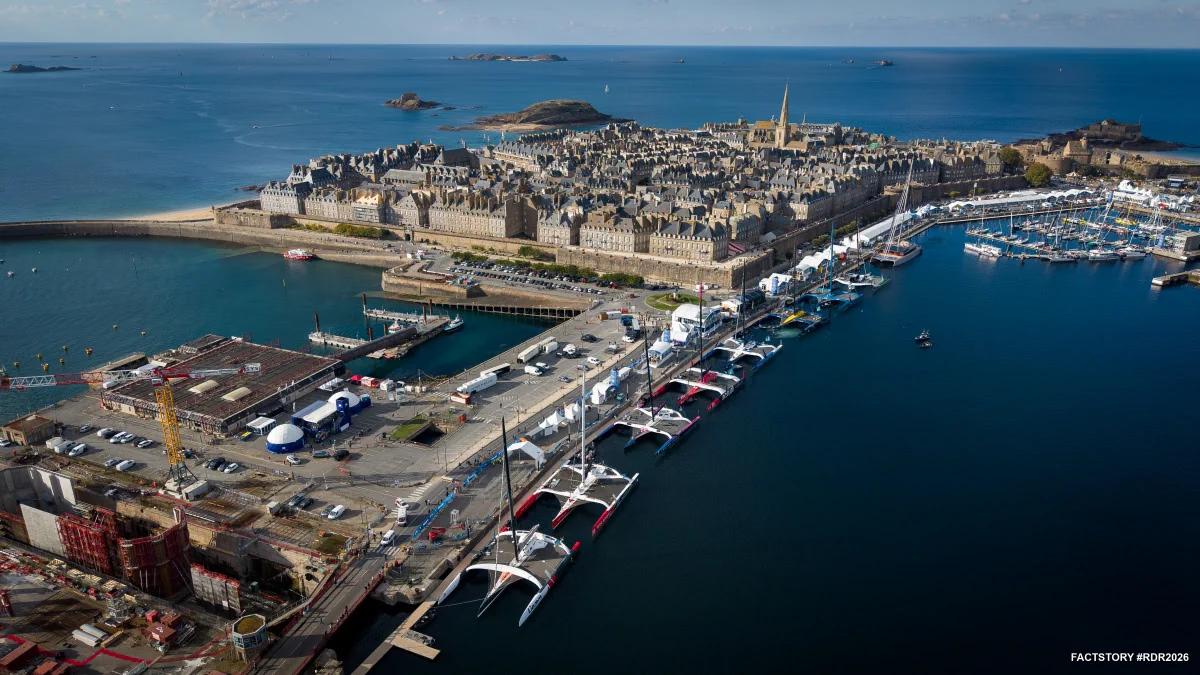
The eight most competitive Ultim trimarans in the world will line up at the start of the 2026 edition of the Route du Rhum – Destination Guadeloupe. With defending champion Charles Caudrelier, some of offshore sailing's biggest names, and several skippers looking to establish themselves in the class, the race promises to be wide open.
While boat performance, reliability, and sailing experience will play a major role, strategic decisions, fatigue management, and the ability to maintain a high pace throughout the crossing will be just as crucial. With these machines capable of reaching Guadeloupe in five to eight days, every mistake could prove costly.
A technological revolution yet to be mastered
An innovative boat
Defending champion Charles Caudrelier returns at the helm of Maxi Edmond de Rothschild, renamed Gitana 18. Launched eight months before the start, this trimaran, equipped with Y-shaped foils, was designed to fly continuously above the water. Its ambitious design could give it an edge over its rivals, but its development is still ongoing.
The team prioritized testing and improving the boat's reliability rather than competing against other boats in September. The Route du Rhum will therefore be its first real competitive test. Charles Caudrelier now has extensive solo sailing experience, but he will have to contend with a boat that still has relatively few offshore miles under its belt. A project of this kind typically requires two or three years of development before reaching its full potential.
An unknown factor for the competition
Gitana 18's potential has intrigued its rivals, particularly Tom Laperche, who sees it as a concept that could represent a new generation of sailing technology. The question remains whether the trimaran's theoretical performance will translate into race conditions and whether its reliability will allow its full potential to be unleashed.
Ambitious contenders
Tom Laperche, youth and skill
Aboard SVR-Lazartigue for his first Route du Rhum, Tom Laperche is among the strongest contenders for victory. He knows his trimaran inside out and comes into the race fresh from a recent victory in the 24H Ultim. This preparation has boosted his confidence in a well-developed boat backed by a strong team. For him, the Route du Rhum is a childhood dream come true.
Armel Le Cléac'h, seeking redemption
Armel Le Cléac'h will compete in the Route du Rhum for the fifth time aboard Maxi Banque Populaire XI. Despite an impressive sailing record, including victories in the Vendée Globe, Solitaire du Figaro, and Transat Jacques Vabre, he has never won this transatlantic race. His trimaran, launched in 2021, has benefited from several years of optimization and reliability improvements.
Thomas Coville, experience and ambition
Thomas Coville will make his eighth appearance aboard Sodebo Ultim 3, following his Jules Verne Trophy record set the previous winter. Twenty-eight years after winning the IMOCA class in this event, he hopes to return to the top of the podium. Like Armel Le Cléac'h, he can rely on a proven boat and extensive offshore racing experience.
Between heritage and discovery
Anthony Marchand, a proven winning boat
At the helm of Actual Ultim 4, Anthony Marchand will sail the former Gitana 17, the trimaran Charles Caudrelier used to win the previous edition while setting the race record. The boat's potential is well established, although the competition has continued to improve. For his first Route du Rhum, the skipper will have to adapt to the intensity of the maneuvers and sail adjustments, which require constant attention.
Anthony Marchand is aiming for a podium finish while hoping to complete a controlled crossing and make the most of his boat's capabilities. The first 36 hours will be particularly important in finding the right pace without exhausting his physical reserves too quickly.
Louis Burton, a new multihull challenge
Third in the 2020–2021 Vendée Globe, Louis Burton is discovering the Ultim class after fifteen years of sailing monohulls. His trimaran, launched in 2015, is a proven flying platform, but older than several of its competitors. His sailing experience and training sessions since acquiring the boat should help him make rapid progress.
The skipper of Ultim Armand Thiery is focusing on caution and learning during his first appearance in the class. He believes sixth place would match his boat's theoretical potential, but hopes to break into the top five. His determination and tendency to push his boats hard could nevertheless allow him to surprise more experienced Ultim sailors.
From around-the-world sailing to a transatlantic race
Extensive solo offshore experience
Just a few months after his first Vendée Globe, Guirec Soudée completed a solo, westward circumnavigation aboard an Ultim trimaran, sailing against the prevailing direction from east to west. In March, he became the fastest sailor to complete this route. This achievement demonstrates his ability to handle a demanding multihull and sail for extended periods.
A different pace of racing
The Route du Rhum, however, calls for a different approach from an around-the-world record attempt. On a shorter transatlantic race sailed in close competition with other boats, skippers will need to push harder while preserving their boats' reliability. Aware that his boat, Liamm, does not have the same technological advantages as the latest Ultim trimarans, Guirec Soudée is counting on its robustness and his determination to make his mark.
A female pioneer in the Ultim class
A second Route du Rhum, an almost unprecedented challenge
Alexia Barrier will become the first woman to start the Route du Rhum – Destination Guadeloupe in the Ultim class. Eight years after her first appearance in the IMOCA class, she approaches this new edition with additional experience gained during the Jules Verne Trophy, in which she took part as the leader of an all-female crew.
Aboard IDEC Sport – CIC, an older trimaran than several of her competitors' boats but with an impressive racing record, her main goal is to sail a strong race and protect her boat. She aims to gain more solo multihull experience without putting excessive pressure on herself to achieve a particular result.
Racing in the service of ocean science
Alexia Barrier will also use the crossing to pursue her scientific and educational commitments. She will deploy a buoy capable of collecting data at depths of up to 6,562 feet. Fifth-grade students will follow the project as part of an educational program. The sailor also hopes to encourage girls, women, and anyone who doubts their abilities to take on ambitious challenges.
An ocean sprint
A sustained pace for five to eight days
Ultim trimarans can cross the Atlantic in five to eight days, with the crossing likely to take closer to six or seven days depending on weather conditions. This short duration turns the Route du Rhum into a true ocean sprint: skippers have little time to settle into the race and must maintain a high pace all the way to the finish.
Sail changes, constant adjustments, and maneuvers come thick and fast. Managing sleep, fatigue, and concentration becomes essential to maintaining precise boat handling without compromising safety.
Reliability, strategy, and physical endurance
Victory will depend as much on trimaran performance as on the sailors' ability to make the most of their boats. Some will need to find the best balance between speed and protecting their equipment, while others will be looking to master a still-new boat or make up for a technological disadvantage. Strategic decisions and changing weather conditions could also shake up the standings.
Eight skippers, one title
Between the innovation of Gitana 18, the reliability of proven boats, and the ambition of sailors with less experience in the class, no outcome can be ruled out. As Charles Caudrelier points out, winning in the Ultim class requires having the best machine, much like in Formula 1. But the skipper must also know how to push it to the limit, at the right moment, without breaking it. Boat handling, physical endurance, and sound decision-making will make the difference all the way to Guadeloupe.