

Sealife guideThe European spiny lobsterPalinurus elephas
Last updated on 08/24/2026 at 10:41 PM
The European spiny lobster (Palinurus elephas), also known as the European red lobster or common spiny lobster, is a large crustacean highly prized for its meat. It is recognizable by its long, spiny antennae and shell covered with numerous spines. It inhabits the rocky bottoms of the Northeast Atlantic and Mediterranean Sea, where it generally hides in crevices during the day before setting out in search of food at night.
Taxonomy
English names
European spiny lobster
French namesLangouste rougeLangouste rouge europeenneLangouste commune
Spanish namesLangosta común
Scientific namePalinurus elephas (Fabricius, 1787)
FamilyPanuliridae
OrderDecapoda
ClassMalacostraca
Description
The European spiny lobster has an elongated body covered by a robust shell, slightly compressed on the sides and covered with numerous spines. Its coloration ranges from reddish brown to purplish brown, with lighter marbling and spots. Two large triangular spines protect the front of the shell, while its two long, spiny antennae, often longer than the body, are one of its main distinguishing features. Unlike lobsters, it does not have claws, and its five pairs of legs are mainly used to move along the seafloor.
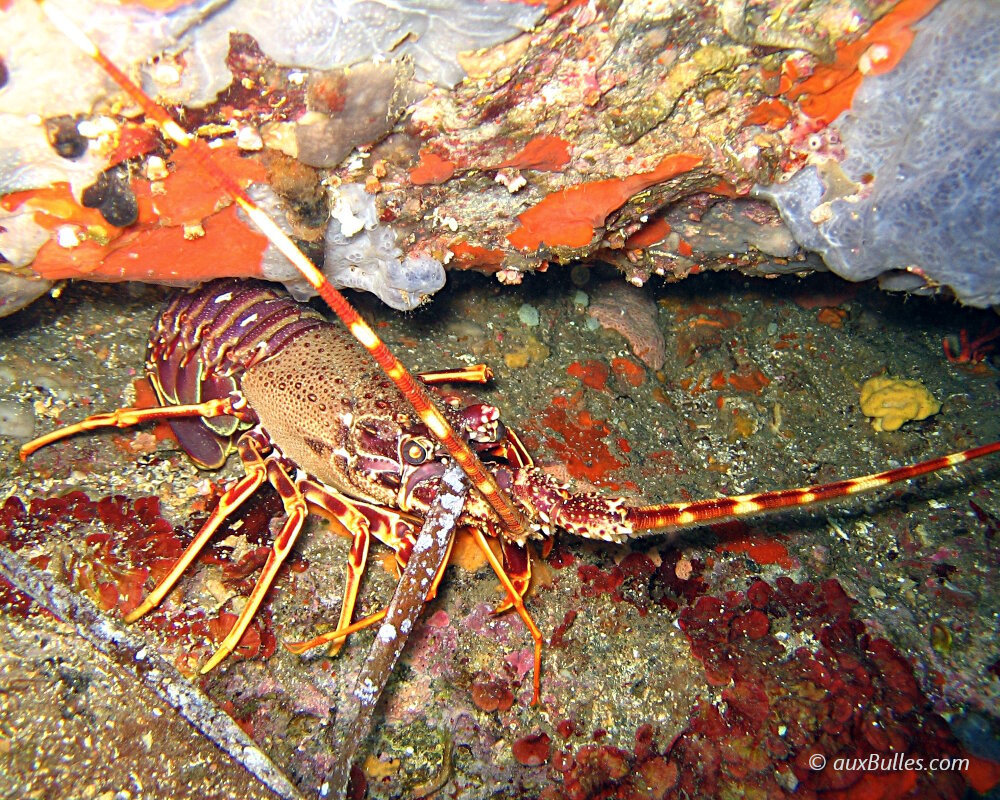
A European spiny lobster nestled in a rocky crevice
As an adult, the European spiny lobster generally measures between 8 and 16 inches in length, but the largest individuals can reach 20 inches
Geographic range
The European spiny lobster mainly inhabits the temperate waters of the Northeast Atlantic and Mediterranean Sea. In the Atlantic Ocean, it occurs from southern Norway and the British Isles south to Morocco, as well as around the Azores and Canary Islands. In the Mediterranean Sea, it is found in many areas, particularly in the western and central regions, as well as in the Adriatic and Aegean seas.
Habitat
The European spiny lobster is found on rocky seafloors, particularly in areas with faults, crevices, cavities, and coralligenous formations that provide shelter. It is most commonly found between 33 and 230 feet deep, but it can also be observed at depths of up to 656 feet.
The European spiny lobster generally remains hidden in its shelter during the day and becomes most active at night, when it moves along the seafloor in search of food. Adults may live alone, in pairs, or in small groups.
Diet
The European spiny lobster is an omnivorous and opportunistic animal that feeds mainly on organisms living on the seafloor. Its diet includes mollusks, echinoderms, and other crustaceans, including prey protected by shells or exoskeletons that it can consume with its powerful mouthparts. It may also eat algae, sponges, marine worms, and, when the opportunity arises, fish or dead animals. Its diet therefore varies depending on the availability of prey in its environment.
Reproduction
The European spiny lobster reproduces once a year, and its breeding season varies depending on the region. After mating, the male deposits spermatophores on the female's underside, after which she releases her eggs, which are fertilized and attached beneath her abdomen. The female then carries the eggs for several months until they hatch.
In the Mediterranean, incubation lasts about five months, while it can reach approximately nine months in the Atlantic. The eggs hatch into pelagic larvae called phyllosomas, which drift in the water column before continuing their development and metamorphosing into young spiny lobsters.
Did you know ?
The european spiny lobster is listed as many other marine species within The IUCN Red List of threatened species. The european spiny lobster appears in the IUCN Red List since 2014 within the category Vulnerable !
Within the same family

California spiny lobsterPanulirus interruptus
Caribbean spiny lobsterPanulirus argus

Japanese crayfishPanulirus japonicus
Spotted spiny lobsterPanulirus guttatus
Discover also

Atlantic ghost crabOcypode quadrata

Atlantic horseshoe crabLimulus polyphemus

Common prawnPalaemon serratus

Durban dancing shrimpRhynchocinetes durbanensis

Gulf of Mexico golden crabChaceon fenneri

Mosaic boxer crabLybia tessellata

Peacock mantis shrimpOdontodactylus scyllarus

Ring-legged fiddler crabUca annulipes
The marine species in the Mediterranean Sea



Our latestUpdates

Major movesThe 2026 Route du Rhum enters a decisive phase as Tom Laperche extends his lead in the Ultim class, Armel Le Cléac'h capsizes, and Class40 skippers prepare to face a powerful weather front.Read more

A tough startThe 2026 Route du Rhum gets off to an intense start, with major technical failures, Francis Joyon's capsize, impressive speeds and strategic route choices near the Azores. A look back at the first 48 hours of racing.Read more

A smooth start, an uncertain AtlanticDiscover the 2026 Route du Rhum start off Saint-Malo, where favorable initial conditions contrast with an uncertain Atlantic crossing shaped by changing winds and weather.Read more
Photo of the Day

Méduse pélagique
(Pelagia noctiluca)
(Pelagia noctiluca)
 Copyright © 2007-2026 auxBulles.com - All rights reserved. Legal notices.
Photo credits - Our partners