

Sealife guideThe high-hatPareques acuminatus
Last updated on 09/25/2026 at 07:10 PM
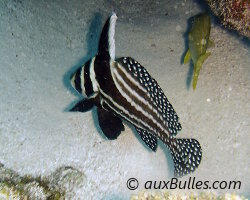
The high-hat (Pareques acuminatus) is a small tropical fish found in the western Atlantic Ocean. Its light-colored body is crossed by several broad dark bands alternating with narrower bands.
It is mainly active at night and stays sheltered during the day, particularly under rocks and overhangs.
Taxonomy
English names
High-hat
French namesDragonnet
Spanish namesObispo
Scientific namePareques acuminatus (Bloch & Schneider, 1801)
FamilySciaenidae
OrderPerciformes
ClassActinopterygii
Description
The high-hat has a short, deep, laterally compressed body. Its back is strongly arched and its head is low. Its body has 3 to 5 broad dark longitudinal bands separated by white bands.

The high-hat (Pareques acuminatus)
Its fins are dark, and the tip of its first dorsal fin is edged with a thin white band. Its small mouth is directed downward.
The high-hat averages around 7 inches in length but can reach up to 9 inches.
Geographic range
The high-hat inhabits tropical waters of the western Atlantic Ocean, from Virginia and the Gulf of Mexico to Cuba, Puerto Rico, and Colombia. It is notably found in the waters of Florida and the Caribbean Sea, around the Bahamas and the Virgin Islands.
Habitat
The high-hat inhabits coral reefs and coastal bays with bottoms offering plenty of shelter. During the day, it takes refuge among rocks, under overhangs, and in crevices. Juveniles can gather in very shallow water, near reef crevices and sandy bottoms.
Diet
The high-hat mainly hunts at night over sandy, muddy, or rubble-covered bottoms. It feeds on crustaceans, marine worms, small bony fish, and zooplankton.
Reproduction
The high-hat is an oviparous species, but its reproduction remains poorly known.
Did you know ?
The high-hat is listed as many other marine species within The IUCN Red List of threatened species. The high-hat appears in the IUCN Red List since 2020 within the category Least Concern !
Tips for observing
Young high-hats can gather in small groups of a few individuals of the same age in very shallow water, under rocky ledges or near sandy areas close to the reef.
Within the same family

Discover also



Our latestUpdates
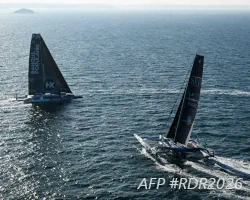
Major movesThe 2026 Route du Rhum enters a decisive phase as Tom Laperche extends his lead in the Ultim class, Armel Le Cléac'h capsizes, and Class40 skippers prepare to face a powerful weather front.Read more

A tough startThe 2026 Route du Rhum gets off to an intense start, with major technical failures, Francis Joyon's capsize, impressive speeds and strategic route choices near the Azores. A look back at the first 48 hours of racing.Read more
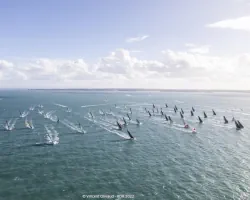
A smooth start, an uncertain AtlanticDiscover the 2026 Route du Rhum start off Saint-Malo, where favorable initial conditions contrast with an uncertain Atlantic crossing shaped by changing winds and weather.Read more
Photo of the Day

Méduse pélagique
(Pelagia noctiluca)
(Pelagia noctiluca)
 Copyright © 2007-2026 auxBulles.com - All rights reserved. Legal notices.
Photo credits - Our partners