

Sealife guideEchinoids: from sea urchins to amazing shapesEchinoderms
Last updated on 08/11/2026 at 10:23 PM
The echinoids are, along with sea stars, one of the best-known groups of echinoderms among the general public. Although the scientific term echinoids is rarely used, it actually refers to familiar marine animals found along many coastlines: sea urchins. These marine animals with rounded bodies, protected by a rigid shell covered with spines, play an important role in marine ecosystems.
Classification
- Phylum: Echinoderms
- Class:
- Common name: Echinoid, Sea urchin
- Scientific name: Echinoidea
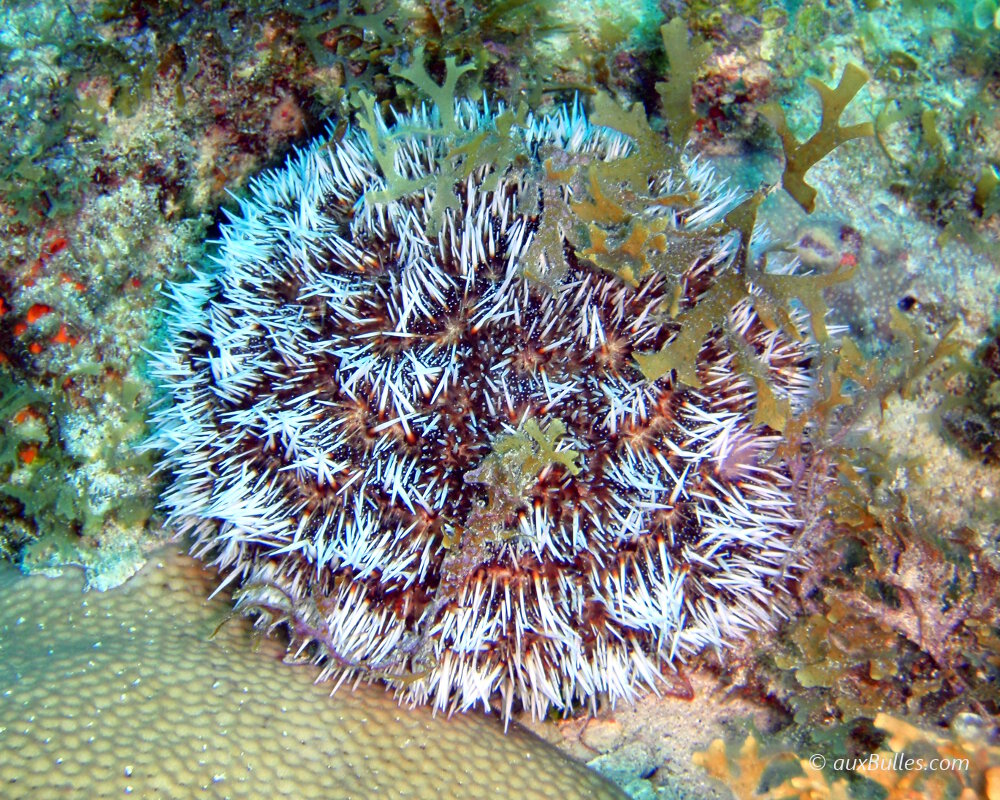
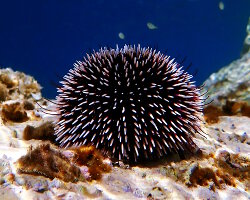
The white sea urchin, a representative of the echinoderm phylum
Description
The sea urchin's skeleton is made up of numerous rigid calcareous plates joined together. This protective structure, called the test, forms a true armor around the animal while retaining a certain flexibility, which is essential for movement and feeding.
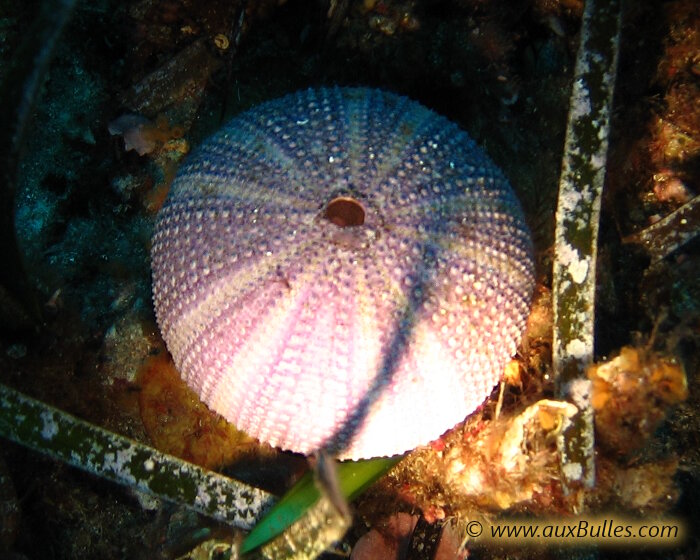
The calcareous covering of the sea urchin, called the test, is made up of adjoining calcareous plates and protects the animal
Contrary to appearances, the sea urchin does not have a true shell. Its test is an internal structure covered by a thin layer of living tissue on which movable spines are attached. These spines play an essential role in protection against predators, but also contribute to movement and help the animal remain attached to the seabed.
The body of sea urchins displays the characteristic organization of echinoderms, with a radial symmetry generally based on five axes. Between the spines are numerous small appendages called pedicellariae, which help clean the test, defend the animal and sometimes capture small food particles.
Sea urchins also possess a unique water vascular system made up of thousands of small tube feet. These flexible structures, operated by an internal hydraulic system called the water vascular system, allow them to move slowly, attach themselves to rocks and sometimes manipulate objects in their environment.
Geographic range
Sea urchins are found in all seas and oceans around the world, from tropical regions to polar areas, and live across almost all latitudes. Their distribution is mainly influenced by water temperature, food availability and the characteristics of their environment.
Habitat
Sea urchins inhabit a wide variety of marine environments, from shallow coastal areas to the deep sea, with some species living at depths of several miles. They are mainly found on rocky seabeds, coral reefs, seagrass beds and sandy areas, environments that provide both food resources and shelter from predators.
Diet
Most sea urchins are herbivores that feed mainly on algae growing on rocks. Thanks to their complex feeding apparatus called Aristotle's lantern, they can scrape rocky surfaces to obtain their food.
Some species, however, have a more diverse diet and may also consume organic debris, sponges or small organisms living on the seabed. By grazing on algae covering rocks, sea urchins help maintain the balance of coastal ecosystems and influence the dynamics of rocky reefs.
Reproduction
Sea urchin reproduction is generally sexual. Males and females release their reproductive cells directly into the water, where fertilization takes place. After several planktonic larval stages, young sea urchins undergo metamorphosis and gradually settle on the seabed.
Did you know ?
Sea urchins play an essential role in many marine environments. By consuming algae that cover rocks, they help control underwater vegetation and contribute to maintaining the balance of coastal ecosystems.
They are also a food source for many predators, including certain fish, sea stars, crustaceans and marine mammals. Their presence or disappearance can therefore have significant consequences throughout the entire food web.
Nos fiches
Black sea urchin
(Arbacia lixula)
(Arbacia lixula)
Hatpin sea urchin
(Centrostephanus longispinus)
(Centrostephanus longispinus)
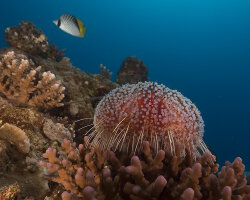
Red Sea fire sea urchin
(Asthenosoma marisrubri)
(Asthenosoma marisrubri)
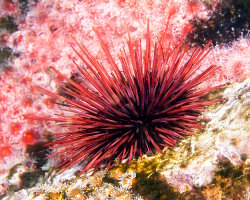
Red sea urchin
(Mesocentrotus franciscanus)
(Mesocentrotus franciscanus)
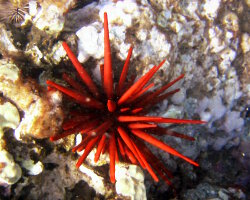
Slate pencil urchin
(Heterocentrotus mamillatus)
(Heterocentrotus mamillatus)
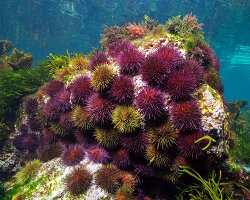
Stony sea urchin
(Paracentrotus lividus)
(Paracentrotus lividus)
Violet sea urchin
(Sphaerechinus granularis)
(Sphaerechinus granularis)
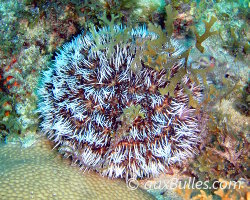
West Indian sea egg
(Tripneustes ventricosus)
(Tripneustes ventricosus)
Our latestUpdates
Morrocoy National ParkDiscover Morrocoy National Park in Venezuela, with white-sand beaches, turquoise waters, coral reefs, mangroves, scenic cayos, and remarkable marine biodiversity.Read more
Milos IslandDiscover Milos Island in the Cyclades, known for its volcanic landscapes, crystal-clear beaches, traditional villages, and the famous Venus de Milo.Read more
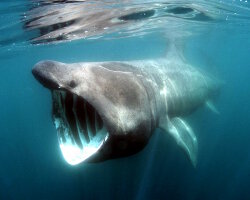
The basking sharkDiscover the basking shark (Cetorhinus maximus), the world's second-largest fish. This huge shark feeds on plankton by filtering large amounts of water.Read more
Photo of the Day

Poisson papillon à bandes cuivrées
(Chelmon rostratus)
(Chelmon rostratus)
 Copyright © 2007-2026 auxBulles.com - All rights reserved. Legal notices.
Photo credits - Our partners