

Sealife guideThe basking sharkCetorhinus maximus
Last updated on 09/25/2026 at 07:10 PM
The basking shark (Cetorhinus maximus) is one of the largest sharks in the world. Despite its impressive size, it is harmless to humans and feeds on tiny organisms found in the water. It swims slowly with its mouth wide open to filter the water and retain its food.
This ocean giant primarily lives in temperate waters and undertakes long migrations to follow areas rich in food. It can sometimes be observed near the surface, where its large dorsal fin makes it easy to recognize.
Taxonomy
English names
Basking shark
French namesRequin pèlerin
Scientific nameCetorhinus maximus (Gunnerus, 1765)
FamilyLamnidae
OrderLamniformes
ClassElasmobranchii
Description
The basking shark has a large, elongated body, generally gray to grayish brown on the back and lighter on the underside. Its most remarkable feature is its enormous mouth, which can open very wide when feeding. Its gill slits are also enormous and almost completely encircle the rear of its head.

The basking shark (Cetorhinus maximus)
It has a pointed snout, long pectoral fins, and a large crescent-shaped caudal fin. It can exceed 33 feet in length and is one of the largest known fish, second only to the whale shark. Its teeth are very small and play a very limited role in feeding, which relies primarily on filtering plankton from the water.
Geographic range
The basking shark primarily inhabits the cold to temperate waters of the North Atlantic, around the coasts of Europe and North America, as well as several temperate regions of the Southern Hemisphere.
The basking shark sometimes travels several thousand miles during its migrations. Its presence therefore varies with the seasons, as it moves to areas where plankton is most abundant.
The basking shark can be observed in several regions of Europe, particularly off Ireland, France, Spain, and Portugal. The United Kingdom is one of the best destinations for observing it, especially from late spring through summer, when plankton-rich waters attract these large sharks close to shore. They are regularly reported around Cornwall, Devon, the Isle of Man, and along the west coast of Scotland. The Isles of Scilly, southwest of Cornwall, are also an area where basking sharks can be observed during their migration.
Habitat
The basking shark inhabits coastal waters and offshore areas, particularly above the continental shelf. It can approach the coast and enter bays, but it is also capable of traveling long distances in the open ocean.
During periods when plankton is abundant, it is often observed near the surface, where it swims slowly with its mouth open to feed. It can also dive deeper when plankton is less abundant near the surface.
Diet
The basking shark feeds primarily on plankton, particularly small crustaceans such as copepods. When it finds an area rich in food, it swims slowly with its mouth wide open. Water enters its mouth and passes over its gills, where small filtering structures retain the organisms it feeds on before allowing the water to flow back out.
Reproduction
The basking shark is an aplacental viviparous species, but its reproduction remains poorly understood to this day.
Did you know ?
The basking shark is the second-largest fish in the world after the whale shark. Despite its enormous size, it feeds on tiny organisms that it captures by filtering large quantities of water.

The basking shark (Cetorhinus maximus) © Simon Burt | Dreamstime.com
The basking shark can undertake migrations of several thousand miles. Movements of more than 5,600 miles have been recorded, making it one of the ocean's great travelers.
The basking shark is listed as many other marine species within The IUCN Red List of threatened species. The basking shark appears in the IUCN Red List since 2021 within the category Endangered !
Within the same family
Discover also



Our latestUpdates
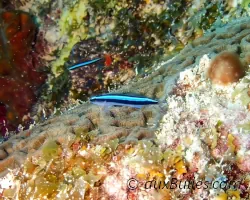
The neon gobyDiscover the neon goby (Elacatinus oceanops), a small western Atlantic reef fish known for its brilliant blue stripe and its role as a cleaner fish that removes parasites from other fish.Read more

The poison gobyDiscover the poison goby (Gobiodon citrinus), a tiny reef fish with a bright yellow body and distinctive blue markings. It lives among branching Acropora corals in the tropical waters of the Indo-Pacific.Read more
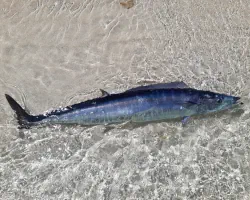
The wahooDiscover the wahoo (Acanthocybium solandri), a powerful pelagic predator found in tropical and subtropical oceans. Recognizable by its streamlined body and distinctive blue vertical stripes, it is a fast swimmer that feeds mainly on fish and squid.Read more
Photo of the Day
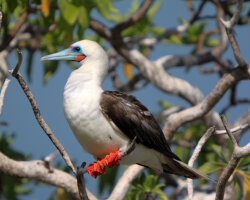
Fou à pieds rouges
(Sula sula)
(Sula sula)
 Copyright © 2007-2026 auxBulles.com - All rights reserved. Legal notices.
Photo credits - Our partners