

Sealife guideThe purple sun starSolaster endeca
Last updated on 08/12/2026 at 10:34 PM
Taxonomy
English names
Purple sun starSmooth sun starNorthern sun star
French namesEtoile de mer soleil pourpreSoleil de mer pourpre
Scientific nameSolaster endeca (Linnaeus, 1771)
FamilySolasteridae
OrderValvatida
ClassAsteroidea
Description
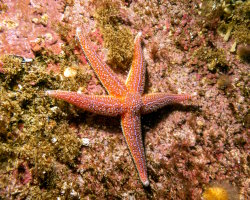
The purple sun star, more simply known as the purple sun star, is a large sea star easily recognized by its high number of arms. Unlike most sea stars, which have five arms, this species usually has 9 to 11, although the number can vary from 7 to 15.
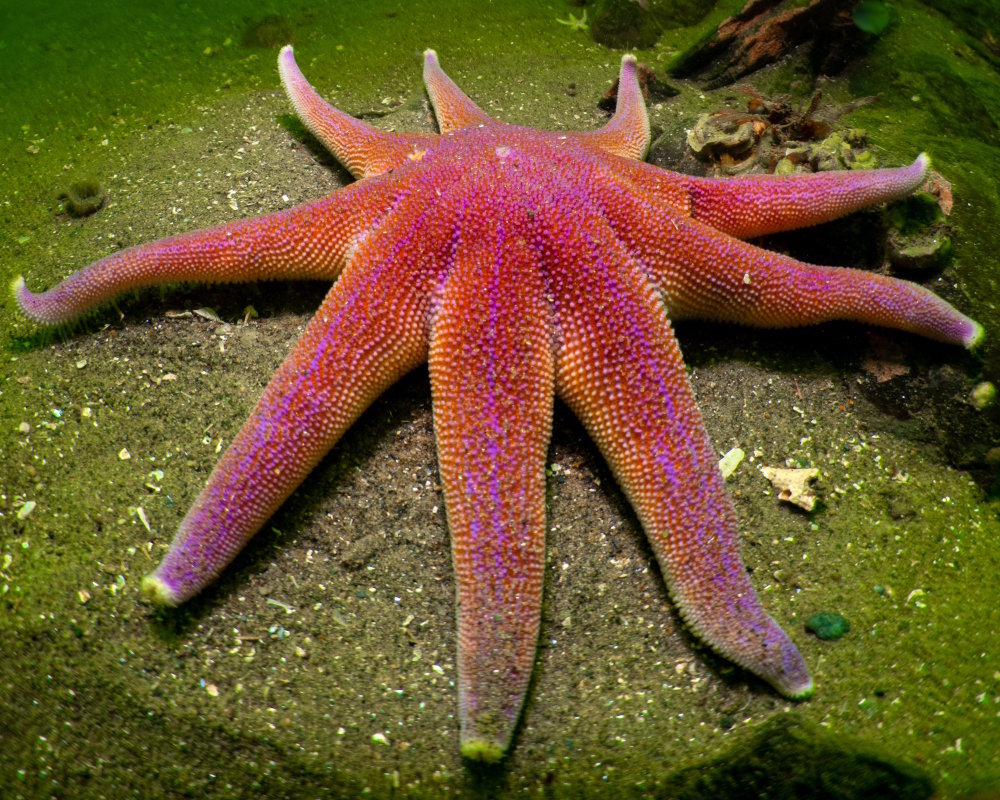
A purple sun star (Solaster endeca) resting on a sandy bottom in Loch Leven, near Glencoe, Scotland © Mark Kirkland | Dreamstime.com
Its body can reach about 16 inches in diameter. Its arms are relatively long, slender, and similar in length, giving the animal a silhouette reminiscent of the rays of the sun. Its upper surface is smooth to finely granular, and its coloration ranges from purple or mauve to yellow-orange, sometimes with reddish hues.
Geographic range
The purple sun star is found in the cold waters of the Northern Hemisphere. It occurs in the North Atlantic, from the Arctic regions and the coast of Greenland to the eastern coast of North America, where its range extends as far south as Cape Cod, Massachusetts.
In Europe, the purple sun star is found notably in Scandinavia, Denmark, the North Sea, and along the coasts of Great Britain and Ireland.
Habitat
The purple sun star prefers cold waters and lives on the seafloor, particularly on rocky and gravelly substrates. It can also inhabit bottoms made up of small pebbles, muddy sand, or mud in deeper areas.
The purple sun star is generally found at depths ranging from about 33 to 330 feet, but it can descend much deeper, reaching depths of around 1,640 feet.
Diet
The purple sun star feeds primarily on other animals living on the seafloor. In the North Atlantic, it is known to prey on other sea stars, sometimes ones nearly as large as itself, as well as bivalve mollusks. It can also consume sea cucumbers and nudibranchs.
Reproduction
The purple sun star reproduces sexually, with separate male and female individuals. The breeding season occurs in spring, with spawning taking place in March and April in some regions. Females release their eggs into the water, where they are fertilized by sperm released by males. The eggs then develop into larvae that live temporarily in the plankton before undergoing metamorphosis and settling on the seafloor.
This sea star also has a remarkable ability to regenerate and, under certain circumstances, can reproduce asexually by splitting its body.
Discover also


The marine species in the North Atlantic



Our latestUpdates
The neon gobyDiscover the neon goby (Elacatinus oceanops), a small western Atlantic reef fish known for its brilliant blue stripe and its role as a cleaner fish that removes parasites from other fish.Read more

The poison gobyDiscover the poison goby (Gobiodon citrinus), a tiny reef fish with a bright yellow body and distinctive blue markings. It lives among branching Acropora corals in the tropical waters of the Indo-Pacific.Read more
The wahooDiscover the wahoo (Acanthocybium solandri), a powerful pelagic predator found in tropical and subtropical oceans. Recognizable by its streamlined body and distinctive blue vertical stripes, it is a fast swimmer that feeds mainly on fish and squid.Read more
Photo of the Day
Fou à pieds rouges
(Sula sula)
(Sula sula)
 Copyright © 2007-2026 auxBulles.com - All rights reserved. Legal notices.
Photo credits - Our partners