

Sealife guideThe common cuttlefishSepia officinalis
Last updated on 08/24/2026 at 10:41 PM
The common cuttlefish (Sepia officinalis) is a well-known mollusk along European coasts, but its biology is far more fascinating than it may seem. Closely related to squid and octopuses, it has a remarkable ability to rapidly change the color and patterns of its skin to communicate, camouflage itself, or escape predators. It lives mainly on the seafloor and spends much of its life close to the substrate, where its body shape and camouflage abilities allow it to blend almost completely into its surroundings.
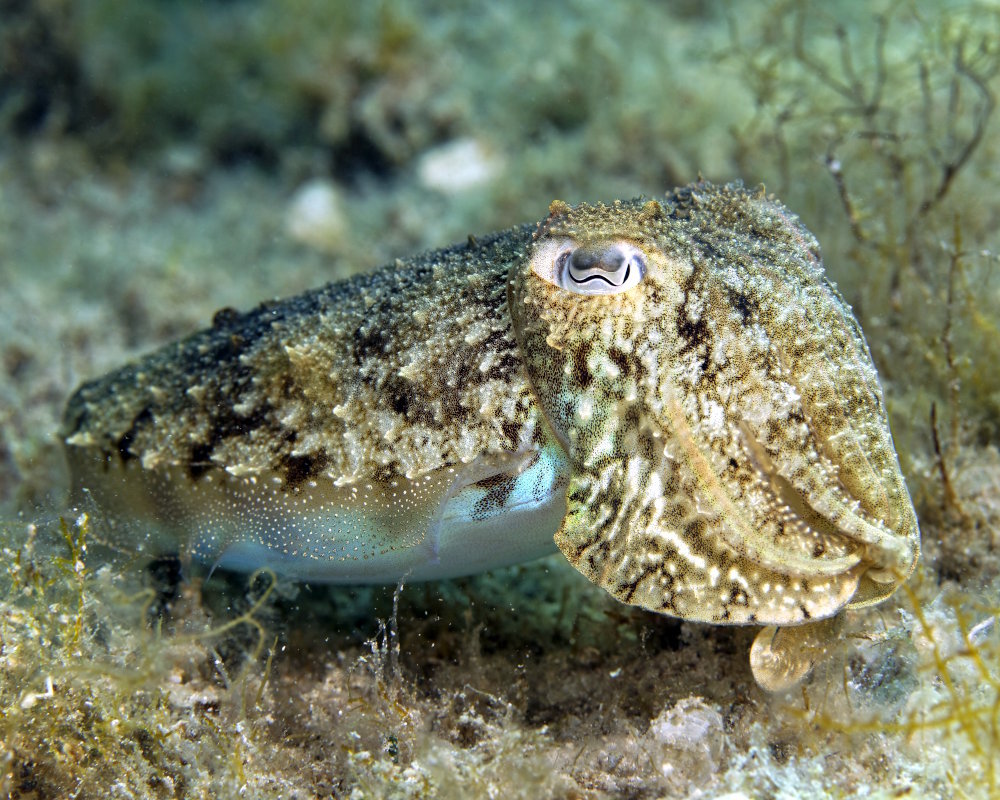
The common cuttlefish (Sepia officinalis) © Goran Šafarek | Dreamstime.com
Taxonomy
English names
Common cuttlefish
French namesSeiche commune
Spanish namesSepia común
Scientific nameSepia officinalis (Linnaeus, 1758)
FamilySepiidae
OrderSepiida
ClassCephalopoda
Description
The common cuttlefish has a flattened, oval-shaped body surrounded by a broad fin that forms a continuous border around the mantle. Its mantle can reach up to 18 inches in length in the largest specimens. Inside its body is a cuttlebone, an internal calcareous structure that helps with buoyancy and is the famous white « bone » found on beaches or given to pet birds. Its head bears two large, highly developed eyes, eight arms lined with suckers, and two long tentacles specialized for capturing prey.
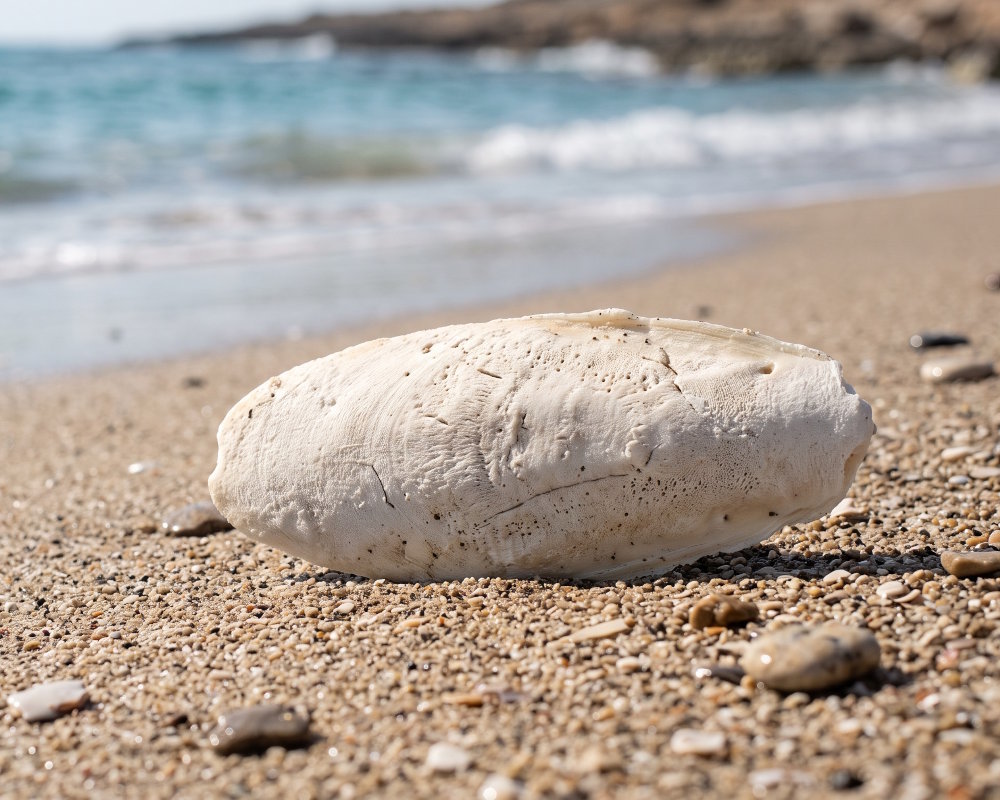
A cuttlebone lying on the sand of a beach
The common cuttlefish's coloration is extremely variable and can change within seconds thanks to pigment cells and other specialized structures in the skin. It can alter the color and patterns of its body to closely match the appearance of the seafloor where it is resting. When threatened, it can also release a cloud of ink that disrupts its attacker's vision and allows it to escape. In males, one of the arms is modified into a hectocotylus, an organ used to transfer spermatophores to the female during mating.
Geographic range
The common cuttlefish occurs in the eastern Atlantic Ocean, from the waters of northern Europe to the coasts of West Africa. Its range includes the North Sea and European Atlantic coasts, then extends southward along the African coast. It is also widespread throughout the Mediterranean Sea, including both the western and eastern basins.
The common cuttlefish also undertakes seasonal migrations during its life cycle. In several regions, adults move closer to shore in spring and summer, which coincides with the breeding season, before returning to deeper areas of the continental shelf during the colder months.
Habitat
The common cuttlefish is a benthic and demersal species, meaning that it lives mainly close to the seafloor rather than in the open water. It is most commonly found on sandy, muddy, or sandy-muddy bottoms of the continental shelf. It generally occurs from very shallow waters down to about 330 feet, but it can also be observed at depths of up to 660 feet. Adults may move into deeper areas outside the breeding season.
Coastal seafloors also play an essential role during spawning. As the breeding season approaches, cuttlefish move into shallower waters where females seek out surfaces to which they can attach their eggs. These may be attached to algae, seagrass beds, tube worms, or other structures found on the seafloor. In some regions, spawning takes place only a few feet below the surface, while eggs are rarely deposited deeper than 100 to 130 feet.
Diet
The common cuttlefish is an opportunistic predator that adapts its diet to the prey available in its environment. Its two long tentacles can be rapidly projected to seize prey before bringing it back toward the arms surrounding the mouth. It feeds on crustaceans, small fish, cephalopods, and polychaete worms. Young individuals also consume small prey appropriate to their size and rapidly develop their hunting abilities after hatching.
Hunting relies largely on a combination of vision, camouflage, and a rapid strike. A cuttlefish resting motionless on the seafloor can alter the colors and patterns of its skin to camouflage itself in its surroundings until it becomes almost invisible to its prey, before suddenly capturing them by surprise when they pass nearby. Its tentacles are particularly effective at seizing mobile animals, while its arms and suckers then hold the prey close to the mouth.
Reproduction
Reproduction in the common cuttlefish is particularly spectacular in spring and early summer. Males use their hectocotylus to deposit spermatophores near the female's mouth. A female may mate with several males and retain sperm from different partners. Seasonal migrations toward coastal waters allow adults to gather in areas suitable for reproduction.
After fertilization, the female attaches her eggs one by one to various surfaces on the seafloor. The black eggs, often grouped in clusters resembling grapes, are protected by a coating that has been covered with ink by the female. Embryonic development depends strongly on water temperature and can last from several weeks to several months. At hatching, young cuttlefish are only a few millimeters long but already resemble adults and are capable of feeding. The species has a relatively short lifespan, generally around one to two years, and adults die after reproduction.
Did you know ?
The common cuttlefish is listed as many other marine species within The IUCN Red List of threatened species. The common cuttlefish appears in the IUCN Red List since 2012 within the category Least Concern !
Within the same genus

Within the same family
Discover also




The marine species

Our latestUpdates
The neon gobyDiscover the neon goby (Elacatinus oceanops), a small western Atlantic reef fish known for its brilliant blue stripe and its role as a cleaner fish that removes parasites from other fish.Read more

The poison gobyDiscover the poison goby (Gobiodon citrinus), a tiny reef fish with a bright yellow body and distinctive blue markings. It lives among branching Acropora corals in the tropical waters of the Indo-Pacific.Read more
The wahooDiscover the wahoo (Acanthocybium solandri), a powerful pelagic predator found in tropical and subtropical oceans. Recognizable by its streamlined body and distinctive blue vertical stripes, it is a fast swimmer that feeds mainly on fish and squid.Read more
Photo of the Day
Fou à pieds rouges
(Sula sula)
(Sula sula)
 Copyright © 2007-2026 auxBulles.com - All rights reserved. Legal notices.
Photo credits - Our partners