

Sealife guideThe giant rock scallopCrassadoma gigantea
Last updated on 09/10/2026 at 10:35 PM
The giant rock scallop is a large bivalve that lives along the Pacific coast of North America. Unlike most scallops, it permanently attaches itself to rocky substrates as an adult and can reach a remarkable size.
The giant rock scallop can be recognized by its thick, strongly ribbed shell, often covered with marine organisms, as well as by the characteristic purple coloration of its hinge. The species nevertheless begins its life in a very different form, with larvae and then young individuals that are capable of moving before becoming permanently attached.
Taxonomy
English names
Giant rock scallopPurple hinged rock scallop
French namesPétoncle des rochesPeigne des roches géantHinnite géant
Scientific nameCrassadoma gigantea (J. E. Gray, 1825)
FamilyPectinidae
OrderPectinida
ClassBivalvia
Description
The giant rock scallop has a thick, robust shell made up of two asymmetrical valves with numerous prominent radial ribs. These ribs may bear short spines, and the shell surface is often colonized by sponges, algae, and other marine organisms. The hinge has a characteristic purple coloration, particularly visible when the valves are open.
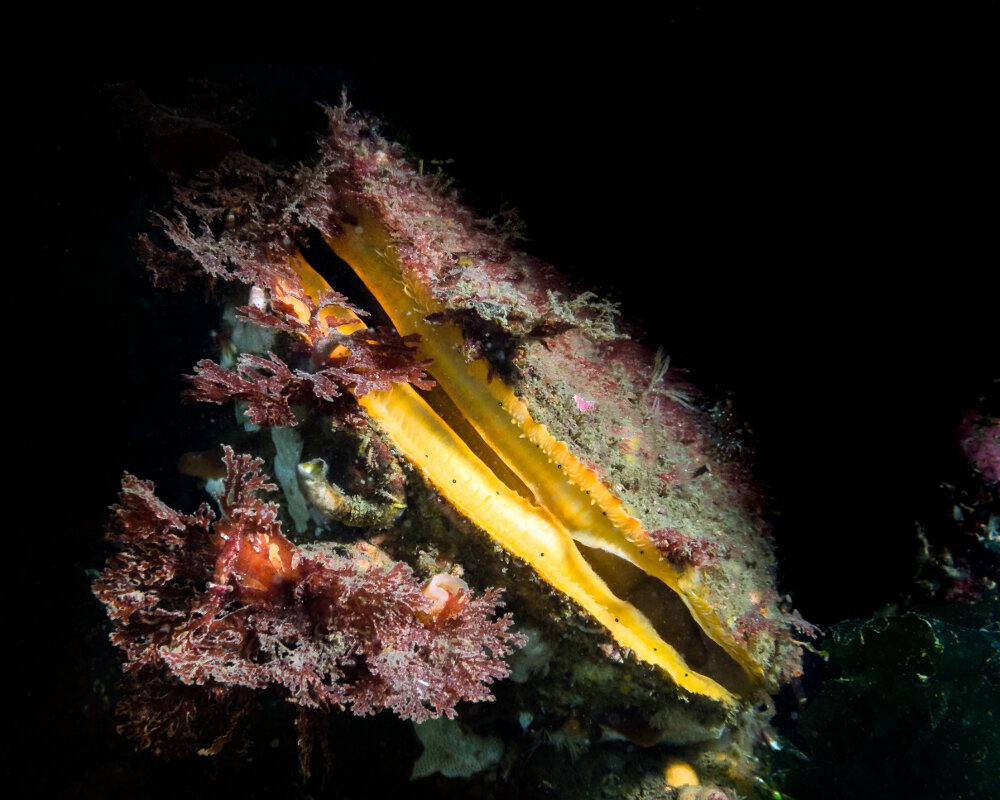
A giant rock scallop partially open to filter seawater, its shell colonized by algae © Derek Holzapfel | Dreamstime.com
The giant rock scallop's shell can reach up to 9.8 inches in height in the largest individuals. When the valves are open, the fleshy mantle visible around the edge bears numerous small light-sensitive organs that help detect changes in light levels and movements around the animal.
In adults, one valve is firmly attached to the rocky substrate, giving the shell an irregular shape adapted to its support. This characteristic explains its former scientific name Hinnites giganteus, which is still found in some older publications.
Geographic range
The giant rock scallop inhabits the temperate and cold waters of the northeastern Pacific along the western coast of North America, from Mexico to Alaska, particularly along the coasts of California, Washington State, British Columbia, and as far north as Unalaska Island.
Its distribution is not continuous, however. Populations may be locally scattered, and the species generally occurs at relatively low densities, partly because of its lifestyle attached to rocky substrates.
Habitat
The giant rock scallop is found primarily on rocky substrates exposed to sometimes strong currents. It occurs from the lower intertidal zone to several tens of meters in depth, generally in areas where hard bottoms provide surfaces to which it can attach.
Once attached, the adult generally remains in the same place for much of its life. Its shell can gradually become covered with sponges, algae, and other organisms that help camouflage it and can sometimes make the animal difficult to distinguish from its surroundings.
Young individuals, however, have a very different lifestyle. After their larval development in the water column, they settle on the seafloor and may still move temporarily before permanently attaching themselves to a hard substrate.
Diet
The giant rock scallop is an active filter feeder that circulates water through its gills using the movements of numerous cilia. As water passes through, suspended food particles are trapped by the gills, including phytoplankton and other microscopic organisms, and are then directed toward the mouth by a system of cilia and mucus.
This feeding method allows the giant rock scallop to obtain food without leaving the substrate to which it is attached.
Reproduction
The giant rock scallop generally has separate sexes, with male and female individuals, and fertilization is external. Reproduction can extend over several months depending on the region, with spawning periods observed particularly in spring and summer in British Columbia and at different times of the year farther south.
After fertilization, the eggs develop into larvae that live freely in the water column. They gradually develop while swimming and feeding in the water before undergoing metamorphosis and settling on the seafloor. The young scallops can then still move temporarily before permanently attaching themselves to a rocky substrate.
The giant rock scallop grows relatively quickly during its first few years, but growth slows considerably with age.
Did you know ?
The giant rock scallop begins its life as a swimming larva before becoming a bivalve attached to a rock. Young individuals can even retain some ability to move temporarily before permanently cementing their shell to a hard substrate.
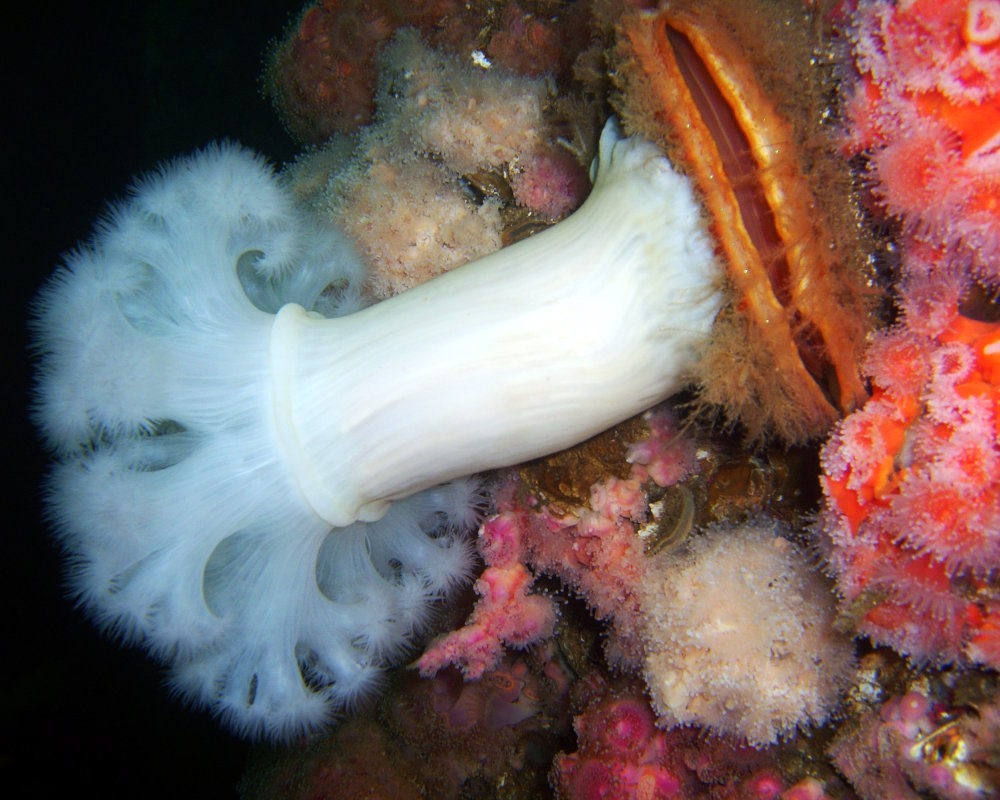
A giant white plumose anemone attached to a giant rock scallop (Crassadoma gigantea), surrounded by anemones at a depth of 120 feet on the Grace oil rig off the central California coast © Deeann Cranston | Dreamstime.com
Despite its permanently attached lifestyle as an adult, the giant rock scallop belongs to the scallop family, which includes several species capable of swimming by rapidly opening and closing their valves. In the giant rock scallop, this ability disappears once the adult becomes permanently attached.
Within the same family
Discover also



Our latestUpdates
The neon gobyDiscover the neon goby (Elacatinus oceanops), a small western Atlantic reef fish known for its brilliant blue stripe and its role as a cleaner fish that removes parasites from other fish.Read more

The poison gobyDiscover the poison goby (Gobiodon citrinus), a tiny reef fish with a bright yellow body and distinctive blue markings. It lives among branching Acropora corals in the tropical waters of the Indo-Pacific.Read more
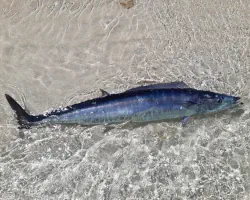
The wahooDiscover the wahoo (Acanthocybium solandri), a powerful pelagic predator found in tropical and subtropical oceans. Recognizable by its streamlined body and distinctive blue vertical stripes, it is a fast swimmer that feeds mainly on fish and squid.Read more
Photo of the Day
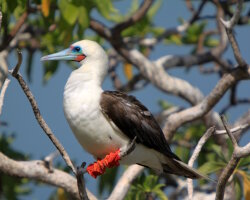
Fou à pieds rouges
(Sula sula)
(Sula sula)
 Copyright © 2007-2026 auxBulles.com - All rights reserved. Legal notices.
Photo credits - Our partners