Sealife guideThe reef manta rayMobula alfredi
Last updated on 08/14/2026 at 10:56 PM
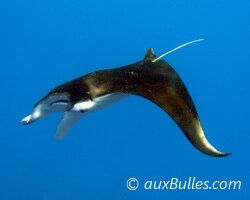
The reef manta ray (Mobula alfredi), also known as Prince Alfred's ray, named after Prince Alfred, is one of the largest rays in the world. Despite its impressive size, it is completely harmless to humans and feeds by filtering seawater to capture the tiny organisms that make up plankton. It mainly inhabits tropical and subtropical waters near coasts, islands, and reefs.
Taxonomy
English names
Reef manta ray
French namesRaie manta de récif
Spanish namesChino mero
Scientific nameMobula alfredi (Krefft, 1868)
Description
The reef manta ray has a flattened, diamond-shaped body, with very broad pectoral fins that give it the appearance of large wings when swimming. Its head is broad, and its mouth, located at the front of the body, is accompanied by two cephalic fins that can unfold to direct water and plankton toward the mouth.
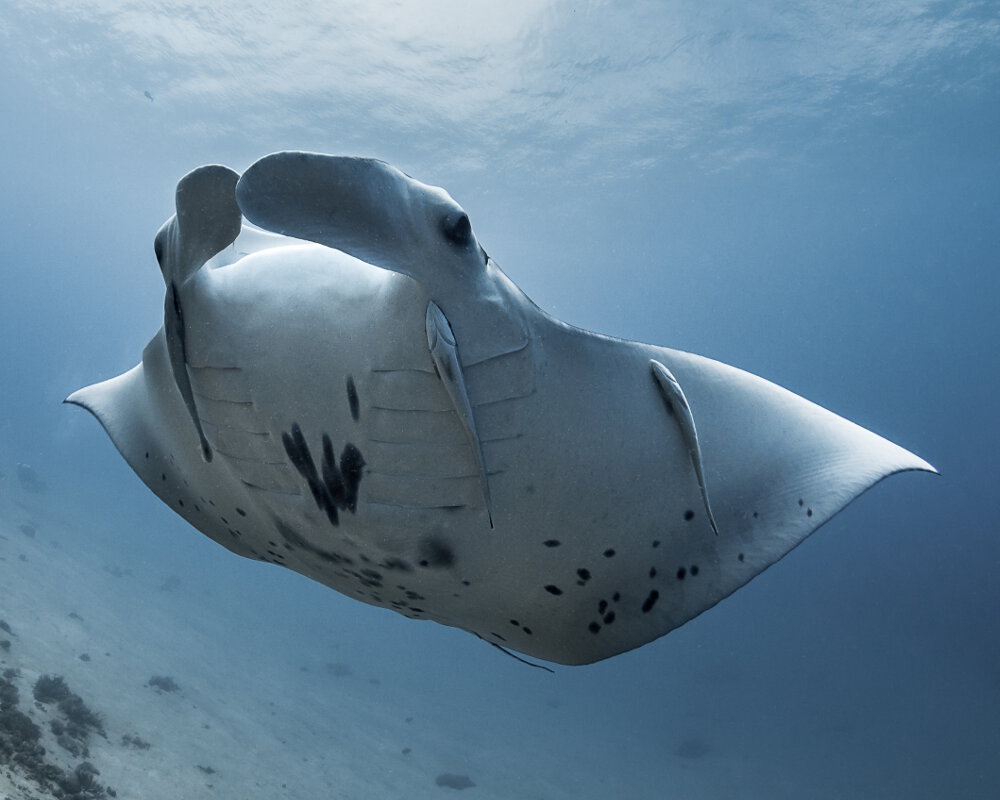
The light-colored underside of a reef manta ray, with its dark markings and two remoras attached beneath its body
© Diverstef | Dreamstime.comIts coloration varies among individuals, but the back is generally dark while the underside is lighter and features patterns that can be used to identify individual rays. The largest specimens can reach a wingspan of up to 15 feet, measured from the tip of one pectoral fin to the other.
Geographic range
The reef manta ray is found in tropical and subtropical waters of the Indo-Pacific. It occurs notably in the Red Sea, in the Indian Ocean around eastern Africa and Asia, as well as in the western and central Pacific, extending as far as
Australia, Japan, French Polynesia, and
Hawaii.
The species has also been reported in some regions of the tropical Atlantic, particularly around the
Canary islands and Cape Verde, but its main range remains associated with the Indo-Pacific.
Habitat
Unlike the
giant manta ray, which spends more time in the open ocean, the reef manta ray is particularly associated with coastal waters, coral and rocky reefs, lagoons, bays, and tropical islands.
The reef manta ray can be observed near the surface when feeding or visiting cleaning stations, where small fish remove parasites from its skin. It can nevertheless undertake significant movements and dive to depths exceeding 330 feet.
Diet
The reef manta ray is a filter feeder. It swims with its mouth wide open and uses its cephalic fins to channel food-rich water toward its mouth. The water then passes through the filtering structures of the gills, which retain the small prey while the water is expelled. Its diet consists mainly of zooplankton, particularly small
crustaceans such as
copepods, along with other planktonic organisms and, to a lesser extent, fish eggs. It generally frequents areas where currents and tides promote the concentration of large quantities of plankton, forming true « food soups ».
When food is particularly abundant, several manta rays may gather and use different techniques to efficiently exploit these concentrations of plankton. They may swim in circles, perform barrel rolls, or follow one another in a line to remain in areas where prey are most abundant. These aggregations are often associated with particular oceanographic conditions that favor the accumulation of plankton.
Reproduction
Reproduction in the reef manta ray is particularly slow. Mating may take place near reefs and cleaning stations. After mating, gestation lasts approximately one year. The female gives birth to only one pup, which is already well developed and capable of swimming from birth.
Did you know ?
The reef manta ray can perform spectacular leaps out of the water, sometimes launching almost its entire body above the surface. The reasons for these jumps remain difficult to determine with certainty, but they may play a role in communication or help the manta ray get rid of parasites
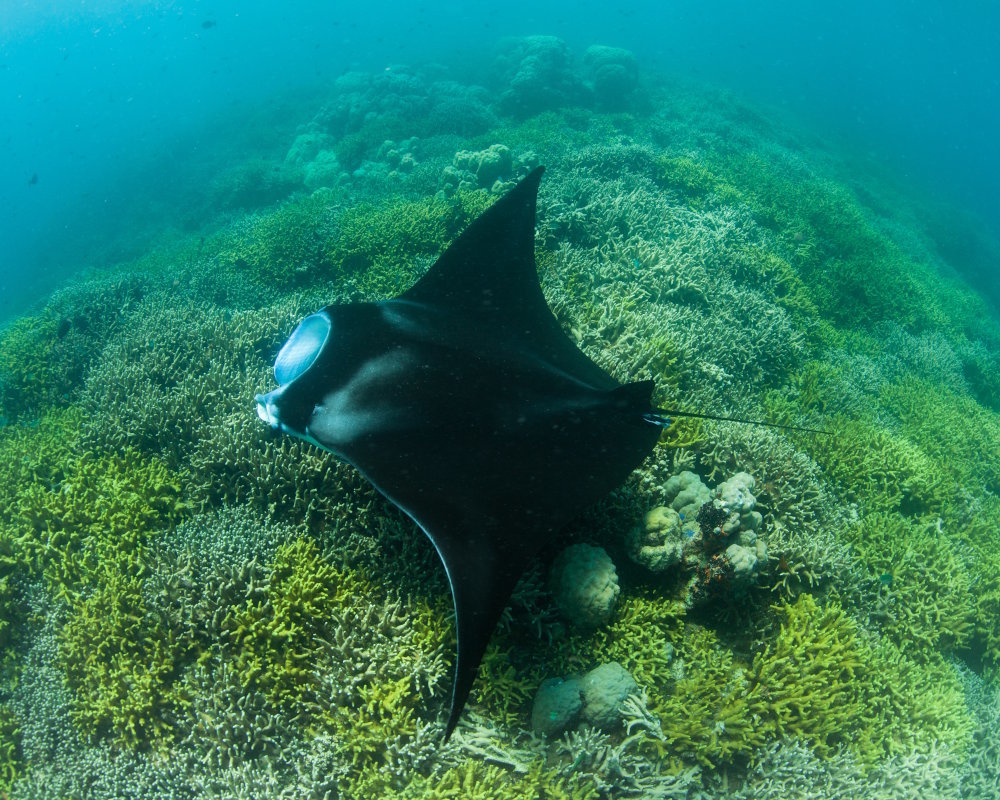
A reef manta ray (Mobula alfredi) swimming over a shallow cleaning station near Yap island in Micronesia
© Ethan Daniels | Dreamstime.comThe reef manta ray is listed as many other marine species within The
IUCN Red List of threatened species. The reef manta ray appears in the
IUCN Red List since 2022 within the category Vulnerable !
Within the same genus
Discover also
The marine species in the Indo-Pacific