

Sealife guideThe honeycomb cowfishAcanthostracion polygonium
Last updated on 11/12/2026 at 11:59 PM
The honeycomb cowfish (Acanthostracion polygonium) is a coral reef fish found in the tropical western Atlantic. It is distinguished by its angular body, protected by a bony carapace, and the hexagonal patterns covering its flanks. Four distinctive spines, two above the eyes and two near the anal fin, complete its unusual appearance.
Rather shy, it often shelters among corals and sea fans, where its coloration helps it remain inconspicuous. Its color ranges from yellow to green and blue, allowing it to blend into the reef environment.
Taxonomy
English names
Honeycomb cowfish
French namesPoisson-coffre nid d'abeillePoisson-coffre polygone
Spanish namesTorito hexagonal
Scientific nameAcanthostracion polygonium (Poey, 1876)
FamilyOstraciidae
OrderTetraodontiformes
ClassActinopterygii
Description
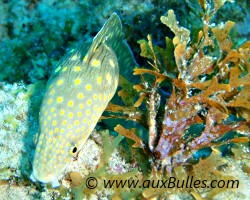
The honeycomb cowfish has a stocky, angular body entirely enclosed in a rigid shell made of fused bony plates. Their hexagonal outlines form a dark network bordered by lighter lines, resembling the cells of a honeycomb. Its coloration ranges from yellow to green and blue, while its cheeks display a reticulated pattern. Its head bears two horn-like spines above the eyes. Two additional backward-pointing spines are located near the anal fin. Its mouth is small, and its dorsal and anal fins are positioned toward the rear of the carapace.
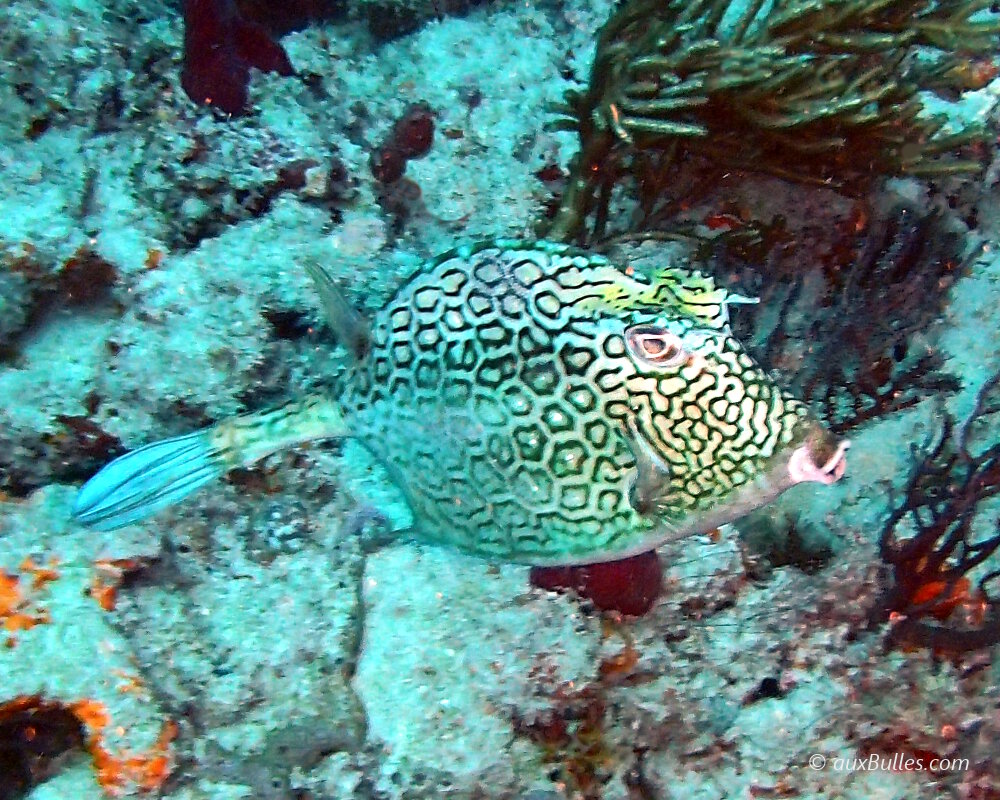
The honeycomb cowfish (Acanthostracion polygonium)
It typically measures around 10 inches in length, although the largest individuals can reach 20 inches. Juveniles are easily recognized by their orange coloration covered with small dark spots. They already possess the distinctive spines found in adults.
Geographic range
The honeycomb cowfish inhabits tropical and subtropical waters of the western Atlantic, ranging from New Jersey and Bermuda south to Brazil, including the coast of Florida. It is found in the Gulf of Mexico and the Caribbean Sea, particularly around the Bahamas, Puerto Rico, and the Lesser Antilles, including Guadeloupe and Martinique. It also occurs along the coasts of Central America and northern South America.
Habitat
The honeycomb cowfish mainly inhabits coral reefs and areas rich in soft corals. It also occurs around rocky bottoms and in estuaries, where it finds a variety of organisms to feed on.
It generally stays close to the seabed, at depths ranging from a few feet to more than 330 feet. Its coloration and honeycomb-like patterns help it camouflage itself among the corals and sponges found on the reefs.
Diet
The honeycomb cowfish feeds mainly on small invertebrates that it searches for on the seabed and among coral formations. Its diet includes sponges, soft corals, sea squirts, and crustaceans such as shrimp.
Reproduction
Honeycomb cowfish reproduce in open water, usually at dusk. During courtship, the male and female swim around each other, moving up and down before sometimes rising close to the surface. They release their eggs and sperm simultaneously, allowing fertilization to take place in the water. The fertilized eggs are then carried away by currents. After hatching, the larvae lead a pelagic life before settling on the reefs to continue their development.
Did you know ?
Juvenile honeycomb cowfish look like tiny dice ! Their almost cube-shaped bodies and yellowish-orange coloration, covered with dark red spots, give them a very different appearance from adults. Even at this early stage, they already have the small horns above their eyes that characterize the species.
Within the same genus
Within the same family

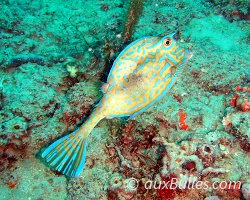
Reticulate boxfishOstracion solorensis
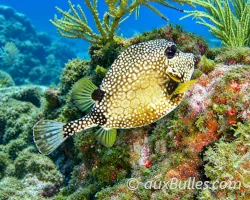
Smooth trunkfishRhinesomus triqueter

Spotted boxfishOstracion meleagris
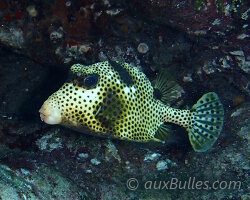
Spotted trunkfishLactophrys bicaudalis
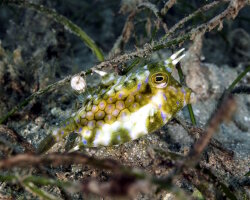
Thornback cowfishLactoria fornasini

Yellow boxfishOstracion cubicus
Discover also

Azure damselfishChrysiptera hemicyanea

Black breasted pipefishCorythoichthys nigripectus
California sheepheadBodianus pulcher

CrocodilefishCymbacephalus beauforti
Horse-eye jackCaranx latus
Longsnout seahorseHippocampus reidi

Malabar grouperEpinephelus malabaricus

Royal dottybackPictichromis paccagnellorum
The marine species in the Caribbean


Dive centers


Our latestUpdates

Miami, in the footsteps of Vice City and GTA VIDiscover Miami, the real-life inspiration behind GTA Vice City and GTA VI. Explore South Beach, Ocean Drive, Brickell, Wynwood, the Florida Keys, and the Everglades, from iconic landmarks and vibrant neighborhoods to tropical landscapes.Read more
The smooth trunkfishDiscover the smooth trunkfish (Rhinesomus triqueter), a reef-dwelling fish from the tropical western Atlantic. Its angular body, protected by a bony carapace, features a dark coloration with white spots and distinctive honeycomb patterns.Read more
A tense finish in the CaribbeanA look back at the 2026 Route du Rhum finish: Tom Laperche wins the Ultim class as the leading boats arrive and close battles continue across the other fleets.Read more
Photo of the Day
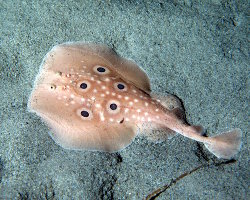
Raie torpille ocellée
(Torpedo torpedo)
(Torpedo torpedo)
 Copyright © 2007-2026 auxBulles.com - All rights reserved. Legal notices.
Photo credits - Our partners