

Sealife guideThe bar jackCaranx ruber
Last updated on 05/21/2026 at 11:14 PM
Taxonomy
English names
Bar jack
French namesCarangue comade
Spanish namesCojinuda carbonera
Scientific nameCaranx ruber (Bloch, 1793)
FamilyCarangidae
OrderCarangiformes
ClassActinopterygii
Description
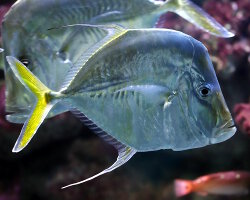
The bar jack has a fusiform, laterally compressed body perfectly adapted for fast swimming in open water and active hunting. As an adult, it generally measures around 20 inches in length but can reach a maximum size of 29 inches and a weight exceeding 17.5 lbs for the largest individuals.

The bar jack (Caranx ruber)
The bar jack is distinguished by its silvery coloration with a bluish stripe along its back as well as a characteristic black stripe extending to the lower tip of its caudal fin, making it easily identifiable in its natural environment.
Geographic range
The bar jack is mainly found in the tropical and subtropical waters of the western Atlantic ocean, from the coasts of Florida and the Gulf of Mexico to the Caribbean, particularly around Guadeloupe, and the northern coasts of South America.
Habitat
The bar jack inhabits a variety of coastal environments. It is mainly found around coral reefs, seagrass beds, lagoons, and shallow coastal waters, but it can also be observed in open water or near reef structures where it actively hunts.
Diet
The bar jack is an opportunistic predator that mainly feeds on small fish, crustaceans, and benthic organisms, which it captures thanks to its speed.

The bar jack (Caranx ruber)
Reproduction
The bar jack is an oviparous species. Eggs and larvae are planktonic and drift with ocean currents before juveniles move into shallow coastal areas where they find food and protection.
Growth is relatively rapid, and sexual maturity is reached after a few years, allowing the species to maintain stable populations despite fishing pressure in certain regions.
Did you know ?
The bar jack is listed as many other marine species within The IUCN Red List of threatened species. The bar jack appears in the IUCN Red List since 2015 within the category Least Concern !

The bar jack (Caranx ruber)
Within the same genus
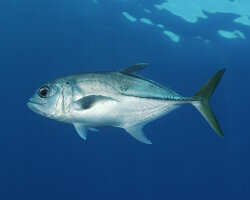
Bigeye trevallyCaranx sexfasciatus
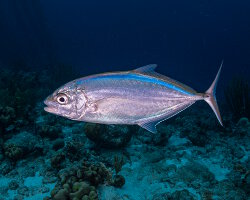
Blue runnerCaranx crysos

Bluefin trevallyCaranx melampygus
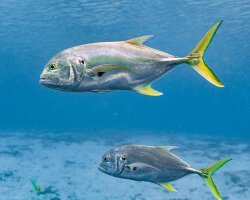
Crevalle jackCaranx hippos
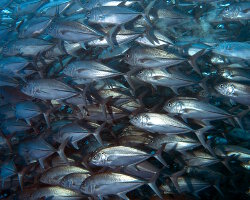
Giant trevallyCaranx ignobilis
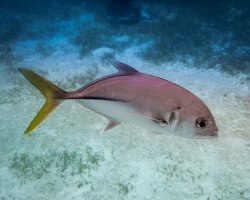
Horse-eye jackCaranx latus
Within the same family

African PompanoAlectis ciliaris

Black tail permit fishTrachinotus falcatus

Double-spotted queenfishScomberoides lysan
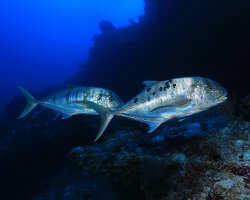
Golden trevallyGnathanodon speciosus

Indian threadfishAlectis indica

LeerfishLichia amia
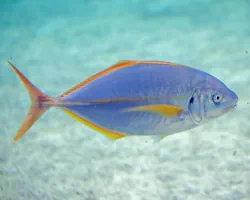
White trevallyPseudocaranx dentex
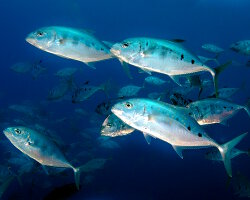
Yellowspotted trevallyTurrum fulvoguttatum
Discover also

Blackwedged butterflyfishChaetodon falcula
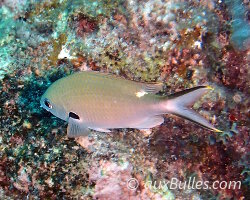
Brown chromisChromis multilineata

Green razorfishXyrichtys splendens

Parva gobyValenciennea parva

Polka dot batfishOgcocephalus radiatus
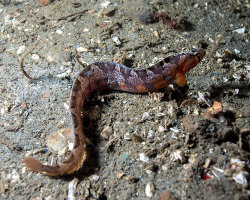
Saddleback gunnelPholis ornata

Spotband butterflyfishChaetodon punctatofasciatus

Whitecheek monocle breamScolopsis vosmeri
The marine species in the Western Atlantic


Our latestUpdates

Major movesThe 2026 Route du Rhum enters a decisive phase as Tom Laperche extends his lead in the Ultim class, Armel Le Cléac'h capsizes, and Class40 skippers prepare to face a powerful weather front.Read more

A tough startThe 2026 Route du Rhum gets off to an intense start, with major technical failures, Francis Joyon's capsize, impressive speeds and strategic route choices near the Azores. A look back at the first 48 hours of racing.Read more

A smooth start, an uncertain AtlanticDiscover the 2026 Route du Rhum start off Saint-Malo, where favorable initial conditions contrast with an uncertain Atlantic crossing shaped by changing winds and weather.Read more
Photo of the Day

Méduse pélagique
(Pelagia noctiluca)
(Pelagia noctiluca)
 Copyright © 2007-2026 auxBulles.com - All rights reserved. Legal notices.
Photo credits - Our partners