

Sealife guideThe golden crinoidDavidaster rubiginosus
Last updated on 08/10/2026 at 10:24 PM
Taxonomy
English names
Golden crinoidYellow feather star
French namesComatule dorée
Scientific nameDavidaster rubiginosus (Pourtalès, 1869)
FamilyComatulidae
OrderComatulida
ClassCrinoidea
Description
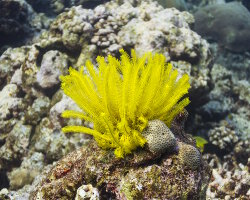
The golden crinoid may appear fragile with its long, slender arms spread out. Its arms, numbering in multiples of 5, resemble delicate « feathers » and measure around 8 inches in length.

The arms of the golden crinoid have a main central ridge and secondary branches called pinnules
The central area or main central ridge is most often black, while the secondary ridges or pinnules - to use the scientific term - display a splendid gradient from black to golden yellow toward the tips.
Held upright, its arms curl slightly at the tips into a crook-like shape.
Geographic range
The golden crinoid is found in the tropical waters of the western Atlantic ocean, from northern Florida to Brazil in the south, as well as in the Gulf of Mexico. The golden crinoid is a common species found on Caribbean sea reefs, around the Bahamas and throughout the many islands of the West Indies (Guadeloupe, …).
Habitat
The golden crinoid is found at depths ranging from about 33 to 131 feet. It takes advantage of the richness and diversity of reef structures, using its cirri - small appendages at the base of its body - to anchor itself in areas exposed to currents, making it easier to capture food.
Diet
With its arms spread out in areas exposed to currents, it captures plankton suspended in the water like « combs ». The food is then transported toward its mouth, located at the center of its body.
Reproduction
The golden crinoid is oviparous, meaning that the female lays eggs that are fertilized by the male. The eggs remain attached to the female's pinnules until the larvae hatch. The feather star regains its mobility after several months of a larval stage attached to the seabed.
Tips for observing
Unlike most feather stars, which are nocturnal, you may have the opportunity to observe the golden crinoid during the day ! The golden crinoid takes advantage of the inside of a sponge or crevices in the reef to hide, while extending its arms outside to feed !

Shaped like slender golden rods, the feather star's arms rise up in the current
Within the same family
Discover also


The marine species in the Western Atlantic



Our latestUpdates
The neon gobyDiscover the neon goby (Elacatinus oceanops), a small western Atlantic reef fish known for its brilliant blue stripe and its role as a cleaner fish that removes parasites from other fish.Read more

The poison gobyDiscover the poison goby (Gobiodon citrinus), a tiny reef fish with a bright yellow body and distinctive blue markings. It lives among branching Acropora corals in the tropical waters of the Indo-Pacific.Read more
The wahooDiscover the wahoo (Acanthocybium solandri), a powerful pelagic predator found in tropical and subtropical oceans. Recognizable by its streamlined body and distinctive blue vertical stripes, it is a fast swimmer that feeds mainly on fish and squid.Read more
Photo of the Day
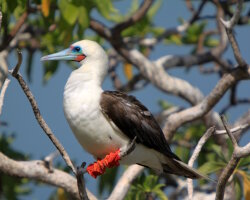
Fou à pieds rouges
(Sula sula)
(Sula sula)
 Copyright © 2007-2026 auxBulles.com - All rights reserved. Legal notices.
Photo credits - Our partners