

Sealife guideThe ridged cactus coralMycetophyllia lamarckiana
Last updated on 10/20/2026 at 12:24 AM
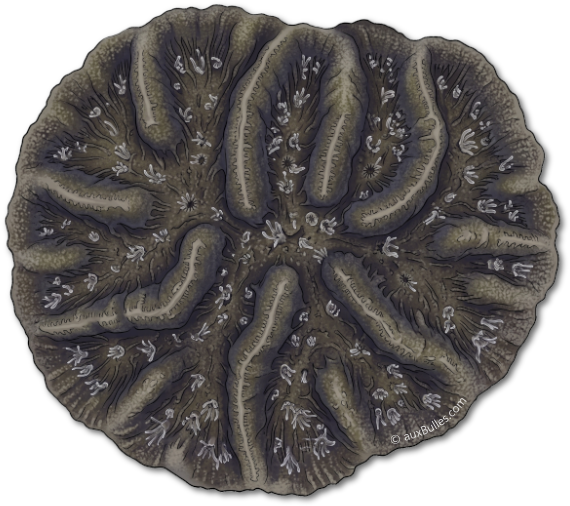
The ridged cactus coral (Mycetophyllia lamarckiana)
The ridged cactus coral (Mycetophyllia lamarckiana) is a stony coral found in the Caribbean, recognizable by its flattened colony covered with fleshy ridges and winding grooves. Its coloration is generally gray or brown, sometimes with pink and green hues. It lives on tropical reefs, where its polyps gradually secrete a limestone skeleton that contributes to reef formation.
Taxonomy
English names
Ridged cactus coralLarge cactus coral
French namesCorail cactus ridé
Scientific nameMycetophyllia lamarckiana (Milne Edwards & Haime, 1849)
FamilyFaviidae
OrderScleractinia
ClassAnthozoa
Description
The ridged cactus coral forms a rounded, flat or slightly domed colony that often reaches about 4 inches in diameter. Its surface is covered with broad, shallow grooves, sometimes more pronounced, radiating outward from the growth center. Each groove contains a row of small mouths surrounded by fleshy tissue, belonging to the polyps, the tiny animals that make up the coral. Irregular ridges separate the grooves, while the edges of the colony are often scalloped. Its coloration is generally mottled gray or brown, but it may also display shades of pink and green.
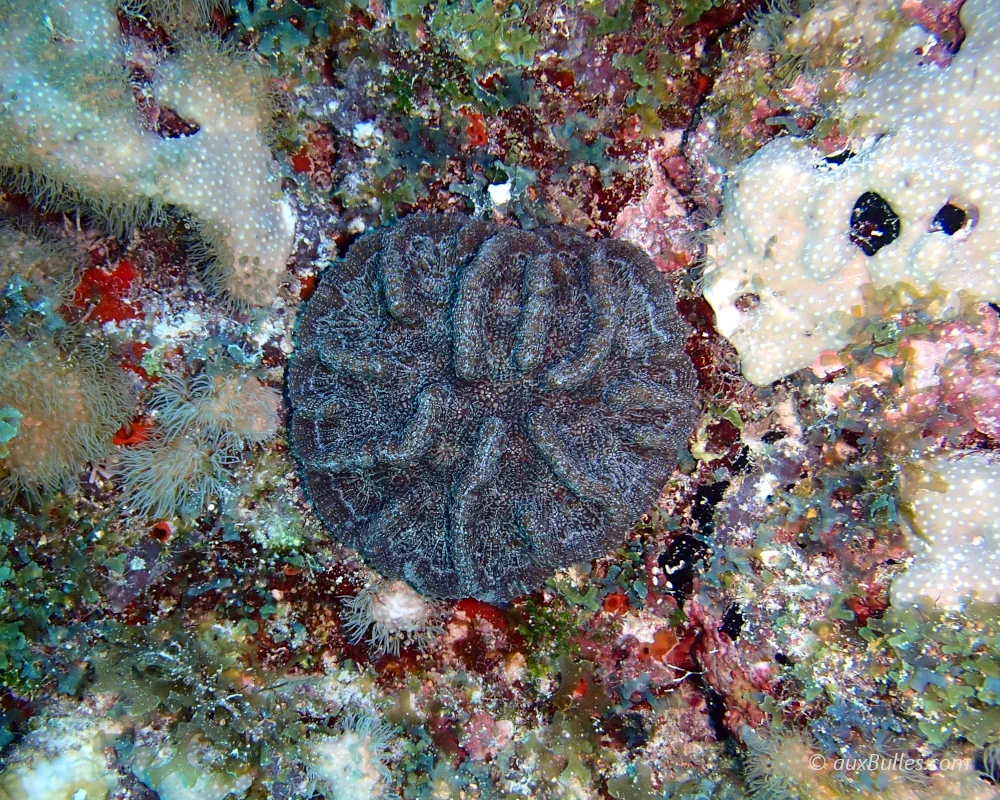
The ridged cactus coral forms a disk-shaped colony marked by fleshy ridges and winding grooves
Geographic range
The ridged cactus coral inhabits the tropical western Atlantic, from southern Florida and the Bahamas to the coasts of Central America and northern South America. It is widespread throughout the Caribbean Sea and the Gulf of Mexico, particularly around Cuba, Jamaica, Hispaniola, Puerto Rico, and the Cayman Islands. It is also found along the coasts of Mexico, Belize, Honduras, Nicaragua, Costa Rica, Panama, Colombia, and Venezuela, as well as around Aruba, Bonaire, and Curaçao. In the French West Indies, it can be observed in Guadeloupe, Martinique, Saint Martin, and Saint Barthélemy.
Habitat
The ridged cactus coral inhabits a variety of reef environments, from lagoons to outer reef slopes. It is found mainly at depths of 33 to 66 feet, but can occur at depths of up to about 246 feet. It favors warm tropical waters, where temperatures generally range from 72 to 86 °F.
Diet
Like many reef-building corals, the ridged cactus coral lives in symbiosis with microscopic algae called zooxanthellae, which live in its tissues. Through photosynthesis, these algae provide some of the energy and organic compounds needed for its growth. Its polyps supplement this supply by capturing tiny organisms suspended in the water, particularly zooplankton.
Reproduction
The ridged cactus coral reproduces sexually and can also multiply through asexual reproduction. During sexual reproduction, fertilization takes place within the colony, where larvae develop inside the polyps before being released into the water. Known as planulae, these larvae then drift with the currents until they find a suitable surface on which to settle and form a new colony.
Did you know ?
Despite its sculpted stone-like appearance, the ridged cactus coral is made up of numerous tiny living animals called polyps. These polyps extend their tentacles at night to capture food. As the colony grows, it secretes a limestone skeleton that contributes to reef formation.
The ridged cactus coral is listed as many other marine species within The IUCN Red List of threatened species. The ridged cactus coral appears in the IUCN Red List since 2022 within the category Least Concern !
Within the same family
Discover also

The marine species in the Western Atlantic



Our latestUpdates
The neon gobyDiscover the neon goby (Elacatinus oceanops), a small western Atlantic reef fish known for its brilliant blue stripe and its role as a cleaner fish that removes parasites from other fish.Read more

The poison gobyDiscover the poison goby (Gobiodon citrinus), a tiny reef fish with a bright yellow body and distinctive blue markings. It lives among branching Acropora corals in the tropical waters of the Indo-Pacific.Read more
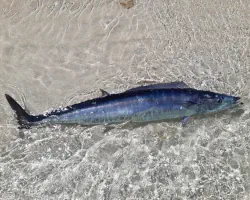
The wahooDiscover the wahoo (Acanthocybium solandri), a powerful pelagic predator found in tropical and subtropical oceans. Recognizable by its streamlined body and distinctive blue vertical stripes, it is a fast swimmer that feeds mainly on fish and squid.Read more
Photo of the Day
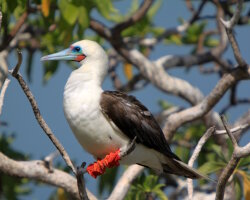
Fou à pieds rouges
(Sula sula)
(Sula sula)
 Copyright © 2007-2026 auxBulles.com - All rights reserved. Legal notices.
Photo credits - Our partners