

Sealife guideThe yellow sponge ClathrinaClathrina clathrus
Last updated on 11/23/2026 at 11:08 PM
The yellow sponge Clathrina (Clathrina clathrus) is a small calcareous sponge recognizable by its network of bright yellow tubes, which gives it a delicate lace-like appearance. Common throughout the Mediterranean, it favors sheltered, dimly lit rocky areas where it grows protected from direct light.
Taxonomy
English names
Yellow sponge Clathrina
French namesEponge clathrine jaune
Spanish namesClatrina amarilla
Scientific nameClathrina clathrus (Schmidt, 1864)
FamilyClathrinidae
OrderClathrinida
Description
The yellow sponge Clathrina is a calcareous sponge that forms a cluster of soft, interconnected tubes, creating a particularly dense network. This network has openings called oscula, through which water is expelled. They are located where the larger tubes converge.

The yellow sponge Clathrina (Clathrina clathrus)
The yellow sponge Clathrina generally reaches a size of around 4 inches.
Its bright yellow, slightly translucent color makes it particularly striking, especially when it grows alongside the yellow encrusting sea anemone on cave walls : a spectacular display of color !
Geographic range
The yellow sponge Clathrina is found mainly in the Mediterranean Sea, but it also occurs, more rarely, in the northeastern Atlantic, particularly along the western coasts of France and Spain.
Habitat
The yellow sponge Clathrina colonizes rocky surfaces sheltered from light. It commonly grows in rocky cavities, crevices, fissures, and beneath overhangs inside caves, generally at depths of 16 to 66 feet.
Diet
Like other sponges, the yellow sponge Clathrina is an active filter feeder. It circulates water through its body, trapping suspended food particles and microorganisms, including tiny planktonic crustaceans. Specialized cells called choanocytes play an essential role in this filtration process by capturing nutrients.

The yellow sponge Clathrina (Clathrina clathrus)
Reproduction
The yellow sponge Clathrina is hermaphroditic and reproduces sexually. In the Mediterranean, its breeding season takes place mainly in March and April. Sperm released into the water are captured by another individual during filter feeding. Fertilization takes place inside the body, producing a larva that is subsequently released into the water.
Carried by currents, this larva may travel a variable distance before settling on a new rocky surface and developing into a new sponge.
Did you know ?
This sponge is particularly easy to recognize by its bright yellow color, which is sometimes slightly translucent. It is widespread throughout the Mediterranean, where it readily colonizes dimly lit rocky areas.
The yellow sponge Clathrina occurs in two forms, distinguished by the diameter of the tubes making up their network : some have relatively thin tubes, while others have wider ones. These two forms may be found growing close to each other, but it is much rarer to see both occurring together in a single individual, within the same tubular network.
Tips for observing
Look for rocky areas sheltered from light : you will probably discover this sponge growing alongside the yellow encrusting anemone, much to your delight !

The yellow sponge Clathrina (Clathrina clathrus)
Discover also
Azure vase spongeCallyspongia plicifera
Caribbean giant barrel spongeXestospongia muta

Compressed purse spongeGrantia compressa
Giant barrel spongeXestospongia testudinaria
Orange-red encrusting spongeCrambe crambe
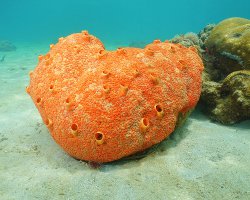
Rred boring spongeCliona delitrix
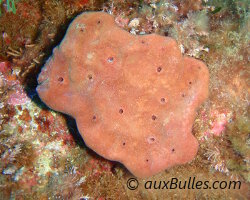
Stony spongePetrosia ficiformis

Venus flower basketEuplectella aspergillum
The marine species in the Mediterranean Sea

Our latestUpdates

Miami, in the footsteps of Vice City and GTA VIDiscover Miami, the real-life inspiration behind GTA Vice City and GTA VI. Explore South Beach, Ocean Drive, Brickell, Wynwood, the Florida Keys, and the Everglades, from iconic landmarks and vibrant neighborhoods to tropical landscapes.Read more
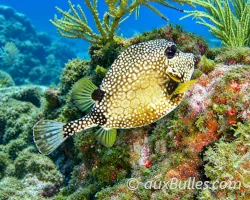
The smooth trunkfishDiscover the smooth trunkfish (Rhinesomus triqueter), a reef-dwelling fish from the tropical western Atlantic. Its angular body, protected by a bony carapace, features a dark coloration with white spots and distinctive honeycomb patterns.Read more
A tense finish in the CaribbeanA look back at the 2026 Route du Rhum finish: Tom Laperche wins the Ultim class as the leading boats arrive and close battles continue across the other fleets.Read more
Photo of the Day
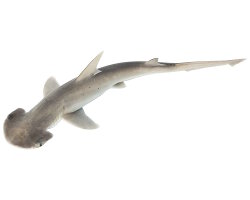
Requin marteau tiburo
(Sphyrna tiburo)
(Sphyrna tiburo)
 Copyright © 2007-2026 auxBulles.com - All rights reserved. Legal notices.
Photo credits - Our partners