

Islands destinationIsola Bella IslandSicily Island | Mediterranean Sea
Last updated on 10/06/2026 at 11:55 PM
Isola Bella is a small islet located at the foot of Taormina, on the eastern coast of Sicily. Connected to the shore by a narrow strip of sand and pebbles, this small, vegetation-covered island forms one of the most iconic landscapes along Sicily's Ionian coast.
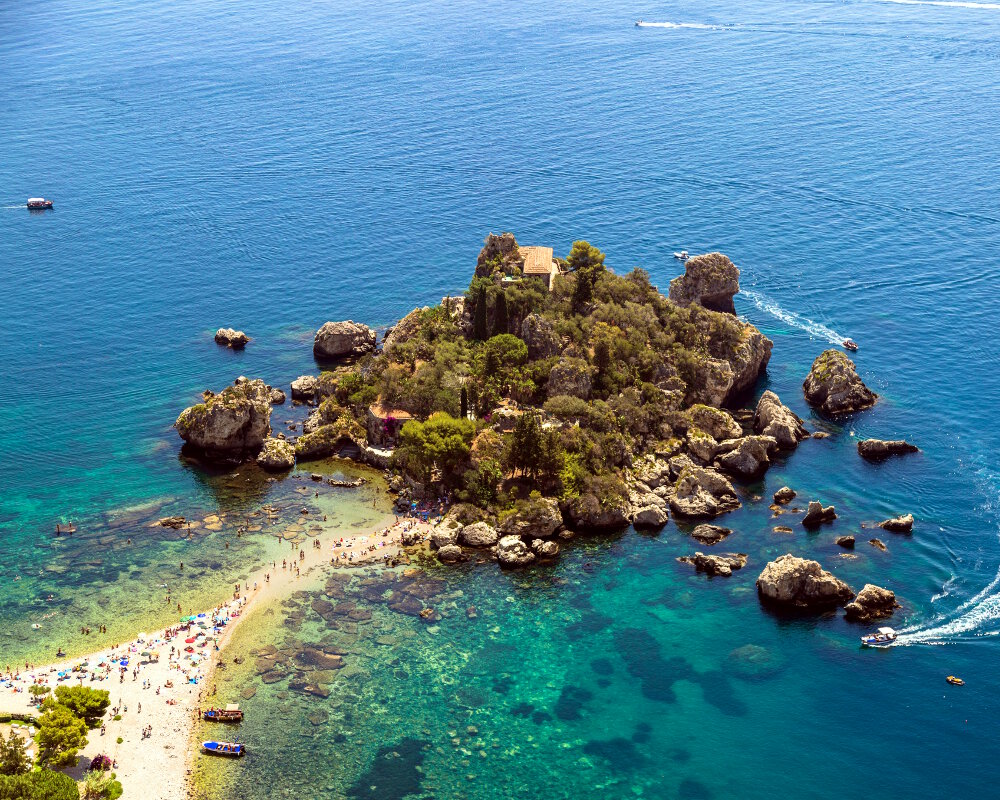
Isola Bella Island (Mer Méditerranée) © Ebastard129 | Dreamstime.com
Protected as part of a nature reserve, Isola Bella combines a preserved Mediterranean environment, crystal-clear waters, and a fascinating history linked to Florence Trevelyan, who landscaped the islet in the late 19th century. Its exceptional setting facing Taormina also makes it a must-see site when exploring this part of Sicily.
An islet between sea and mountains
An exceptional setting
Isola Bella is a small islet located at the foot of Taormina, on the eastern coast of Sicily, in Mazzarò Bay. Surrounded by the waters of the Ionian Sea, it lies between Cape Taormina and Cape Sant'Andrea, in a spectacular setting dominated by the rugged Sicilian coastline.
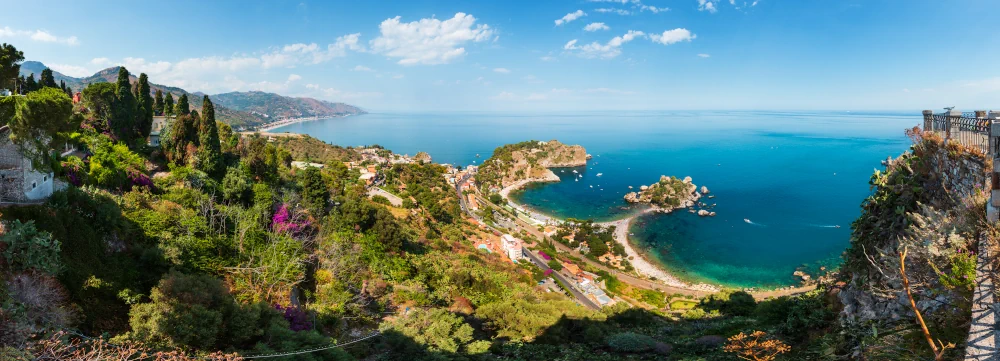
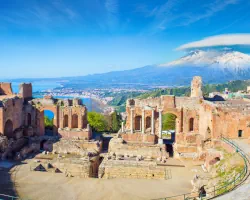
Panoramic view of Taormina, the Sicilian coast, and Isola Bella from the hills above © Yuriy Brykaylo | Dreamstime.com
The islet is connected to the shore by a narrow strip of sand and pebbles that can be partially covered by the sea depending on the water level. This distinctive feature gives Isola Bella a constantly changing appearance and creates a very different landscape depending on sea conditions. The beach and crystal-clear waters surrounding it form one of the most iconic sites along Taormina's coastline.
Lush vegetation
Despite its small size, Isola Bella has particularly abundant vegetation. Mediterranean scrub mixes with species introduced in the 19th century, giving the islet a lush appearance that contrasts with the rocks and blue waters of the bay.
This vegetation is an important part of Isola Bella's character. The combination of Mediterranean plants and exotic species is particularly linked to the landscaping carried out by Florence Trevelyan, who transformed the islet after acquiring it in the late 19th century.
The history of Florence Trevelyan
A botanical enthusiast
In 1890, Isola Bella was purchased by Florence Trevelyan, an English aristocrat who settled in Taormina. Passionate about botany and gardens, she landscaped the islet and had a small house built there, surrounded by vegetation combining Mediterranean plants and exotic species.
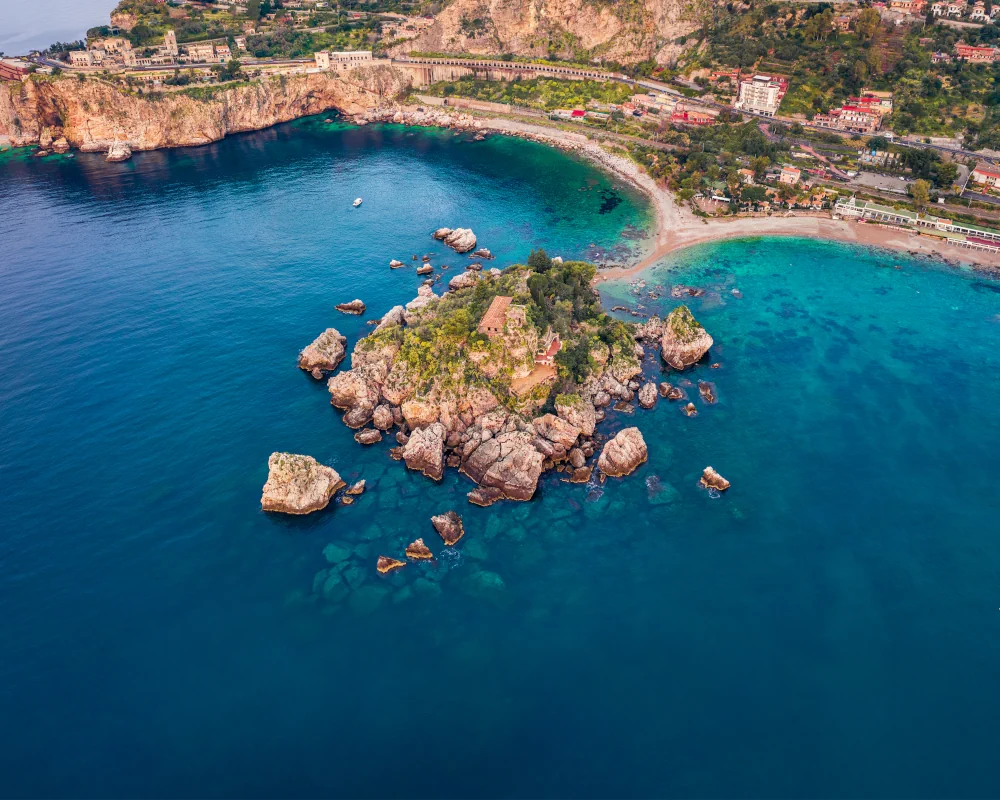
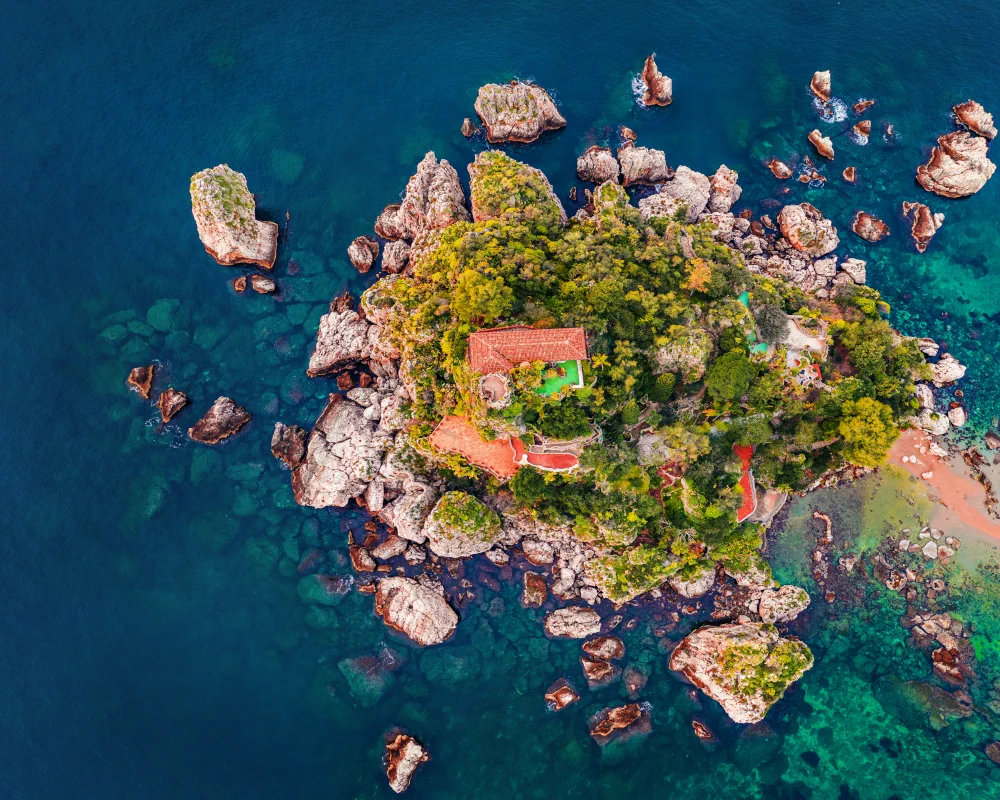
This transformation gave Isola Bella a distinctive character, combining natural and landscaped elements. The plants introduced by Florence Trevelyan helped create the lush setting that remains part of the islet's identity today. Her work was also part of the broader history of the gardens and landscaped spaces she developed in Taormina.
A preserved heritage
Before it was acquired by Florence Trevelyan, the islet had been given in 1806 by Ferdinand Ist of Bourbon to the municipality of Taormina. After the deaths of Florence Trevelyan and her husband, Salvatore Cacciola, Isola Bella changed hands several times and also went through periods of neglect.
During the 20th century, the site's heritage value was gradually recognized. The Sicilian Region declared it a natural monument of major historical and artistic interest in 1984, before the public authorities acquired it in 1990. This development helped provide greater protection for a site whose value lies as much in its natural environment as in its history.
A nature reserve in the heart of Taormina Bay
A protected natural area
Isola Bella became a nature reserve in 1998. Covering approximately 26 acres, this protected area aims to preserve the landscapes, vegetation, and natural environments of the islet and its surroundings. Isola Bella is also part of the sites protected under the European Natura 2000 network.
This protection helps preserve a particularly sensitive coastal environment where Mediterranean vegetation, introduced species, rocks, and marine habitats coexist. The seabed around Isola Bella is also protected, particularly in the area between Taormina and Cape Sant'Andrea.
The Natural History Museum
Discovering Isola Bella is not limited to its landscape above the water. A natural history museum has been established on the site to showcase its natural heritage and the history of the islet. It provides a better understanding of this distinctive environment and the measures implemented to protect it.
From the Mazzarò coast, Isola Bella can first be admired as a whole before being explored up close. The cable car connecting Taormina with Mazzarò provides easy access to the coastal area. Depending on visiting conditions and the tide, the strip of sand connecting the islet to the shore also offers a unique perspective of this iconic site on the Sicilian coast.
How to get there ?
From Taormina
To reach Isola Bella from central Taormina, the Taormina-Mazzarò cable car provides quick access to the coast. The upper station is located on Via Luigi Pirandello, near Porta Messina, while the lower station is in Mazzarò, just a few hundred yards from Isola Bella.
From Mazzarò, continue on foot toward Isola Bella and take the stairs leading down to the nature reserve. Another option is to walk from Taormina to the Isola Bella viewpoint and then follow the path to the entrance of the site.
By car or bus
Isola Bella can also be reached by car via SS 114, the coastal road connecting Taormina with Catania and Messina. From the A18 highway, the Taormina exit provides access to the coast by following signs for Mazzarò and Isola Bella. You then continue on foot from the parking areas nearby.
Public transportation also serves the Taormina coast, including an Isola Bella stop on the SS 114 bus route. The best option therefore depends mainly on your starting point: the cable car is convenient from Taormina's historic center, while the bus or car provides direct access to the coastal area. Since transportation schedules may vary depending on the season, it is best to check them before departure.
Sicily island
The islands from mediterranean Sea
Frioul islands
Golden island
Grand Gaou island
Ischia island
Petit Gaou island

Porquerolles island
Port-Cros island
Vulcano island
Explore new islands
Our latestUpdates
The Guide des poissons de Nouvelle-CalédonieDiscover Guide to the Fishes of New Caledonia by Pierre Laboute and René Grandperrin, an illustrated reference featuring nearly 1,200 species, from rivers and coral reefs to the depths of the ocean.Read more
The neon gobyDiscover the neon goby (Elacatinus oceanops), a small western Atlantic reef fish known for its brilliant blue stripe and its role as a cleaner fish that removes parasites from other fish.Read more

The poison gobyDiscover the poison goby (Gobiodon citrinus), a tiny reef fish with a bright yellow body and distinctive blue markings. It lives among branching Acropora corals in the tropical waters of the Indo-Pacific.Read more
Photo of the Day

Gorette bleue
(Haemulon sciurus)
(Haemulon sciurus)
 Copyright © 2007-2026 auxBulles.com - All rights reserved. Legal notices.
Photo credits - Our partners