

Australia Travel GuideThe Sydney Opera House
Last updated on 06/05/2026 at 12:33 AM
In 1956, Danish architect Jørn Utzon was the winner of the international architecture competition organized by the government of New South Wales to design the Sydney Opera House.
The construction of the monument was long, complex, and turbulent, including the resignation of its architect. Finally, on October 20, 1973, the Sydney Opera House was officially inaugurated by Queen Elizabeth II.
The Sydney Opera House is an iconic building with a distinctive architectural design whose shape leaves no one indifferent. In addition to the opera house itself, the building includes a large symphony concert hall, several theaters of varying capacities, restaurants, souvenir shops, and two large entrance halls.
An Iconic Architectural Masterpiece
The Sydney Opera House to Australia is what the Eiffel Tower is to France: an architectural masterpiece and a symbol of a country and a city. With its white shell-like structures and clean lines, the Sydney Opera House is instantly recognizable. This image has become a world-famous symbol of Australia !
Located in Sydney Harbour on a promontory at « Bennelong Point » to be precise, the Opera House stands on a large platform surrounded by terraces that serve as pedestrian walkways. With the Harbour Bridge, a steel arch bridge, nearby and a wooded park as a backdrop, the resulting landscape is more than just a postcard view—it is a symbol of Australia, and of Sydney in particular.

Sydney Opera House by night

Sydney Opera House with the Harbour Bridge in the background
In 2007, UNESCO inscribed the Sydney Opera House on the World Heritage List. Since its construction, this building extending into Sydney Harbour has had a major influence on the world of architecture.
The Breath of a New Architecture
The selection of Danish architect Jørn Utzon symbolized the desire to adopt an architectural approach in total rupture with the conventional practices of the time.
Indeed, Jørn Utzon belonged to a movement of young architects opposing the stagnation of modernism and advocating a return to pure form. He aimed to create a living sculpture: the ribbed shells are inspired by organic forms, and the vaults blend into the clouds.
Technical Challenges and Engineering Feats
The Sydney Opera House served as an experimental laboratory and a production site for prefabricated structures.
The famous “shells” of the Sydney Opera House consist of a framework of precast concrete ribs covered with white ceramic tiles, inspired by Japanese bowls that had captured Jørn Utzon’s imagination. These tiles have the unique ability to reflect sunlight.

The light festival dressed the Sydney Opera House from May 24 to June 10, 2013

Fully illuminated, the Sydney Opera House at night
The different “shell” elements were designed by the architect from a single sphere, which also explains the perfect reproducibility of the tiles. They are symmetrically positioned, paired at the top two by two. Each set of three then interlocks with the previous one.
This opera house stands out thanks to its smooth, shining roof that changes color depending on the time of day. In full sunlight, the tiles take on a subtle golden hue.
Inside, the ribs of each “shell” converge into massive matte concrete pillars. The vaults are made of steel. Glass walls and large open volumes give a sense of lightness once inside the building.
Impressive Figures
The proportions of the Sydney Opera House are extraordinary, with a height of 213 feet (65 meters) at its highest point, a length of 600 feet (183 meters), and a width of 394 feet (120 meters), covering a ground area of nearly 5 acres (about 2 hectares).
The roof, composed of symmetrical shell-like segments paired two by two, contains more than one million white ceramic tiles.
Finally, located in Sydney Harbour, the architect had to demonstrate remarkable ingenuity to build the structure on more than 580 concrete piles extending below sea level.
Sails, Shells, or ...
The shape of the Sydney Opera House is what makes it so unique, sparks imagination, and gives it its symbolic meaning. Some see a sailing ship moving toward the sea, others see three large interwoven “shells,” or even breaking ocean waves.

Sunset over the Sydney Opera House

The Sydney Opera House by day with its iconic architecture
These white shells do not refer to the function of the building, but are meant to evoke emotions !
Top must-see places in Australia

Must-see places around the world






Our latestUpdates

The Guide des poissons de Nouvelle-CalédonieDiscover Guide to the Fishes of New Caledonia by Pierre Laboute and René Grandperrin, an illustrated reference featuring nearly 1,200 species, from rivers and coral reefs to the depths of the ocean.Read more
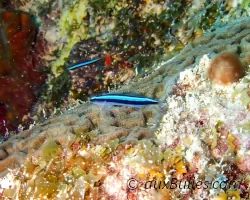
The neon gobyDiscover the neon goby (Elacatinus oceanops), a small western Atlantic reef fish known for its brilliant blue stripe and its role as a cleaner fish that removes parasites from other fish.Read more

The poison gobyDiscover the poison goby (Gobiodon citrinus), a tiny reef fish with a bright yellow body and distinctive blue markings. It lives among branching Acropora corals in the tropical waters of the Indo-Pacific.Read more
Photo of the Day

Crevette nettoyeuse d'Amboine
(Lysmata amboinensis)
(Lysmata amboinensis)
 Copyright © 2007-2026 auxBulles.com - All rights reserved. Legal notices.
Photo credits - Our partners