

Sealife guideThe white-spotted jellyfishPhyllorhiza punctata
Last updated on 11/17/2026 at 10:25 PM
The white-spotted jellyfish (Phyllorhiza punctata) is a large jellyfish easily recognized by its rounded, translucent bell covered with numerous evenly distributed white spots. Native to the western Pacific, it inhabits tropical and warm-temperate coastal waters, particularly lagoons, bays and estuaries.
Growing up to around 20 inches in diameter, this jellyfish has a remarkable feature: its tissues host microscopic algae living in symbiosis with it. These organisms provide part of the energy it needs through photosynthesis.
Taxonomy
English names
White-spotted jellyfishAustralian spotted jellyfishFloating bell
French namesMéduse constelléeMéduse à pois blancs
Spanish namesMedusas de puntos
Scientific namePhyllorhiza punctata (von Lendenfeld, 1884)
FamilyMastigiidae
OrderRhizostomeae
ClassScyphozoa
Description
The white-spotted jellyfish has a rounded, hemispherical and slightly flattened bell that can reach approximately 20 inches in diameter. Its translucent surface, which may have a bluish, brownish or yellowish tint, is covered with numerous distinctive small white spots.
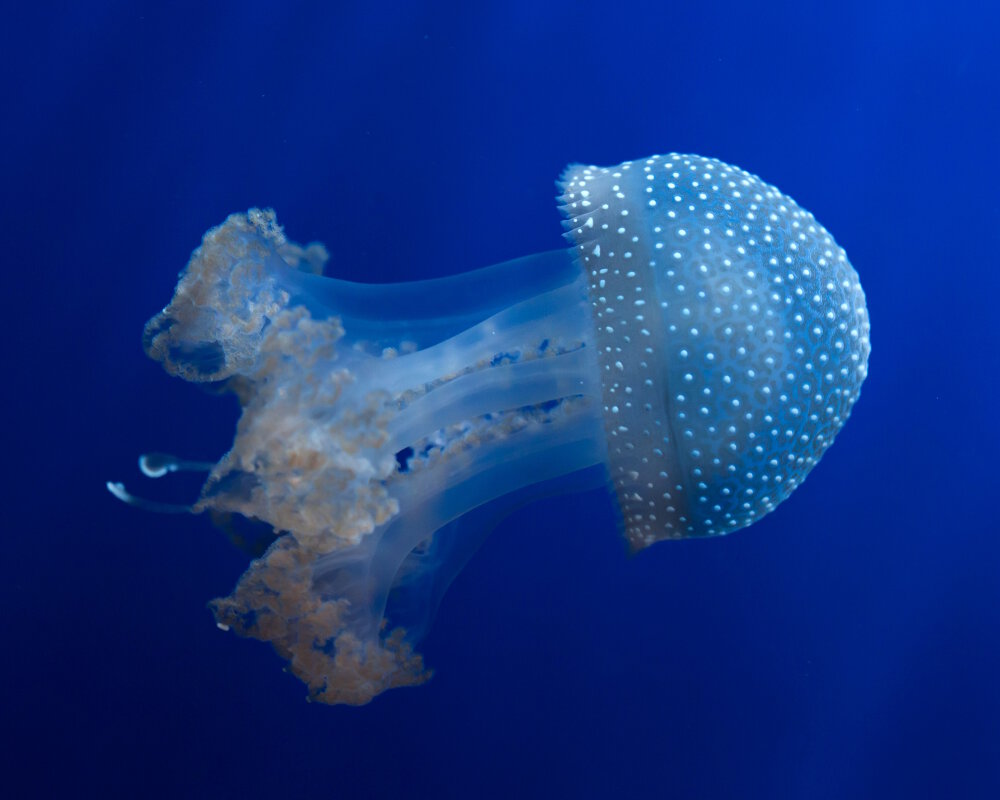
The white-spotted jellyfish (Phyllorhiza punctata) © Wrangel | Dreamstime.com
Unlike many other jellyfish, it has no tentacles along the edge of its bell. Instead, it has eight thick, branched oral arms extending beneath the bell and ending in club-shaped appendages. These arms bear numerous small structures equipped with stinging cells, which help it capture its prey.
Geographic range
The white-spotted jellyfish is native to the western Pacific, where its natural range extends from Southeast Asia, particularly the coasts of Thailand, to eastern Australia. It has also been reported in various parts of the Pacific and Indian Oceans.
Accidentally transported by maritime activities, particularly in ships' ballast water, it has become established in many parts of the world, where it is considered an introduced species. It is found along parts of the American coastline, in the Gulf of Mexico and the Caribbean, as well as in Brazil and the Mediterranean.
Habitat
The white-spotted jellyfish is mainly found in warm coastal waters, lagoons, sheltered bays and estuaries. It often drifts near the surface in relatively calm, sometimes murky waters, where conditions favor its development. It can also be observed in the open ocean, far from shore. Large aggregations can form in sheltered environments, where currents and environmental conditions favor its accumulation.
Diet
The white-spotted jellyfish has an unusual feeding strategy that combines the capture of small planktonic prey with photosynthesis carried out by microscopic algae living in its tissues. These symbiotic algae, known as zooxanthellae, use sunlight to produce nutrients that benefit their host. The jellyfish supplements this energy supply by capturing zooplankton, particularly with the help of the stinging cells on its oral arms.
Reproduction
The white-spotted jellyfish has a life cycle typical of jellyfish in the class Scyphozoa, alternating between sexual and asexual stages. Adult jellyfish release their reproductive cells into the water, where fertilization takes place. The fertilized egg develops into a free-swimming larva called a planula. It eventually attaches to a suitable surface and transforms into a polyp. The polyp reproduces asexually through a process called strobilation, during which it produces young jellyfish known as ephyrae. These gradually detach from the polyp and grow into adult jellyfish.
Did you know ?
The white-spotted jellyfish can form spectacular aggregations sometimes numbering in the thousands. In some regions where it has been introduced, particularly in the Gulf of Mexico, these blooms can disrupt fishing activities by clogging nets and making fishing operations more difficult.
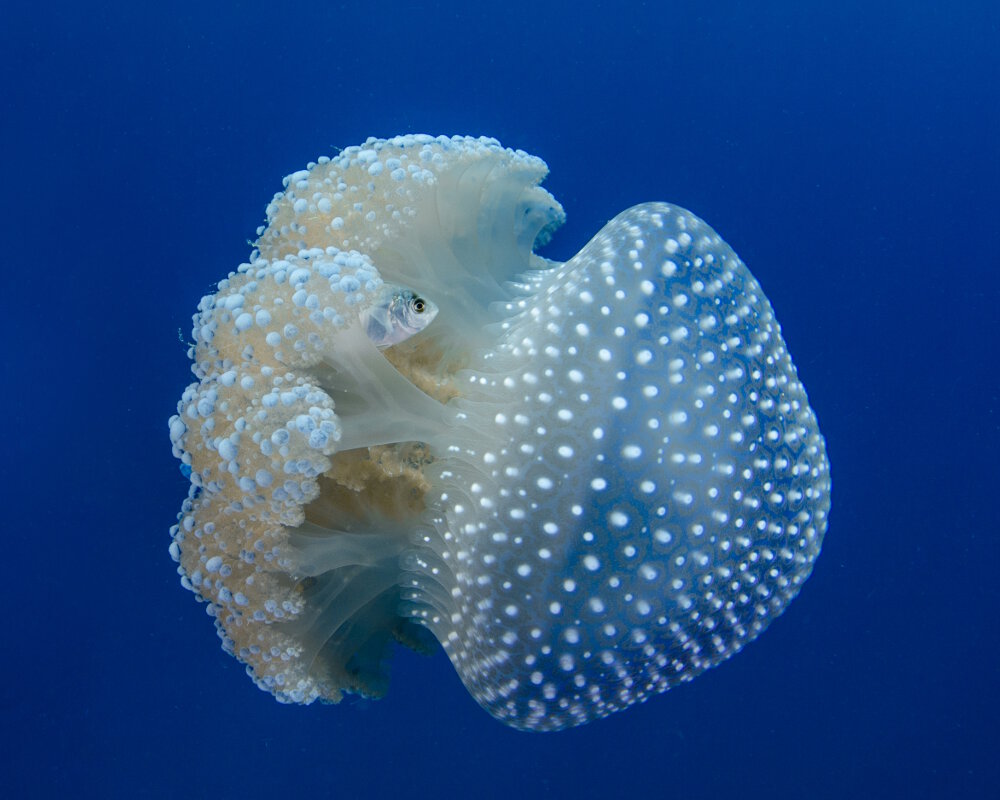
The white-spotted jellyfish (Phyllorhiza punctata) © Krzysztof221 | Dreamstime.com
Discover also
Acropora pulchra coralAcropora pulchra
Big siphonophoreForskalia edwardsii
Elkhorn coralAcropora palmata
Giant caribbean anemoneCondylactis gigantea
Labyrinthine brain coralDiploria labyrinthiformis
Magnificent sea anemoneRadianthus magnifica
Plumose sea anemoneMetridium senile
Purple gorgonianParamuricea clavata
Our latestUpdates

Miami, in the footsteps of Vice City and GTA VIDiscover Miami, the real-life inspiration behind GTA Vice City and GTA VI. Explore South Beach, Ocean Drive, Brickell, Wynwood, the Florida Keys, and the Everglades, from iconic landmarks and vibrant neighborhoods to tropical landscapes.Read more
The smooth trunkfishDiscover the smooth trunkfish (Rhinesomus triqueter), a reef-dwelling fish from the tropical western Atlantic. Its angular body, protected by a bony carapace, features a dark coloration with white spots and distinctive honeycomb patterns.Read more

A tense finish in the CaribbeanA look back at the 2026 Route du Rhum finish: Tom Laperche wins the Ultim class as the leading boats arrive and close battles continue across the other fleets.Read more
Photo of the Day
Raie torpille ocellée
(Torpedo torpedo)
(Torpedo torpedo)
 Copyright © 2007-2026 auxBulles.com - All rights reserved. Legal notices.
Photo credits - Our partners