Sealife guideThe whitespotted wedgefishRhynchobatus australiae
Last updated on 10/14/2026 at 12:35 AM
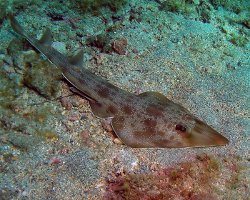
The whitespotted wedgefish (Rhynchobatus australiae) is a large cartilaginous fish whose silhouette resembles both a shark and a ray. Its flattened front end, pointed bottle-shaped snout, and widely spread pectoral fins give it a distinctive appearance. It is particularly recognizable by the black and white markings on its pectoral fins.
This fish lives near the seabed in the warm coastal waters of the western Indo-Pacific. It feeds on small marine animals that it catches over sandy or muddy bottoms. Targeted by fisheries, particularly for its fins, it is now considered critically endangered.
Taxonomy
English names
Whitespotted wedgefish
French namesPoisson coin
Spanish namesChopa blanca
Scientific nameRhynchobatus australiae (Whitley, 1939)
Description
The whitespotted wedgefish has an elongated body with a flattened, broad front end and large triangular pectoral fins extending from either side of its head. Its snout narrows slightly toward the tip, resembling the shape of a bottle. Its back is generally gray to brownish and covered with small white spots. A distinctive black marking is located at the base of each pectoral fin, accompanied by several white spots, three of which are usually aligned above it. These patterns may become less noticeable in larger individuals.
The whitespotted wedgefish can reach about 10 feet in length.
Geographic range
The whitespotted wedgefish inhabits tropical and subtropical waters of the western Indo-Pacific, from Southeast Asia, including the Gulf of Thailand, the Philippines, and Indonesia, to northeastern
Australia. It is found in Queensland, along the
Great Barrier Reef, and around Lady Elliot Island.
In
Australia, it is also found along the western coast, particularly around Shark Bay, as well as along the coast of the Northern Territory and as far south as New South Wales.
Habitat
The whitespotted wedgefish lives near the seabed, mainly on the continental shelf and in shallow coastal waters. It inhabits sheltered bays, estuaries, sandy or muddy bottoms, and areas near coral reefs.
The whitespotted wedgefish is generally found from the surface to depths of 197 feet. Because it frequents shallow coastal waters, it is particularly vulnerable to nets and other fishing gear used near the seabed.
Diet
The whitespotted wedgefish is carnivorous and feeds mainly on
crustaceans,
mollusks, and small fish that live near the seabed. It searches for prey over sandy or muddy bottoms, probing the sediment to uncover animals hiding in it.
Reproduction
The whitespotted wedgefish is
ovoviviparous: the young develop inside the female's body. They initially feed on the nutrients stored in their yolk sacs, then receive additional nutrients from the mother. At birth, the young are fully formed and able to swim.
Did you know ?
Coastal fishing and demand for its fins contribute to the pressure on whitespotted wedgefish populations. The species is listed in Appendix II of CITES, which regulates international trade in the species concerned.
The whitespotted wedgefish is listed as many other marine species within The
IUCN Red List of threatened species. The whitespotted wedgefish appears in the
IUCN Red List since 2019 within the category Critically Endangered !
Tips for observing
The whitespotted wedgefish was long confused with other closely related species, particularly the giant guitarfish (Rhynchobatus djiddensis), which occurs in the western Indian Ocean, from South Africa's Eastern Cape Province to the Red Sea, as well as the smoothnose wedgefish (Rhynchobatus laevis).
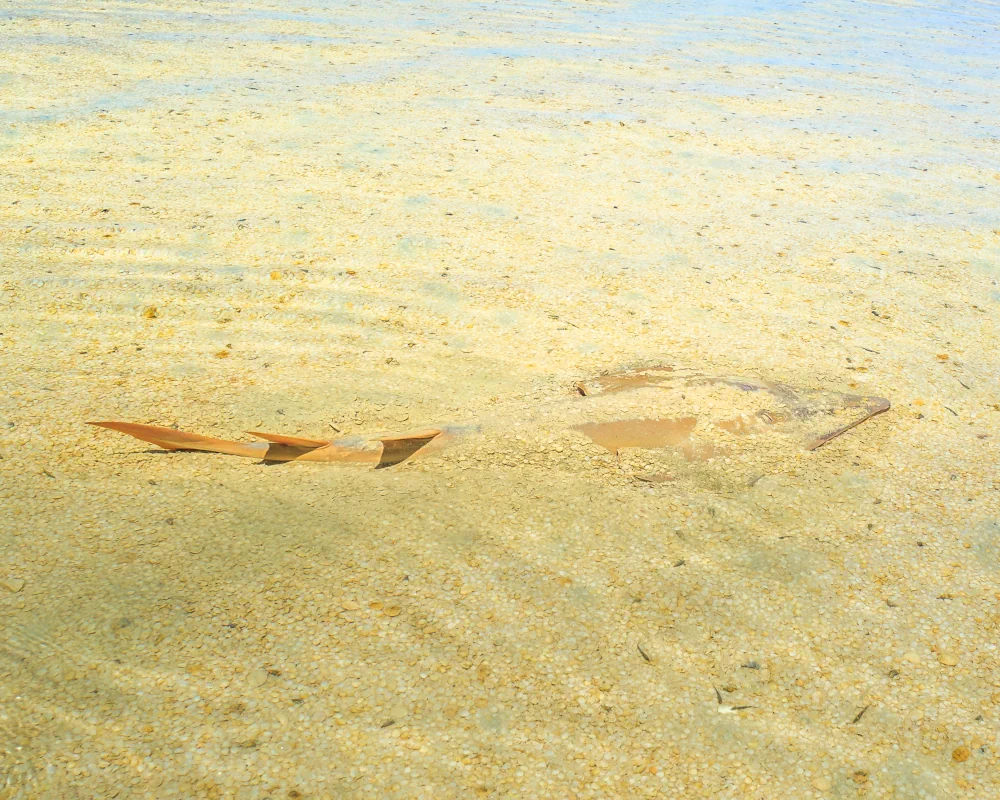
A whitespotted wedgefish (Rhynchobatus australiae) partially camouflaged in the sand in the crystal-clear waters of Shell Beach, Shark Bay, Western Australia
© Bennymarty | Dreamstime.comDiscover also
The marine species in the Indo-Pacific