

Islands destinationThe northern Mariana IslandsMariana Islands | Pacific Ocean
Last updated on 10/02/2026 at 12:30 AM
North of Saipan, Tinian, and Rota lies a chain of much wilder volcanic islands known as the Northern Islands of the Northern Mariana Islands. From Farallon de Pajaros, at the northern end of the archipelago, to Anatahan, these islands are characterized by landscapes dominated by volcanoes, cliffs, tropical forests, and rocky coastlines.
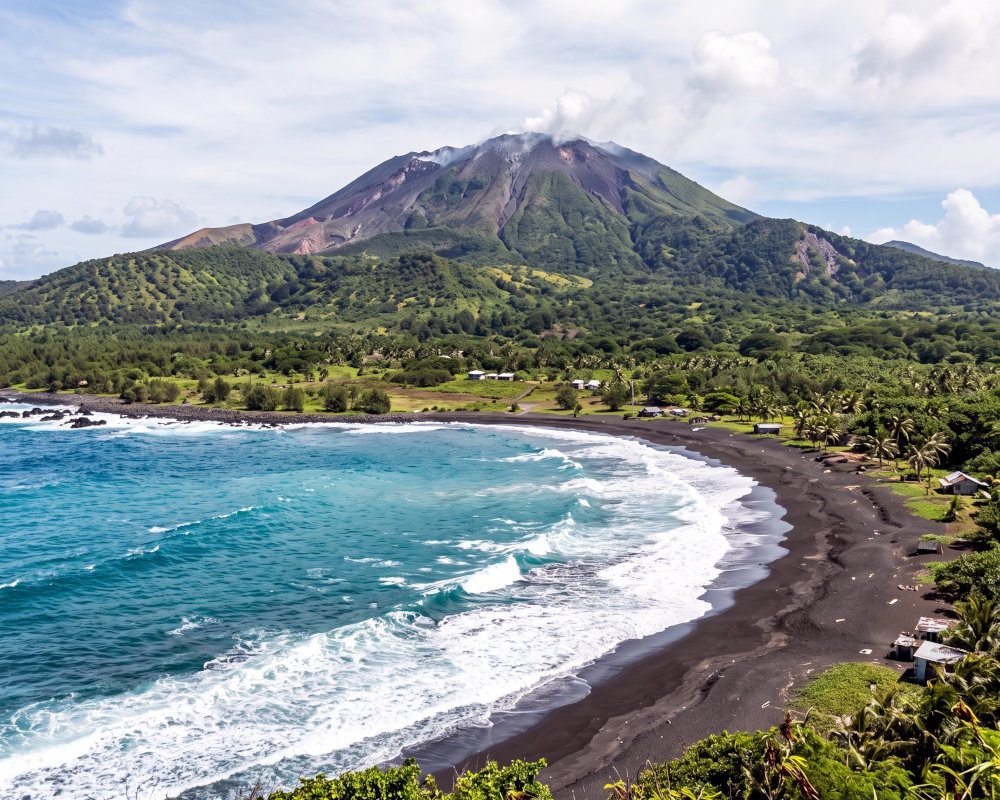
Black-sand beach with Pagan Volcano in the background on the wild coast of Pagan Island in the Northern Mariana Islands
Most of these islands are uninhabited or have only a very limited human presence. They therefore provide important refuges for native forests, birds, and marine species. Some are also protected because of their ecological importance, while Pagan, Agrihan, and Alamagan retain ties to communities from the Northern Islands.
A chain of volcanic islands
Islands shaped by volcanic activity
The Northern Islands of the Mariana Islands are part of the active volcanic arc that extends north of Saipan. Anatahan, Sarigan, Guguan, Alamagan, Pagan, Agrihan, Asuncion, the Maug Islands, and Farallon de Pajaros are all volcanic islands, but their terrain and size vary greatly. Some are dominated by a high volcano, while others consist of several cones or remnants of partially collapsed volcanoes.
Impressive landscapes
Several peaks reach considerable elevations despite the islands' small size. Agrihan rises to about 3,166 feet, making it the highest point in the Northern Mariana Islands, while Asuncion reaches about 2,812 feet and Anatahan nearly 2,585 feet. These mountains rise directly from the Pacific, giving the islands particularly rugged landscapes, with cliffs, volcanic slopes, and deeply incised valleys.
Islands with very different landscapes
Pagan and its vast volcanic landscape
At nearly 18.5 sq mi, Pagan is the largest of the Northern Islands described here. The island has several volcanic formations, including Mount Pagan and North Pagan, as well as two large plains separated by a narrow isthmus. Several eruptions have profoundly altered its landscape and led to the evacuation of its population in the 1980s. A very limited human presence remains today, particularly through temporary stays.
Anatahan, Agrihan, and Alamagan
Farther south, Anatahan is known for its active volcano and the major eruption that began in 2003. Much higher Agrihan has a vast volcano whose summit rises above an island covered in vegetation. Alamagan, located between Guguan and Pagan, also has a rugged volcanic landscape. All three islands remain very sparsely populated, and their landscapes are largely dominated by nature.
Largely preserved islands
Sarigan and Guguan
The small islands of Sarigan and Guguan offer particularly well-preserved landscapes. Sarigan has volcanic slopes covered in vegetation and provides a refuge for several terrestrial and marine species. Guguan, even smaller, is entirely protected as a wildlife conservation area. Its isolation has greatly limited human disturbance and helped preserve important habitats for native species.
Asuncion, Maug, and Farallon de Pajaros
Farther north, Asuncion, the Maug Islands, and Farallon de Pajaros, also known as Uracas, form one of the most isolated parts of the archipelago. The Maug Islands are a small group of three volcanic islands surrounding the remains of an ancient collapsed volcano. Farallon de Pajaros, at the northern end of the Marianas, is itself an active volcano. These islands are uninhabited and protected in part to preserve their natural habitats.
Biodiversity shaped by isolation
Birds and native forests
The isolation of the Northern Islands has helped preserve numerous natural habitats. Native forests still cover significant areas of several islands and provide refuges for birds characteristic of the Marianas. The Mariana kingfisher, Micronesian starling, and other forest and marine species use different habitats throughout this island group. Some populations are nevertheless vulnerable because of their very limited ranges.
Protected marine environments
Biodiversity is not limited to the land. Coral reefs, drop-offs, rocky seabeds, and coastal areas surrounding these islands are home to numerous fish and other marine organisms. The underwater environments of the Northern Mariana Islands have been the subject of scientific mapping programs that have helped improve knowledge of benthic habitats around Pagan, Agrihan, Alamagan, Guguan, Maug, Asuncion, and Farallon de Pajaros.
Difficult-to-reach islands
A very isolated region
The distance between these islands and Saipan gradually increases farther north. Anatahan is about 87 miles from Saipan, Pagan more than 199 miles away, and Farallon de Pajaros about 360 miles away. There is no regular tourist transportation network comparable to the services connecting Saipan, Tinian, and Rota. Travel therefore depends mainly on private boats, expeditions, or organized missions.
Access subject to authorization
The isolation and protected status of several islands make visiting them very different from a conventional trip to the Marianas. Landing on Guguan, Asuncion, Maug, and Uracas is prohibited without prior authorization from the director of the CNMI Department of Lands and Natural Resources, except in an emergency. Any expedition to the Northern Islands must therefore be planned with the appropriate authorities and take weather and sea conditions into account.
A natural heritage to protect
Islands at the heart of conservation efforts
Several Northern Islands are officially designated as wildlife conservation areas. Guguan, Asuncion, Maug, and Uracas have this status because of their natural habitats and importance to wildlife. This protection is intended to limit human disturbance and preserve particularly sensitive environments in a region where island species can be highly vulnerable.
Another side of the Marianas
These islands offer a very different side of the Marianas from Saipan, Tinian, or Rota. They are not developed beach destinations, but a group of isolated volcanic islands where nature still plays a dominant role. Visiting them is mainly suited to scientists, naturalists, and authorized expeditions, while their appeal to the general public lies primarily in the richness of their landscapes, volcanic history, and ecosystems.
How to get there ?
Primarily accessible by boat
The Northern Islands of the Northern Mariana Islands do not have regular commercial air service comparable to that available to Saipan, Tinian, or Rota. Reaching Anatahan, Sarigan, Guguan, Alamagan, Pagan, or Agrihan is mainly done by boat, generally as part of an expedition, scientific mission, or organized trip from Saipan. The distance increases rapidly farther north: Anatahan is about 75 nautical miles from Saipan, Pagan about 173 nautical miles, and Farallon de Pajaros about 315 nautical miles away.
Required permits and restrictions
Travel to the Northern Islands requires special preparation. The CNMI Department of Lands and Natural Resources requires vessels traveling there to notify the Division of Fish and Wildlife before departure. For Guguan, Asuncion, the Maug Islands, and Farallon de Pajaros, which are designated as wildlife conservation areas, landing is prohibited without prior authorization from the department director, except in an emergency. These requirements should be verified before any expedition.
The islands from pacific Ocean
Clipperton island
Kei islands
Mamanuca islands
Mariana islands
Rota Island
Rurutu island
Tubuai island
Yasawa islands
Explore new islands

Brac island

Burano island
Eleuthera island
Grand Bahama island
Grand Cayman island
Long Island
New-Zealand
Tigani island
Our latestUpdates
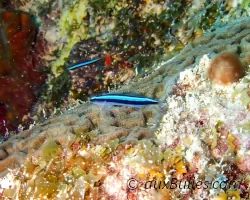
The neon gobyDiscover the neon goby (Elacatinus oceanops), a small western Atlantic reef fish known for its brilliant blue stripe and its role as a cleaner fish that removes parasites from other fish.Read more

The poison gobyDiscover the poison goby (Gobiodon citrinus), a tiny reef fish with a bright yellow body and distinctive blue markings. It lives among branching Acropora corals in the tropical waters of the Indo-Pacific.Read more
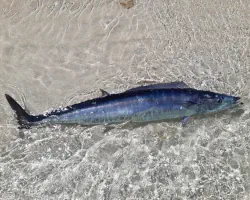
The wahooDiscover the wahoo (Acanthocybium solandri), a powerful pelagic predator found in tropical and subtropical oceans. Recognizable by its streamlined body and distinctive blue vertical stripes, it is a fast swimmer that feeds mainly on fish and squid.Read more
Photo of the Day
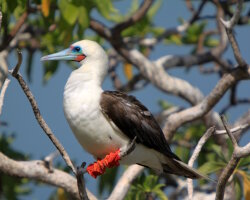
Fou à pieds rouges
(Sula sula)
(Sula sula)
 Copyright © 2007-2026 auxBulles.com - All rights reserved. Legal notices.
Photo credits - Our partners