Sealife guideThe bumphead parrotfishBolbometopon muricatum
Last updated on 08/06/2026 at 12:15 AM
The bumphead parrotfish is the largest member of the parrotfish family. This giant of tropical reefs plays an essential role in the functioning of coral reef ecosystems by contributing to coral erosion and the production of white coral sand. Its impressive size, characteristic forehead hump, and social behavior make it one of the most iconic fish of the Indo-Pacific reefs.
Taxonomy
English names
Bumphead parrotfishGreen humphead parrotfishDouble-headed parrotfish
French namesPoisson perroquet à bosse
Spanish namesLoro cototo verde
Scientific nameBolbometopon muricatum (Valenciennes, 1840)
Description
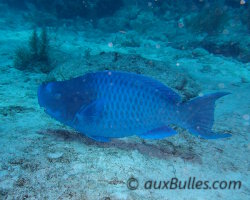
The bumphead parrotfish has a massive, laterally compressed body that is much more imposing than that of other parrotfish. As an adult, the bumphead parrotfish averages around 28 inches in length, although some individuals can reach up to 4.3 feet in length and weigh up to 101 pounds, making it the largest parrotfish species. The bumphead parrotfish is characterized by its large rounded hump that develops on its forehead with age and becomes particularly prominent in large adult individuals. This frontal projection gives it a unique silhouette that is easily recognizable underwater.
Like other parrotfish, the bumphead parrotfish has a powerful beak-like jaw formed by the fusion of its teeth, allowing it to scrape algae from rocky surfaces and coral colonies. Its coloration changes as it grows: juveniles generally display a more subdued pattern, with brownish to greenish tones that may be marked with lighter patches, while adults develop a more uniform coloration dominated by dark green to grayish-green hues. In large individuals, the front of the head, the area around the mouth, and the forehead may display pinkish to yellowish tones that contrast with the rest of the body.
Geographic range
The bumphead parrotfish inhabits tropical waters of the Indo-Pacific region, from the Red sea and the eastern coast of Africa to the central Pacific islands such as Samoa and the Line islands. It is also found northward to the Yaeyama islands and Wake island, and southward to
Australia's
Great Barrier Reef and New Caledonia.
Habitat
The bumphead parrotfish mainly inhabits tropical coral reefs, lagoons, and reef areas. Juveniles are more commonly found in shallow lagoons, while adults live on offshore reefs and reef slopes at depths of several dozen feet.
The bumphead parrotfish is often observed in small groups, slowly cruising along reefs in search of food. At night, it generally shelters in rocky crevices, caves, or sometimes shipwrecks, where it remains hidden until sunrise.
Diet
The bumphead parrotfish is primarily herbivorous. Thanks to its robust beak, it tears off pieces of dead or living coral to reach the algae covering reef surfaces. By grinding the calcareous material it ingests, it contributes to transforming coral skeletons into fine particles that help form the white sand found on tropical beaches.
The bumphead parrotfish actively contributes to maintaining the balance of coral reefs by limiting excessive algae growth and promoting the establishment of new coral colonies.
Reproduction
The bumphead parrotfish is
oviparous. During the breeding season, individuals form temporary pairs for spawning.
As with many reef fish, the eggs and larvae are planktonic and are dispersed by ocean currents before reaching coastal habitats. The bumphead parrotfish has a slow growth rate and a long lifespan, which limits its ability to quickly recover from population declines.
Did you know ?
The bumphead parrotfish is listed as many other marine species within The
IUCN Red List of threatened species. The bumphead parrotfish appears in the
IUCN Red List since 2012 within the category Vulnerable !
Within the same family
Discover also
The marine species in the Indo-Pacific