Sealife guideThe necklace sea starFromia monilis
Last updated on 08/11/2026 at 10:23 PM
Taxonomy
English names
Necklace sea starPearl sea starTiled starfish
French namesEtoile de mer à mailles rouges
Scientific nameFromia monilis (Perrier, 1869)
Description
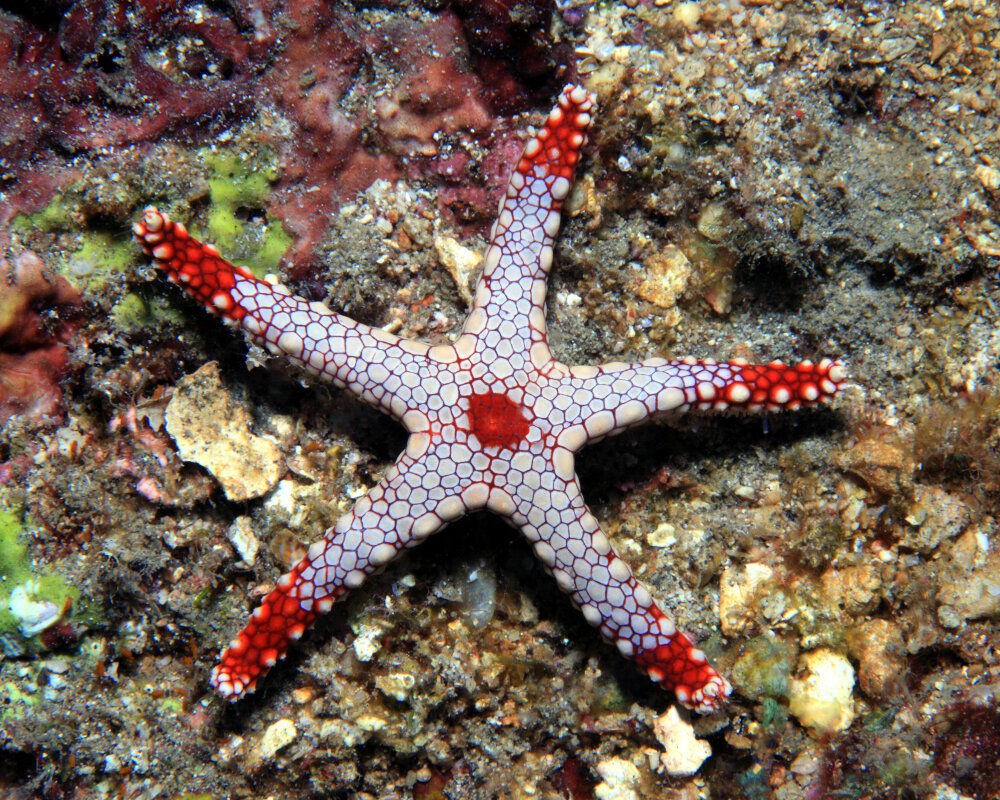
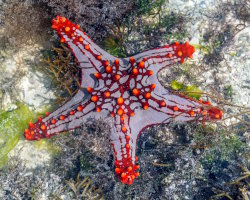
The necklace sea star is a small tropical sea star with a flattened body and generally five arms. As an adult, it typically reaches a span of around 4 inches.
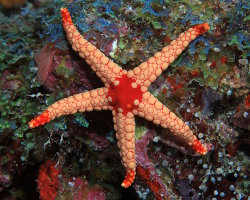
Its central disc is red, while its arms display a distinctive pattern formed by regularly arranged light beige skeletal plates contrasting with red borders. This combination of red and beige gives it a mesh- or necklace-like appearance, which inspired its common name.
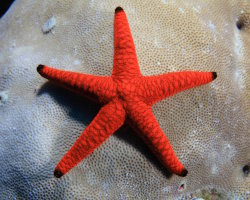
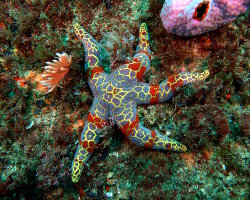
Some individuals may nevertheless show significant variations in the distribution of colors and skeletal plates, which can make identification challenging.
Geographic range
The necklace sea star is found in tropical waters throughout the Indo-Pacific, particularly from the Andaman Islands and the eastern Indian Ocean to Southeast Asia, the Philippines, southern Japan and
Australia.
It has also been recorded in Papua New Guinea, New Caledonia and several islands of the western Pacific.
Habitat
The necklace sea star mainly inhabits shallow reef environments. It is particularly associated with reef drop-offs, where it moves across rocky bottoms and other hard substrates.
The necklace sea star is generally found from a few feet to several dozen feet in depth.
Diet
The necklace sea star feeds on organic debris found on the seafloor, encrusting
sponges covering rocks and small invertebrates.
Reproduction
The necklace sea star primarily reproduces sexually, with separate male and female individuals. As in other
sea stars,
gametes are released into the seawater, where fertilization produces an embryo that subsequently develops into a planktonic larva. The larva drifts in the water column before transforming and settling on the seafloor to become a young five-armed sea star.
Within the same genus
Within the same family
Discover also
The marine species in the Indo-Pacific