

Sealife guideThe bluegirdled angelfishPomacanthus navarchus
Last updated on 09/24/2026 at 12:11 AM

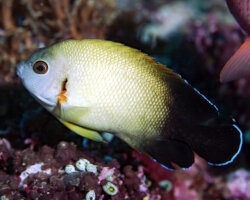
The bluegirdled angelfish (Pomacanthus navarchus) © Tatus | Dreamstime.com
The bluegirdled angelfish (Pomacanthus navarchus) is a reef fish easily recognized by its bright yellow and blue coloration. It lives in tropical waters of the Indo-Pacific, mainly around coral reefs in the western Pacific.
Often solitary, it stays close to corals and can also be observed in pairs. Juveniles and adults have very different coloration, making this species particularly striking as it grows.
Taxonomy
English names
Bluegirdled angelfish
French namesPoisson ange amiral
Spanish namesPez ángel de faja azul
Scientific namePomacanthus navarchus (Cuvier, 1831)
FamilyPomacanthidae
OrderAcanthuriformes
ClassActinopterygii
Description
The bluegirdled angelfish has a flattened, relatively deep body adapted to moving between coral formations. Adults have yellow to orange-yellow and dark blue coloration, marked with bright blue bands and patterns. A broad blue band crosses the front of the body and the operculum, while the scales on the yellow areas have blue markings that give the body a reticulated appearance. The fins are also edged in bright blue.
Juveniles look very different from adults. Their body is black with thin, slightly curved light blue lines. The color change is particularly striking as they grow, with few intermediate forms visible. The largest individuals can reach about 11 inches in length.
Geographic range
The bluegirdled angelfish inhabits tropical waters of the Indo-Pacific, mainly in the western Pacific, from Indonesia and the Philippines east to Papua New Guinea, and south to the Rowley Shoals and the southern part of the Great Barrier Reef. It is also found in Micronesia, including Palau and Yap.
Habitat
The bluegirdled angelfish inhabits clear, coral-rich lagoons, channels, and sheltered outer reef slopes. It generally stays near coral formations, where it can move among the reef structures and find food. It is found from a few meters down to depths of about 131 ft.
The bluegirdled angelfish generally lives alone, but some individuals can be observed in pairs. It can be aggressive toward other members of its species and defend an area of the reef without being considered strictly territorial. Juveniles also inhabit reef areas that provide shelter.
Diet
The bluegirdled angelfish mainly feeds on sponges and tunicates, which it picks directly from the reef. It also eats algae and other small attached organisms found on rocky and coral surfaces.
It explores the many cavities in the reef while picking at organisms attached to corals and rocks.
Reproduction
The bluegirdled angelfish is an oviparous fish that reproduces in open water. During reproduction, the male and female rise above the reef and release their gametes into the water, where fertilization takes place. The eggs and larvae then drift in the plankton before the young fish gradually settle onto the reef.
Like other angelfish, the bluegirdled angelfish is a protogynous hermaphrodite: individuals begin their adult lives as females, and some can later become males. This change is linked to the size of the individuals and their social organization.
Did you know ?
The bluegirdled angelfish changes dramatically in appearance as it grows. The juvenile is black with thin light blue lines, while the adult has yellow and blue coloration. This color change is so striking that intermediate stages are rarely observed.
The bluegirdled angelfish is listed as many other marine species within The IUCN Red List of threatened species. The bluegirdled angelfish appears in the IUCN Red List since 2010 within the category Least Concern !
Within the same genus
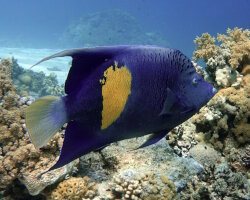
Arabian angelfishPomacanthus asfur

Blueface angelfishPomacanthus xanthometopon

Bluering angelfishPomacanthus annularis
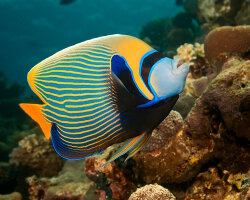
Emperor angelfishPomacanthus imperator
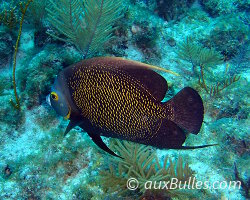
French angelfishPomacanthus paru
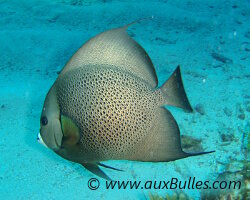
Gray angelfishPomacanthus arcuatus
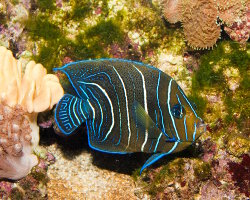
Semicircle angelfishPomacanthus semicirculatus
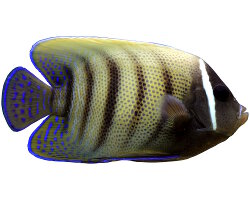
Sixbar angelfishPomacanthus sexstriatus
Within the same family
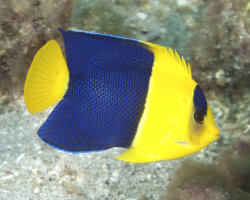
Bicolor angelfishCentropyge bicolor

Blackstriped angelfishGenicanthus lamarck

Blacktail angelfishCentropyge eibli
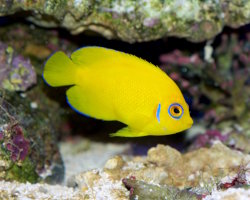
Lemonpeel angelfishCentropyge flavissima

Rock beautyHolacanthus tricolor
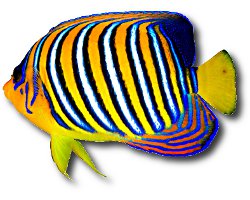
Royal angelfishPygoplites diacanthus

Rusty angelfishCentropyge ferrugata
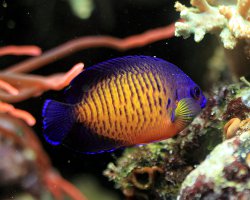
Two spined angelfishCentropyge bispinosa
Discover also
Batu corisCoris batuensis
Blackbar soldierfishMyripristis jacobus

Blackspotted pufferArothron nigropunctatus

Elegant sculpinBero elegans
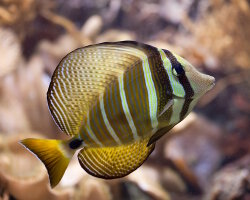
Sailfin tangZebrasoma velifer

Threadfin anthiasPseudanthias huchtii
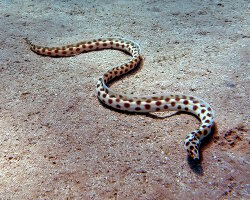
Tiger snake eelMyrichthys maculosus

Weedy scorpionfishRhinopias frondosa
The marine species in the Indo-Pacific


Our latestUpdates

Major movesThe 2026 Route du Rhum enters a decisive phase as Tom Laperche extends his lead in the Ultim class, Armel Le Cléac'h capsizes, and Class40 skippers prepare to face a powerful weather front.Read more

A tough startThe 2026 Route du Rhum gets off to an intense start, with major technical failures, Francis Joyon's capsize, impressive speeds and strategic route choices near the Azores. A look back at the first 48 hours of racing.Read more

A smooth start, an uncertain AtlanticDiscover the 2026 Route du Rhum start off Saint-Malo, where favorable initial conditions contrast with an uncertain Atlantic crossing shaped by changing winds and weather.Read more
Photo of the Day

Méduse pélagique
(Pelagia noctiluca)
(Pelagia noctiluca)
 Copyright © 2007-2026 auxBulles.com - All rights reserved. Legal notices.
Photo credits - Our partners