Sealife guideThe ocellated eagle rayAetobatus ocellatus
Last updated on 08/14/2026 at 10:56 PM
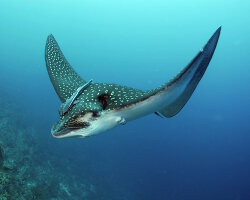
The ocellated eagle ray (Aetobatus ocellatus) is a large tropical ray recognizable by its wing-shaped body and the numerous light-colored spots covering its back. Despite its spectacular appearance, it spends much of its time close to the seafloor, where it searches for the animals it feeds on. It is found mainly in the coastal waters of the Indo-Pacific.
Taxonomy
English names
Ocellated eagle ray
French namesRaie aigle léopard
Spanish namesRaya aguila ocelada
Scientific nameAetobatus ocellatus (Kuhl, 1823)
Description
The ocellated eagle ray has a strongly flattened body, with large pectoral fins that give it a diamond-shaped silhouette when it swims. Its back is generally grayish-green to dark in color, covered with numerous white spots, sometimes surrounded by a ring forming ocelli, and sometimes arranged in more or less regular patterns.
Its head is relatively distinct from the rest of the body, and its long snout gives it a characteristic profile. Its tail is particularly long and bears several venomous spines that serve as a means of defense.
The largest specimens can reach a wingspan of 10 feet and weigh up to 440 pounds.
Geographic range
The ocellated eagle ray is found in tropical waters of the Indo-Pacific, from the coasts of East Africa and the Red Sea through the Indian Ocean, Southeast Asia, and the Pacific, including
Hawaii and French Polynesia.
Habitat
The ocellated eagle ray mainly inhabits tropical coastal waters, but it can also occasionally enter estuaries. It generally stays close to the seafloor, where it can easily search for food.
Diet
The ocellated eagle ray mainly searches for food on the seafloor. It feeds on
mollusks such as oysters, clams, and sea snails, as well as
crustaceans such as hermit crabs. It can also eat
marine worms, octopuses, and, more occasionally, small fish.
Its mouth and teeth are perfectly adapted to its diet, allowing it to crush the shells and hard coverings of its prey. It can therefore feed on animals protected by a hard shell or exoskeleton, such as
mollusks and certain
crustaceans.
Reproduction
The ocellated eagle ray is
ovoviviparous: after fertilization, the embryos develop inside the female's body. Initially nourished by the nutrients stored in their eggs, they also receive nutrients produced by the mother. The young therefore remain protected inside the female until they are born fully developed.
Females generally give birth to four pups or fewer, while the largest litters can contain up to about ten young.
Did you know ?
The ocellated eagle ray is listed as many other marine species within The
IUCN Red List of threatened species. The ocellated eagle ray appears in the
IUCN Red List since 2016 within the category Vulnerable !
Tips for observing
Beware of similar species
The ocellated eagle ray can be difficult to distinguish from other spotted eagle rays. Do not rely solely on its overall appearance: the region where you observe it can help you determine the species.
Observe, but don't touch
The ocellated eagle ray has several long venomous spines on its tail. They are primarily used for defense and are not used to hunt prey. As with other eagle rays, it is therefore best to observe it from a distance and never attempt to touch it.
Within the same genus
Discover also
The marine species in the Indo-Pacific