

Islands destinationThe Lau islands: discover Fiji's eastern archipelagoFiji islands | Pacific ocean
Last updated on 08/21/2026 at 01:25 AM
Located at the eastern edge of Fiji, the Lau islands form a vast archipelago of more than 60 islands and islets divided into two main groups, the Northern Lau islands and the Southern Lau islands. Far from the country's main tourist destinations, they offer remarkably pristine landscapes, with secluded beaches, crystal-clear lagoons, coral reefs and terrain ranging from volcanic islands and limestone formations to atolls.
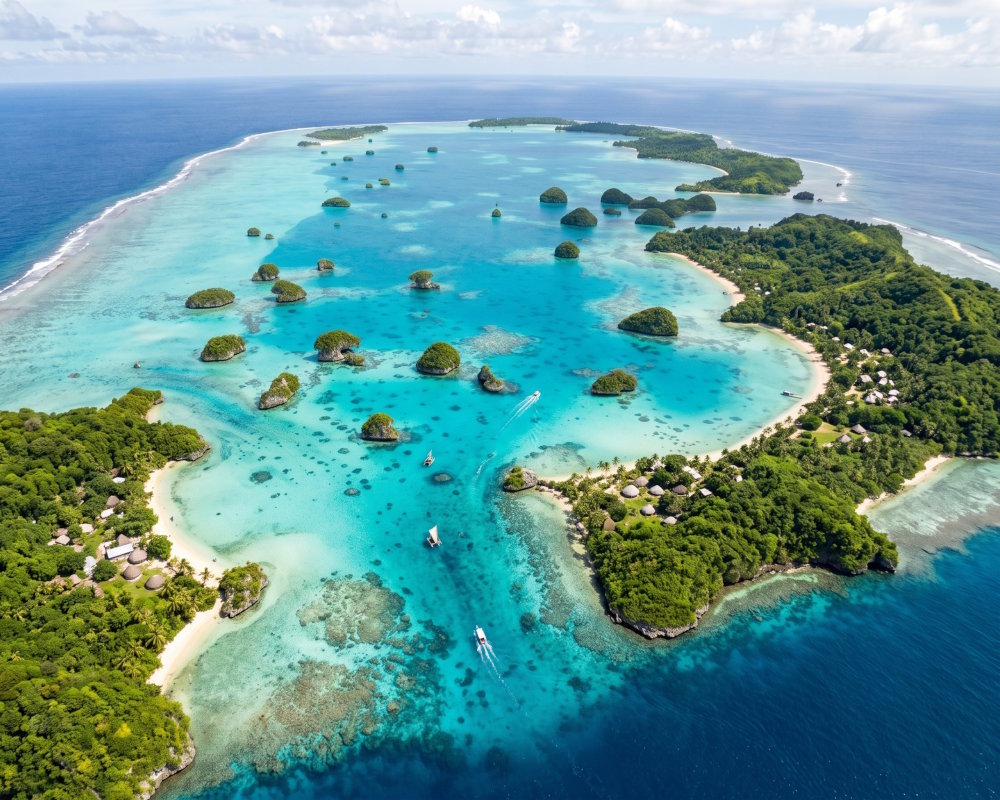
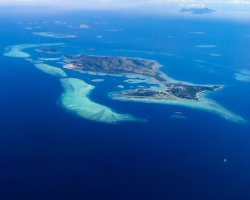
Aerial view of the idyllic landscape of Fiji's Lau islands, revealing rocky islets covered in lush vegetation, surrounded by turquoise waters and coral reefs
Still little visited by travelers, the Lau islands offer a chance to discover another side of Fiji, characterized by isolation, traditional village life and largely untouched nature. The archipelago particularly attracts sailors and travelers looking for off-the-beaten-path destinations, with remarkable sites such as the Fulaga Lagoon and the Bay of Islands on Vanua Balavu island.
An isolated archipelago in eastern Fiji
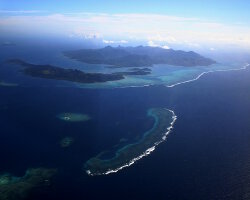
The Lau islands form the easternmost island group of Fiji. The archipelago stretches across a vast area of the Pacific Ocean and includes more than 60 islands with highly varied landscapes. Some are volcanic in origin, while others are made of limestone or take the form of small atolls surrounded by reefs.
This geographical dispersion largely explains the region's isolated character. Tourist infrastructure is far less developed than on Viti Levu, the Mamanuca islands or the Yasawa islands, and transportation options remain limited.
For travelers willing to venture beyond the usual itineraries, this isolation is precisely one of Lau's greatest attractions. You can discover little-visited coastal landscapes and an island atmosphere that contrasts sharply with Fiji's most popular tourist areas.
Landscapes of lagoons, reefs and limestone islands
The geological diversity of the Lau islands is reflected in their landscapes. Some islands feature volcanic terrain, while others are made of limestone and bordered by cliffs, small bays and shallow lagoons. The clear waters surrounding the archipelago further enhance the contrast between rocks, beaches and coral reefs.
The Fulaga Lagoon, in southern Lau, is particularly renowned for its turquoise waters, limestone formations and numerous small islets. It is considered one of the region's most spectacular anchorages and is a favorite destination for sailors exploring the Lau islands by boat.
In northern Lau, Vanua Balavu island is home to the spectacular Bay of Islands, also known as Qilaqila. Located at the northwestern tip of the island, this sheltered bay is dotted with numerous islets and limestone formations rising from its turquoise waters.
These environments are ideal for sailing, snorkeling, scuba diving and kayaking.
Pristine marine environments
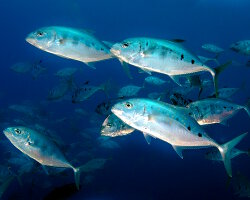
The waters surrounding the Lau islands are home to particularly rich marine life. Coral reefs, lagoons and coastal waters provide habitats for numerous tropical fish and other marine animals. The archipelago's remote location helps preserve large areas of ocean that remain relatively little visited.
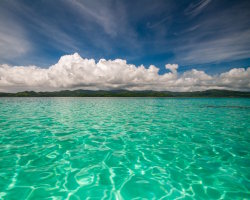
You can explore these underwater environments while snorkeling from beaches or during boat excursions. The clear waters of some lagoons offer excellent visibility, allowing you to observe reefs without necessarily going scuba diving.
Scuba diving, fishing and snorkeling are among the activities that attract travelers and sailors to this remote region. As elsewhere in Fiji, protecting the reefs means avoiding contact with corals and respecting marine life.
Fulaga and its spectacular lagoon
The Fulaga Lagoon is one of the most iconic sites in the southern Lau islands. Its vast lagoon is dotted with small, rounded limestone islands separated by channels of turquoise water. The resulting landscape has an almost otherworldly appearance.
The lagoon is primarily explored from the water. Sailors can find several anchorages, while local excursions provide opportunities to explore the small islands, beaches and shallow waters. Kayaking is also an excellent way to venture into some of the lagoon's sheltered areas.
Fulaga's isolation is an integral part of its appeal. You will not find the extensive tourist infrastructure of Fiji's more frequently visited islands here, but rather spectacular natural surroundings and a limited human presence.
Vanua Balavu and the Bay of Islands
In the northern Lau islands, Vanua Balavu island is home to the Bay of Islands, also known as Qilaqila, at its northwestern tip. This iconic landscape is famous for its limestone islets and pinnacles sculpted by erosion into mushroom-like shapes, rising from a lagoon of translucent turquoise water. Its turquoise waters and numerous natural shelters make it one of the most popular areas for sailors exploring the archipelago.
The bay is primarily explored from the water, by sailing between the islands and limestone cliffs. Several anchorages allow sailboats and catamarans to shelter in relatively protected waters, particularly around Nabavatu.
The landscapes of Vanua Balavu also offer many opportunities to observe reefs and marine life. For travelers who reach this part of Lau, sailing through the Bay of Islands is one of the archipelago's most remarkable experiences.
Villages where traditions remain strong
One of the great attractions of the Lau islands is the opportunity to experience village life that remains closely connected to Fijian traditions. During a village visit, you can discover how the community is organized and observe local customs such as the sevusevu ceremony, which plays an important role in welcoming visitors.
When arriving in a village, it is important to respect local customs. A visit accompanied by a guide or arranged with the community makes it easier to understand local traditions and avoid behavior that could be considered disrespectful.
A paradise for sailors
Because of its remote location and numerous natural anchorages, the Lau islands are particularly popular with sailors and experienced navigators.
Fulaga and Vanua Balavu are among the best-known areas for sailing. Sailors can also find anchorages around other Lau islands, but navigation conditions and the presence of reefs require careful preparation and detailed knowledge of nautical charts.
For travelers who do not sail themselves, access to the Lau islands is much more limited. This difficulty nevertheless helps preserve the archipelago's wild character and explains why exploring the region by private boat or on a suitable cruise is one of the best ways to experience it.
Things not to miss
The Fulaga Lagoon is one of the top destinations in the southern Lau islands, thanks to its limestone islets, turquoise waters and spectacular scenery. In the north, the Bay of Islands on Vanua Balavu island offers an equally remarkable setting, with its numerous islands, limestone cliffs and sheltered bay.
You can also explore the reefs while snorkeling or scuba diving, kayak through the lagoons and discover the archipelago's secluded beaches. The underwater landscapes are one of the main attractions of this still little-visited region.
Finally, take time to discover the local villages and traditions. In the Lau islands, meeting local communities is an integral part of the journey and offers a better understanding of an island culture that remains strong despite the region's distance from Fiji's major tourist centers.
How to get there ?
The Lau islands are much more difficult to reach than Fiji's main tourist island groups. Regular connections are limited, and transportation options depend heavily on which island you wish to visit.
For sailors, Savusavu and Levuka serve as ports of call and gateways to the Lau islands. From there, they can continue to different parts of the archipelago depending on weather and sailing conditions.
For air travel, it is essential to check the available connections to your chosen island before departure. The remoteness of the Lau islands requires more time and careful planning for transfers, but this very difficulty in reaching them is what allows the archipelago to retain its wild and pristine character.
The marine species



Fiji islands
Fiji islands
Kadavu island
Lomaiviti islands
Mamanuca islands
Taveuni island
Vanua Levu island
Viti Levu island
Yasawa islands
The islands from pacific ocean
Bora Bora island
Clipperton island
Cook islands

Galapagos islands
Kei islands
Komodo island
Motuarohia island
Rurutu island
Explore new islands

Our latestUpdates
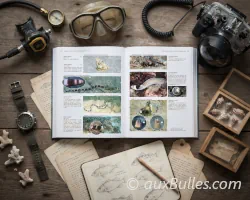
The Guide des poissons de Nouvelle-CalédonieDiscover Guide to the Fishes of New Caledonia by Pierre Laboute and René Grandperrin, an illustrated reference featuring nearly 1,200 species, from rivers and coral reefs to the depths of the ocean.Read more
The neon gobyDiscover the neon goby (Elacatinus oceanops), a small western Atlantic reef fish known for its brilliant blue stripe and its role as a cleaner fish that removes parasites from other fish.Read more

The poison gobyDiscover the poison goby (Gobiodon citrinus), a tiny reef fish with a bright yellow body and distinctive blue markings. It lives among branching Acropora corals in the tropical waters of the Indo-Pacific.Read more
Photo of the Day
Ver plat rose
(Prostheceraeus roseus)
(Prostheceraeus roseus)
 Copyright © 2007-2026 auxBulles.com - All rights reserved. Legal notices.
Photo credits - Our partners